
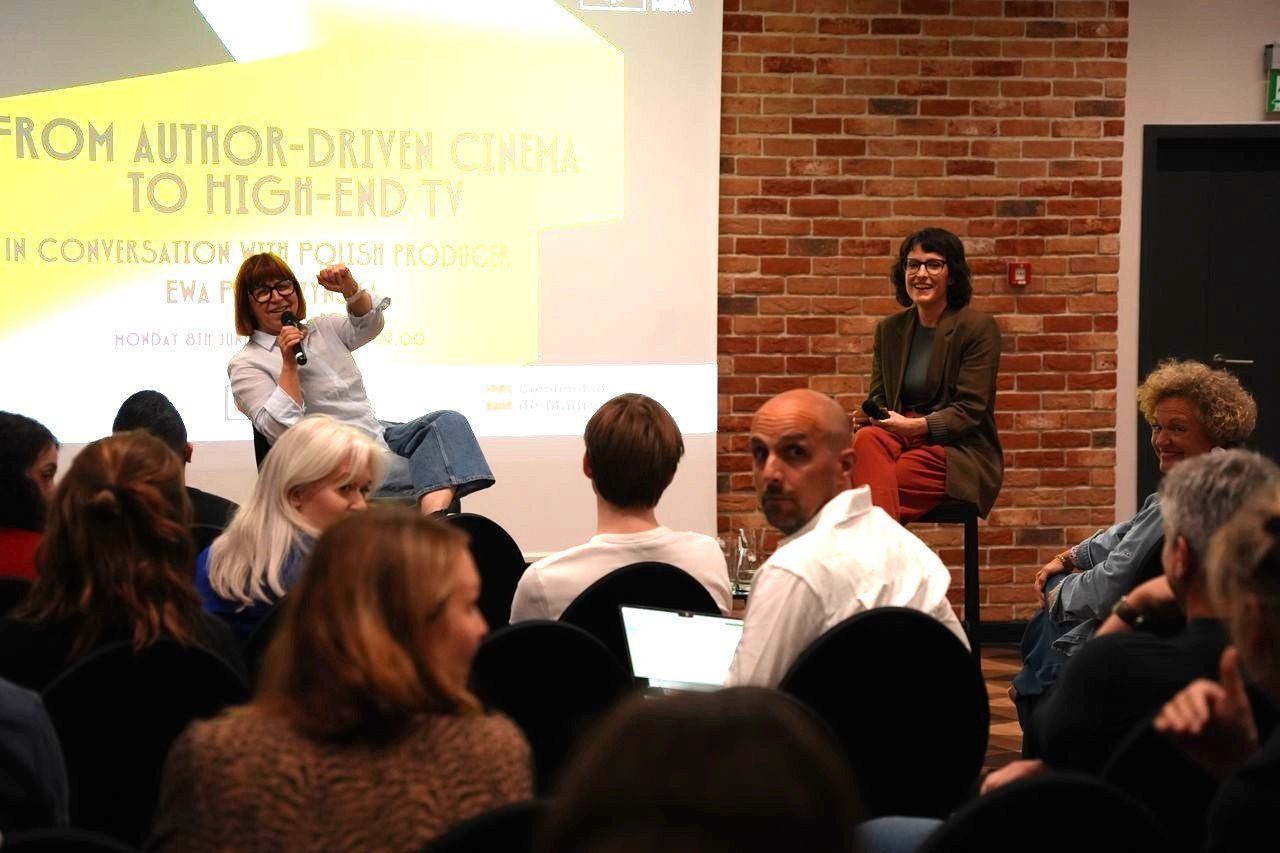
– The producer of Fatherland, The Zone of Interest and Ida discussed her extensive career during the event held in Kraków
Ewa Puszczyńska (left) and Eszter Angyalosy during the event (© Damian Gradek)
This year’s edition of the SeriesLab training programme, held alongside the ComedyLab, took place in Kraków, Poland, and marks the first collaboration between TorinoFilmLab (TFL) and the Polish Film Institute (PFI). The Open Session on 8 June included a master class with Polish producer Ewa Puszczyńska, and a lecture by French screenwriter and story editor Cyril Tysz. The events were open to members of the local film industry following pre-registration through the PFI.
“We became involved in this initiative because I believe that international collaboration is one of the most important drivers of growth in the audiovisual industry today,” Marta Krzeptowska, head of the International Cooperation Department at the PFI, told Cineuropa. “TFL is a well-established European platform supporting filmmakers and producers, and hosting one of its events in Kraków gives Polish professionals access to expertise, networking opportunities and inspiration.”
In conversation with Eszter Angyalosy, head of studies at SeriesLab, Puszczyńska discussed her career in film and television production, which began by chance. She first translated subtitles for VHS releases before working as an interpreter on film sets, eventually joining Opus Film. She focused primarily on her collaboration with auteur Paweł Pawlikowski on his three most recent films – Ida, Cold War and Fatherland – which picked up an Oscar and two Best Director Awards at Cannes, respectively. She also compared the production processes behind arthouse films and premium television series, citing her 2026 HBO miniseries Women’s Hell as an example.
Meanwhile, in his lecture, titled “Playing Frankenstein: Engineering Characters and Conflict”, Tysz explored the creation of complex characters and story arcs. He described television series as the equivalent of a “stretched-out second act” in terms of dramaturgy and narrative structure, and discussed the differences between stories centred on a single protagonist and ensemble narratives.
Organised for the tenth year, TFL’s SeriesLab development programme welcomed nine projects, 24 participants and three story-editor trainees working closely with the selected teams. This year, TFL received 96 project submissions from 50 countries, as well as 43 applications from story editors representing 21 countries.
Angyalosy observed two notable trends in this year’s submissions: the influence of successful series such as The Bear and a growing interest in stories centred on older characters. The latter “feels like a growing trend, perhaps reflecting social changes. As our understanding of ageing evolves and traditional ideas about what different stages of life should look like are being challenged, there seems to be a desire to redefine old age,” she told Cineuropa.
She added: “At the same time, broader industry trends also affect the kinds of stories being told. In recent years, limited series have been especially popular. Broadcasters and commissioners have been more willing to invest in projects with fewer episodes because they involve less financial risk.”
Asked whether similarities to existing stories could put applicants at a disadvantage, Angyalosy explained that the selection process also takes into account a project’s production potential. If buyers feel they have already encountered a similar concept, selling it becomes more difficult. She noted that many acclaimed series are created by established showrunners whose creative freedom is unavailable to newcomers, making them difficult models to follow for debut projects. However, she stressed that projects inspired by existing works remain welcome, provided that they bring an original voice or perspective. The goal, she emphasised, is inspiration, rather than imitation.
Having now operated for 18 years, TFL has supported 930 projects, including 250 completed film and series productions. These include Landmarks by Lucrecia Martel, Vermiglio by Maura Delpero and last year’s Cannes Un Certain Regard winner, The Mysterious Gaze of the Flamingo by Diego Céspedes.
