
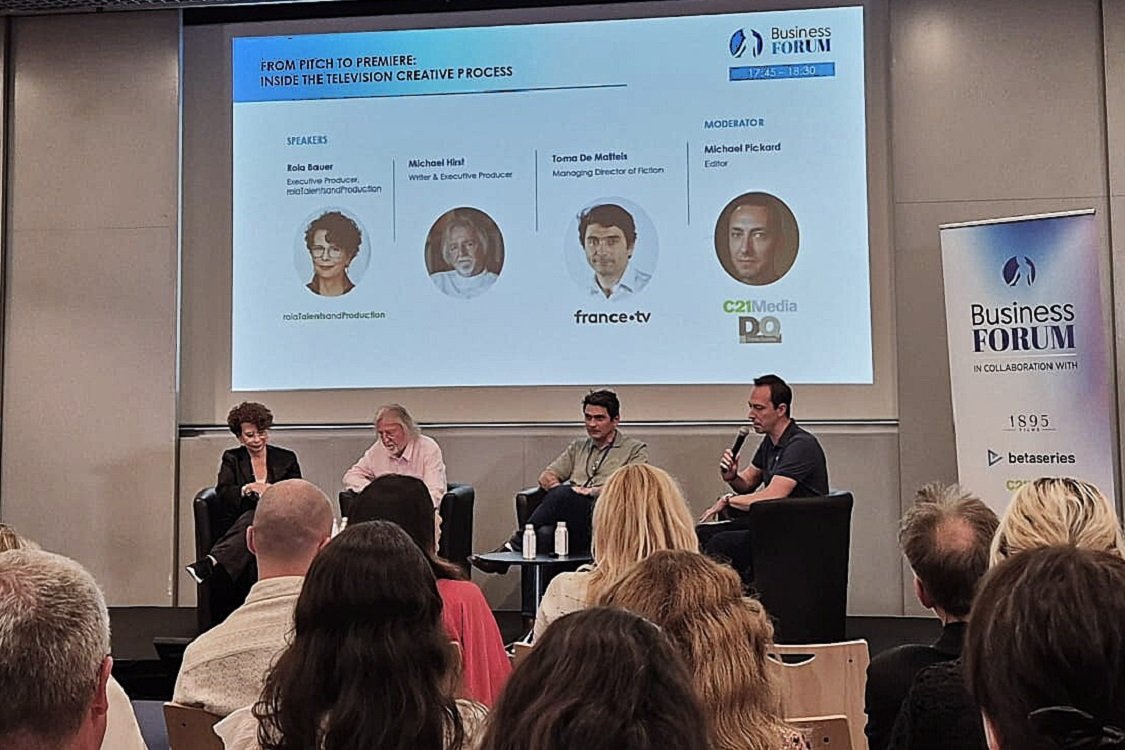
– Across two panels, industry heavyweights such as Lesley Manville, Michael Hirst, Judy Lung and Rola Bauer explored who really shapes screen stories today
Rola Bauer, Michael Hirst, Toma De Matteis and Michael Pickard during the panel
At the Monte-Carlo Television Festival‘s Business Forum (14-16 June), two industry conversations held at the Grimaldi Forum turned into a broader reflection on creative power: who holds it, how it is earned, and how it can be shared without diluting the work itself. Across “From Pitch to Premiere: Inside the Television Creative Process” and “Leading Ladies Changing the Channels,” the recurring idea was that film and television are built not through domination, but through stewardship — of characters, worlds, audiences and collaborators.
Moderated by journalist Michael Pickard, the first talk brought together writer and executive producer Michael Hirst (The Tudors, Vikings, Billy the Kid); France TV managing director of fiction Toma De Matteis and Canadian executive producer Rola Bauer. The panel explored how an idea becomes a series and how writers and producers negotiate the long road from pitch to screen.
For Hirst, the starting point is never simply a premise. Discussing what allows a series to sustain itself over multiple episodes, he said there must be “meat on the bone”. An idea alone is not enough: “Anyone can have an idea. It has to be a world.” That world, he argued, must be rich enough to feed the imagination, while historical material must forge a meaningful connection between past and present.
That principle has guided much of Hirst’s career. Speaking about Vikings, he recalled how his research led him to Ragnar Lothbrok, a figure who emerged from myth into recorded history, and then to Ragnar’s wife, a shieldmaiden who, in his telling, kept a bear at home. Such details were not merely decorative; they demonstrated a dramatic universe with enough depth and contradiction to sustain long-form storytelling.
De Matteis approached the same issue from the perspective of daily drama, including Un si grand soleil, which has passed the 2,000-episode mark. In that format, he explained, the challenge is to build a universe that can constantly evolve. Characters must be recognisable but also surprising, and the writers must keep finding believable reasons for them to love, hate, change and collide. Daily drama, he suggested, is not about mechanically pushing buttons, but about keeping a living world in motion.
Bauer, who has worked across production, studio and platform roles, stressed that producers should not look for a formula. Whether working from a buyer’s demographic needs or a producer’s instinct, she said the basis must remain the same: “Start with the story. Start with the characters.” Passion, in her view, is not an optional extra but the minimum condition for entering the long and demanding production process.
She also argued that a producer’s work does not become passive once the writer begins. Producers should be thinking several steps ahead: about directors, talent, financing, buyers and the practical path to getting the project made. The producer’s responsibility is not to wait for the script, but to safeguard the project’s future while the writing takes shape.
That question of protection — and where it turns into control — was one of the strongest links between the two panels. Hirst was sharply critical of showrunners who impose their vision by telling directors how to shoot and actors how to perform, arguing that such behaviour suppresses talent. De Matteis made a similar point from within the tightly structured world of daily drama: even there, directors and collaborators must be allowed to bring something of their own.
The theme continued in the second panel, moderated by Bauer and featuring Lesley Manville, president of the Fiction Jury, actress and occasional executive producer; Sue Latimer, managing director of ARG Talent Agency; Judy Lung, VP strategy, communications and stakeholder relations at TIFF; and Florida Film producer Maren Knieling.
Manville was clear that she does not choose work according to anticipated fan reaction. “I am not doing the job because of what fans think of it,” she said, adding that writers must write what they want to write, and that audience embrace, if it comes, should follow the work rather than lead it. Her own career, she explained, was shaped by collaboration, from theatre to her long association with Mike Leigh and her work with Paul Thomas Anderson on Phantom Thread.
Her comments on executive producing added a further layer to the discussion. Manville said actors should not claim that role lightly, and that she had only done so when she felt she had the experience and responsibility to contribute meaningfully. On Mrs Harris Goes to Paris, she became involved at that level because she was fronting the film and wanted to ensure the right people worked on the project. Influence, she suggested, has to be earned.
Latimer, speaking from an agent’s perspective, described her role as that of a gatekeeper but not a final decision-maker. She may have views about whether a project is right for a client, but the relationship must remain collaborative. Later, she added that she would like to see more women in positions of power actively helping other women, noting that much of her own career had been supported by men rather than by powerful women.
Lung widened the conversation by looking at how power has shifted beyond traditional industry structures. Festivals, audiences and fandoms now play a larger role in discovery and momentum. She cited the example of fans organising campaigns – even billboards in Times Square – to support endangered shows, arguing that “power is not just with a very small group of people” anymore.
The phrase “female-driven content” also came under scrutiny. Lung acknowledged that the label may have helped secure visibility, resources and funding, but warned that women’s stories cannot be treated as a single category. “Women and women’s stories are not a category,” she said. Manville was more openly impatient with the persistence of such framing, pointing out that women have long proved their cultural and commercial value, from Top Girls to Mamma Mia! and The Best Exotic Marigold Hotel.
Across both panels, the message was strikingly consistent. Whether discussing a Viking saga, a daily French drama, a streamer project, a festival audience or an actor’s move into producing, the speakers returned to the same principle: screen stories survive when their DNA is protected, but they flourish only when power is shared.
