
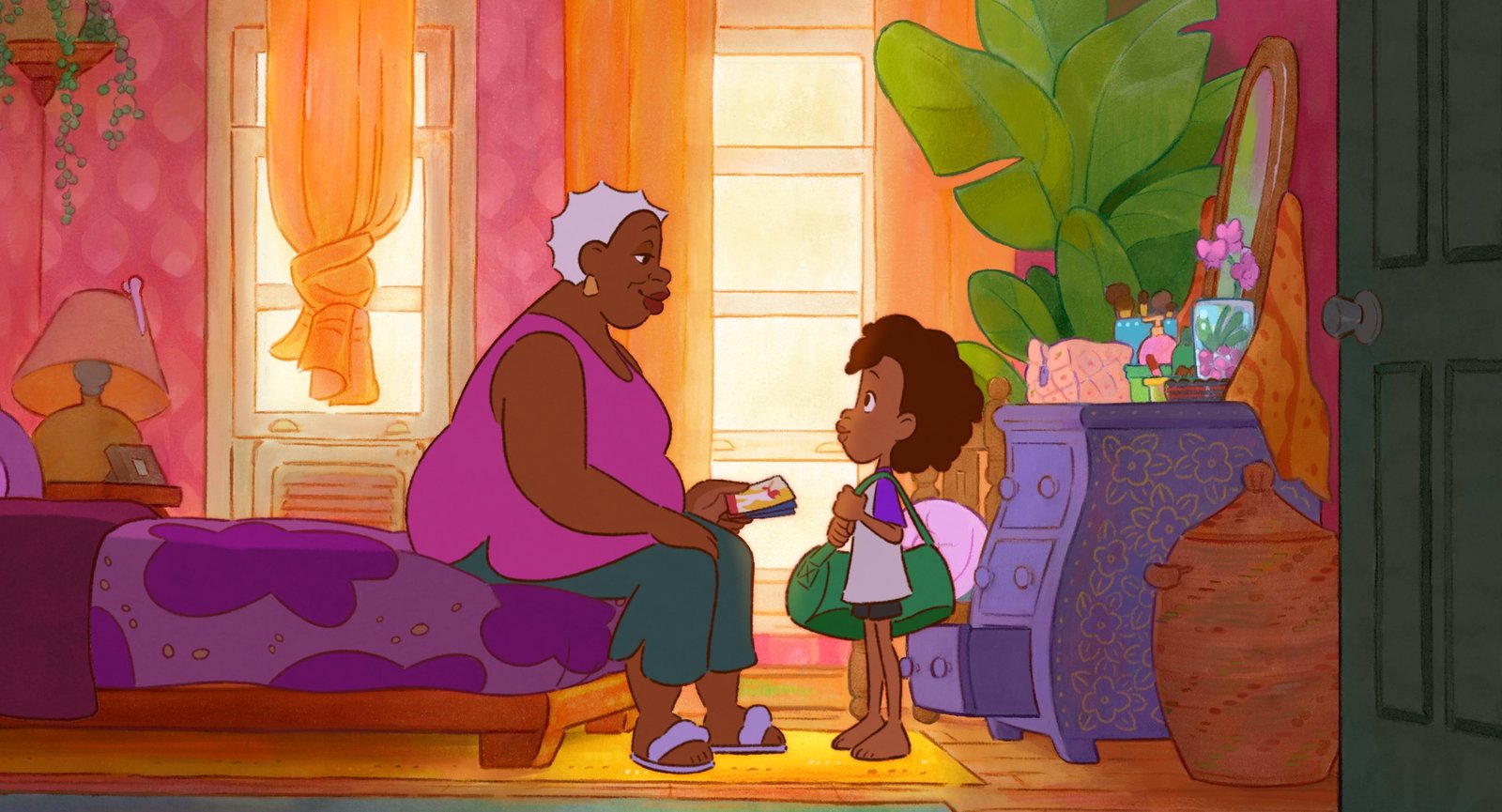
– Louise Bagnall’s animated feature is a colourful and joyful ode to accepting one’s roots and aspirations, as portrayed through the story of a courageous young boy
World-premiering at Annecy, Julián by Louise Bagnall is a triumphant ode to diversity, as seen through the eyes of a young boy, Julián (voiced by Knyght Darius Jack), who spends the summer in Brooklyn with his abuela (Milcania Diaz-Rojas) and discovers new sides to himself. Drawn to the sea, thanks to his Afro-Caribbean origins, he will decide to become a mermaid in spite of the disbelief of the people around him.
Based on a 36-page picture book, Julián Is a Mermaid by Jessica Love, the story is adapted for the screen by writer Juliany Taveras. The way in which Julián and his grandma talk to each other is extremely realistic and comes across in a way that does not feel “forced” to adhere to child-like language, but instead it sounds natural and flows with ease. The movie is filled with Spanish expressions exchanged by the duo, which ensures a strong sense of belonging and heritage. In fact, this is created not only by the language, but also by the soundtrack and the references to food (even conveyed through the details of recipes), or in the short stories that abuela tells her grandson. This is especially exemplified by the guiding figure of Yemayá, a goddess of the sea whom the young boy is hypnotised by; she is rooted in the beliefs of Santería, a syncretism of Yoruba deities and Catholicism.
From a technical standpoint, the visuals of Julián also contribute to this comforting, homey feeling. Thanks to a hand-crafted touch, every scene explodes with colours and light, providing a treat for the eyes that only animation can provide in such a way. The backgrounds are rendered on paper with colouring pencils and markers, and the characters are hand-drawn in 2D animation and emulate cel animation in their use of colour and shadow.
Julián is a film that stands out not necessarily because of its animation – which is excellent, though not groundbreaking – but because of its deeper message. Teaching children to accept themselves as unique individuals who should not be constrained by the opinions of others may seem like a lesson that should be taken for granted. In a world where these values are often undermined by adults, it is important to keep hope alive for the next generation of the world’s citizens. In this sense, Bagnall’s feature has multiple layers of interpretation: there’s the topic of immigration (as mentioned, the Dominican Republic-themed element remains strong throughout the film, as it is set against the multicultural backdrop of New York), and there’s also the emphasis on the ability to break boundaries, also between the feminine and the masculine.
Julián is not afraid to express himself as he really is, and he genuinely does not understand why that should be a problem for anyone. After all, what is so wrong with being a mermaid? His spontaneity, combined with his intelligence, shows that prejudice is learned and acquired, rather than inherent to human nature. The supportive role of his abuela is key in conveying this message: with the right support from one’s family, nothing can stand in the way of one’s true calling.
Julián is an Irish-Luxembourgish-Canadian-Danish co-production between Cartoon Saloon, Aircraft Pictures, Mélusine Productions, and Sun Creature. New Europe Film Sales sells the movie worldwide.
