

The commemoration of the 250th anniversary of the Declaration of Independence, which falls on Saturday, has filled U.S. bookshelves with essays about that period, but few contribute as much new information as Freedom Round the Globe.
In it, Sarah M. S. Pearsall offers a global history of the American Revolution that goes far beyond the 13 colonies that rose up against King George and set down the new nation’s ideals and the list of grievances against the tyrant in a document drafted by Thomas Jefferson that, a quarter of a millennium later, remains as inspiring as it is full of contradictions.
Pearsall was less interested in something much written about — the global impact of that “shot heard round the world,” in Emerson’s felicitous phrase referring to the 1775 Battle of Concord — than in the way the world influenced the American Revolution.
Thus, her history begins with the 1763 execution in what is now Detroit of an Indigenous woman accused of murder, whose death sparked Pontiac’s Rebellion, in which the Ojibwe, the Potawatomi and the Huron stood up to the brutal empire. And it extends beyond the 1781 Battle of Yorktown, whose victory brought the colonists an end to hostilities.
The result is an original book about those years, in which Jefferson is quoted only eight times and July 4, 1776, is handled with an ellipsis. Instead, it offers a journey guided by resistance to the British through India, China, Gibraltar, the Caribbean and the forests of what would become Germany—exotic stops for the average American, who is often reluctant to think of his country’s history as a story with ramifications beyond its borders.
The historian received EL PAÍS in an office at Johns Hopkins University with large windows and walls lined with books about the republic’s dawn, a couple of days after the mixed martial arts fight that Donald Trump hosted at the White House, which made her feel “deep shame.” Pearsall traced the genesis of her essay, well received by critics in the United States, to a course she began teaching in 2018 while at Cambridge. “I thought it would help me make a history I already knew a bit more interesting,” she said. But then she began to discover “astonishing connections and events,” and that new perspective was “too thrilling not to share with the world.”
Question. Have you written a refutation of American exceptionalism?
Answer. Certain aspects of my book do refute U.S. exceptionalism. Plenty of other people in the world resisted British imperialism. I was interested in looking further afield. In seeing how certain events that occurred around the world influenced the origins and development of the American Revolution. That helps to see more clearly what happened in the 13 colonies.
Q. In what state of health does the idea of the United States arrive at its 250th birthday?
A. The principles of the Declaration of Independence remain important ideals, more so than the current — or any — occupant of the White House. The United States has lived through very dark times, including the Civil War, and we managed to overcome them. Let’s hope we can overcome this one too, because otherwise, what else is there but despair? The foundation is an imperfect act: there was slavery, there was the extermination of Indigenous peoples. All of that is ingrained in the DNA of this country, but what is the alternative? Freedom can be used for many things, some of which are not good, like seizing Native American lands. It is, nevertheless, in many cases a valuable principle and one worth upholding.
Q. Trump has named the organization behind the anniversary commemoration, which has come to resemble a MAGA festival, Freedom 250. Has the American far right appropriated the idea of freedom?
A. At the end of Trump’s first presidency, he created the 1776 Commission (and its report). He did so as a reaction to the 1619 Project [a journalistic initiative by The New York Times that proposed framing the nation’s founding around the arrival of the first slave ships], which sought to put slavery front and center of U.S. history. It’s important that we reclaim the idea of 1776, because the MAGA version is far less complex than the historical truth. Our job as historians is to grapple with the complexities of someone like George Washington, who did heroic things but also terrible ones. It can’t all be about placing the founders on a pedestal or tearing them down and erasing them. Neither response is entirely helpful.
Q. Is there a sense among U.S. historians that it is no longer possible to reach common ground?
A. I think some people feel that way. When a colleague read a draft of the manuscript, he said: “Oh, but do you still believe?” Perhaps he thought it was a bit naïve. I refuse to give in to despair. Some think that academics have been too critical and cynical and that it’s our fault if people see us as radical extremists. But I don’t think that’s true. In class, what I have long seen is students discussing ideas and learning to think and to articulate their ideas for themselves. I think that’s what we’re good at — those of us who write books, teach courses, or work with students. And I think that’s important.
Q. How do your students approach the American Revolution?
A. There is some skepticism from some and a weary resignation about the history they were taught in elementary school. The global perspective I teach helps them move beyond the question of whether we should view the Founding Fathers as heroes or hypocrites. I don’t think either of those positions is correct.
Q. Did that attitude change after the murder of George Floyd?
A. That event prompted many students — and others — to see things in a new way. But other events had also shaken complacencies. Before that, the first election of Trump and, in the U.K., Brexit influenced many of my students and plunged them into despair.
Q. Did any of them still experience U.S. independence as a loss for their country?
A. Not exactly, but the English are very good at hating themselves.
Q. Spaniards too; perhaps it has to do with having lost an empire. Are Americans beginning to hate themselves?
A. I think they feel less optimistic, though they haven’t fully embraced self-loathing yet. Maybe we’ll get to that point some day!
Q. The trend of viewing history through global lenses has been around for years, but only now is the American Revolution beginning to be seen that way. Is that delay a symptom of this country’s inwardness?
A. Around the bicentennial there was [in 1976] a flourishing of revolutionary studies, and some of that academic research viewed the war as an event with significant international consequences. But social approaches also proliferated, recounting events beyond the elites, from the point of view of women, enslaved people, and the white lower classes. The myopia that portrays the revolution as an affair concerning only the 13 colonies was never fully abandoned. Afterwards, Atlantic and then global perspectives flourished, but for whatever reason that didn’t affect the revolution’s historiography. More than self-absorption, it’s nationalism, but I think that is changing.
Q. Were the colonists aware they were fighting a global war?
A. They were aware of what was happening elsewhere; for example, news of the Bengal famine and what the British East India Company was doing in South Asia appeared in colonial newspapers and influenced how the tea trade was understood, which led to the famous Boston Tea Party. The involvement of France and Spain was also very clear to the colonists at the time. The Caribbean was also very much on their minds; John Adams and others were angered that the British colonies in the West Indies were not more supportive. And in 1775, the Continental Congress was still writing to Jamaica to ask for support. And to Ireland.
Q. Many Americans who celebrate the 4th of July with hot dogs and fireworks tend to see it as a brilliant isolated act, when it was a chapter in a fundamentally civil war. In the book you also define it as “imperial, colonial and global.” Was it the first war to combine all those characteristics?
A. It’s hard to find an equivalent. Some aspects of those wars appear in earlier conflicts — for example, the 17th-century revolution in England, where several kingdoms in Scotland and Ireland fought — but it wasn’t a world war. Some of my fellow Americans may admit the American Revolution was a civil war, but very few are aware of its many global dimensions. What transformed a colonial rebellion, which had precedents, into something else entirely was the Declaration of Independence, in which Jefferson and others invoked universal principles to make it clear that it was not just about standing up to taxes or rebelling against the mother country, but about changing the world and getting the French and, to a lesser extent, the Spanish, involved.
Q. The European powers were less interested in ideals than in fighting England…
A. Yes. Why would the old regime of France support these small colonial rebels if not out of a mutual hatred of Great Britain?
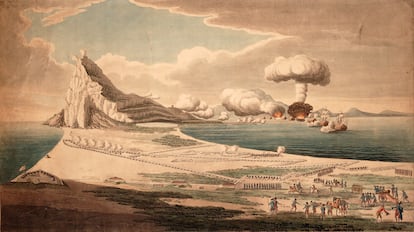
Q. In your book, one of the most surprising chapters is devoted to the Great Siege of Gibraltar (1779–1783)…
A. Even then [the Rock] was a thorn in Spain’s side. The Spanish had offered neutrality to the British in the early stage of the American Revolution in exchange for its return; they should have taken the offer. The obsession with recovering it fueled much of Spain’s actions during the war. The siege of Gibraltar is the longest battle of the American Revolutionary War. Who would have thought? The Franco-Spanish alliance invested heavily in that siege.
Q. In the book, you pair each historical chapter with words used in the Declaration and a concept. In Gibraltar, the word is “life”…
A. Much of the anxiety surrounding the battle centered on the number of troops the British had available to defend it, which led me to delve into demographic considerations at a time when the French far outnumbered the British and the American colonies were rapidly gaining population. It prompted me to think of life as a political matter and of the role of women in maintaining those population figures and consequently that military power. The reader may or may not agree with those connections, but they made sense to me.
Q. You argue that the Revolutionary War did not end in 1781 at Yorktown, so where and when did it finish?
A. There were still aftershocks, such as the 1782 Battle of Los Saints in the Caribbean. The crown’s priority was not the 13 colonies but Jamaica and the sugar-producing centers. Among the English there was a feeling they could let go of the continental possessions [in the United States] and that the British Empire would not be so badly damaged. The American Revolution did not destroy the empire, because it re-emerged stronger: it held on in the Caribbean and, of course, in India.
Q. In the concluding chapter you refuse to answer why the other 13 colonies did not rise up, so I can’t help but ask you.
A. That’s a topic for another book, which I don’t intend to write. There are historians, like Andrew O’Shaughnessy, who are convincingly addressing the Caribbean and why those colonies did not join the Americans. It has a lot to do, of course, with the intense slave system in those places, demographic conditions and the fact that they saw the British army as a protector rather than an enemy. Canada’s story is different. At first, an alliance seemed possible, but it eventually fell apart when the Americans wanted to turn that alliance into conquest. And then there’s Florida, which the British lost even though that territoryhadn’trebelled. They didn’t even make an effort to ally with the Native Americans. [Bernardo de] Gálvez, by contrast, was committed and it ends up being a success.
Q. Is the figure of Gálvez gaining ground in Revolutionary studies in the United States? There is much interest from the Spanish embassy and some lobbying pressure…
A. I would say so. But he is still not as well known as the Marquis de Lafayette. There are streets, squares and towns across the country bearing his name… What do we have from Gálvez? Galveston…
Q. Maybe the French sell themselves better?
A. The Spanish arrived as allies of the French. To be fair, they weresomewhat lessconvinced of the American cause, although yes, that oversight is rather disconcerting. His friend Francisco de Saavedra should also be better known. Gálvez was a great military strategist, but Saavedra was an organizational genius. He supported Gálvez in his desire to reconquer Pensacola [Florida] and persuaded Cuba’s old guard to back that ambition. He helped secure supplies and was responsible for raising funds in 1781 that aided the Virginia campaign, which led to the British surrender at Yorktown. Yet even most scholars of the Revolution do not know his name.
Q. Returning to the anniversary being celebrated these days: do you think it will be remembered and remembered for the right reasons?
A. I don’t think people will want to look back on 2026 fondly in the future. There’s less enthusiasm for celebrating because of who’s in the White House. Although with posterity, you never know: we look back on it now as something mythical, but 1776 was a pretty bad year. Except for the Declaration of Independence, it was one disaster after another. As it was ending, many hoped that there wouldn’t be another year like it. That’s the feeling I have about 2026. There are things, like the UFC fights near the White House, that make me feel ashamed, even though there are much more serious issues than that. I’ve just returned from Europe and saw a lot of concern about what is happening here. And a lot of solidarity, too. People saying: we’re with you, we know you’re not like your government. That gave me hope. Then, when I got to the airport, I saw the huge lines for visitors and how American citizens are being given priority. Once again, I felt ashamed of my country. I hope we can do better.
Sign up for our weekly newsletter to get more English-language news coverage from EL PAÍS USA Edition
