
This article is republished with permission from Laser Wars, a newsletter about military laser weapons and other futuristic defense technology.
The U.S. military is closing in on its high-energy laser weapon of choice for counter-drone missions. Now it needs the vehicles to support it.
With the demise of its Stryker-based Directed Energy-Maneuver Short-Range Air Defense program, the U.S. Army has focused its ground-based laser weapon efforts on light tactical vehicles. AV’s 20-kilowatt LOCUST Laser Weapon System has already been operationally tested aboard both the infantry squad vehicle (ISV) and the joint light tactical vehicle (JLTV) through the Army Multi-Purpose High Energy Laser effort, establishing that the military’s preferred mobile platforms can carry and employ directed energy weapons in the field.
The Army has reinforced this preference with its Enduring High Energy Laser push, which is explicitly targeting light tactical vehicles like the JLTV for what might become the U.S. military’s first directed energy program of record.
Both the ISV and JLTV are at the center of the military’s emerging approach to future distributed operations.
For the Army, the speedy and versatile ISV is seen as providing an essential maneuver capability for Mobile Brigade Combat Teams on a battlefield increasingly dominated by low-cost weaponized drones. And while the ultimate fate of the JLTV remains uncertain, the vehicle is currently the chosen platform for the Marine Corps air defense system that’s the backbone of the service’s new Marine Littoral Regiments.
But both platforms face the same big problem: power. And the two services’ potential solutions offer a look at what the military’s future fleet of laser trucks might actually look like.
As the modern battlefield is increasingly defined by unmanned systems and the electronics needed to counter them, consistent and reliable power at the tactical edge has become as important as ammunition. During the height of the Global War on Terrorism, a 30-soldier infantry platoon carried 400 pounds of batteries during a 72-hour mission to power their equipment, a load that Army researchers have sought to lighten in the intervening years.
The U.S. military’s new tactical vehicles don’t currently offer a robust solution: The JLTV can generate only up to 15 kilowatts of exportable power, while the ISV’s output beyond baseline vehicle operations is not public (and likely negligible).
The challenge for building a laser truck is bigger than just raw power. The core problem for directed energy weapons, as Chariot Defense founder and CEO Adam Warmoth told Laser Wars earlier this month, is that while they don’t consume enormous amounts of energy in absolute terms, each engagement demands a significant spike in power sustained for several seconds.
Conventional generators are optimized for steady output but not for these spikes, and running one at the ready around the clock is not just inefficient and expensive, but actively dangerous on a battlefield where heat signatures and engine noise turn are prime targets for drone-based reconnaissance and precision strikes.
“That targetable signature is always on because you have to be ready to provide power to that laser system at any moment,” Warmoth said. “So you have efficiency challenges, signature management challenges, and then mobility problems, where you have to bring the generator sized to your peak demand, which is three to five times larger than the equivalent battery system.”
The proposed solution to this problem is a hybrid architecture: a generator sized for average load paired with a high-voltage battery system capable of delivering instantaneous surges on demand. The battery handles the spike, the generator recharges the battery between shots, and the overall system is smaller, quieter, and more tactically versatile than alternatives.
A vehicle with the right hybrid architecture becomes more than just a maneuver capability, but a node in a distributed battlefield power grid capable of charging drone batteries, running C2 and sensor networks, and powering electronic warfare equipment—and, when the moment requires it, feeding a laser weapon the juice it needs to fry a target.
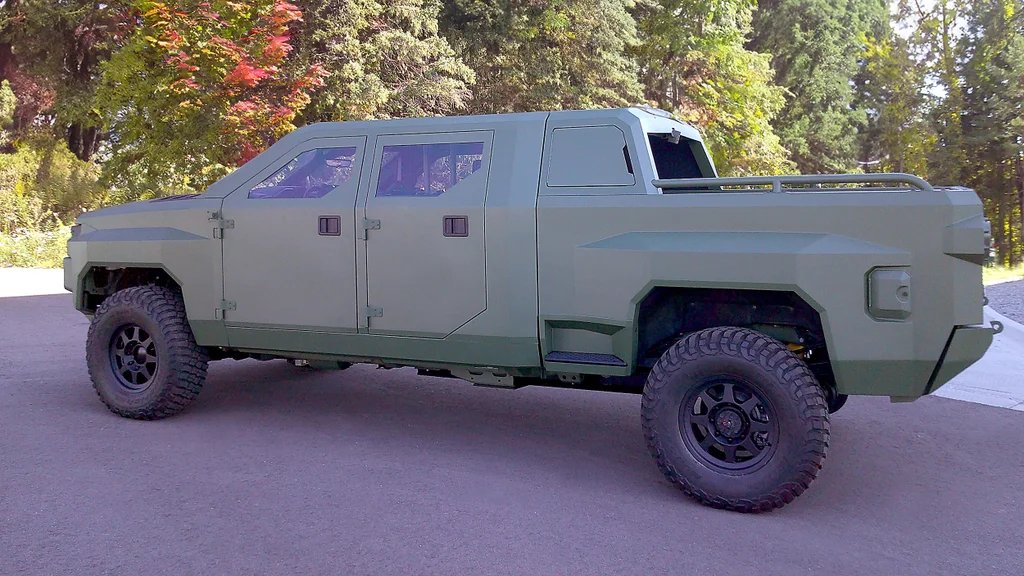
The Army and Marine Corps have understood the benefits of vehicle electrification for some time. In January 2024, GM Defense demonstrated its Next Generation Tactical Vehicle-Hybrid—built on a Chevrolet Silverado HD 3500 with the same Duramax engine used in the ISV paired with a battery producing roughly 300 kilowatt hours—with soldiers from the 3rd Brigade, 10th Mountain Division in Hohenfels, Germany.
The following February, the service’s Rapid Capabilities and Critical Technologies Office demonstrated a Humvee-based Tactical Hybrid Electric Vehicle at Aberdeen Proving Ground in Maryland highlighting silent watch, silent mobility, and increased power generation and export as the core operational advantages. And later that month, the Army’s JLTV program office released a market survey for a “projected new production effort of a light tactical wheeled hybrid-electric vehicle.”
The military has validated this technology despite ongoing concerns that the Trump administration might put the kibosh on such efforts. Now the Pentagon has to actually field it in the right package.
The Army’s answer to the power gap is the ISV-Heavy. The name is slightly misleading: What makes the vehicle “heavy” is its chassis and, more importantly, its proposed power generation capabilities.
According to a commercial solutions opening document published in late March, the system must produce and export a minimum 60 kilowatts of continuous high-voltage DC power to support modular mission-specific payloads, from C2 communication equipment and radar to, explicitly, future directed energy weapons. If the original ISV, based on GM Defense’s Chevrolet Colorado ZR2, was intended as a high-speed troop transport, the ISV-H is envisioned as a mobile power plant that happens to carry soldiers.
The ISV-H is designed to fill a “niche requirement there between an ISV and then, say, a JLTV, and it’s really going to be focused on the power generation part,” as Jess Tolleson, principal deputy assistant secretary of the Army for Acquisition, Logistics, and Technology, told the Senate Armed Services Committee during a June 16 hearing. “One of the things that we do have a critical capability gap on right now is power generation at that mobile brigade combat team level.”
The ISV-H is moving faster than the earlier CSO document might have indicated. According to the Army’s fiscal year 2027 budget request released in April, the service plans on procuring an initial tranche of 34 ISV-H vehicles at a unit cost of roughly $463,000 each, with a total procurement objective set at 606 vehicles. The service plans to release proposal requests by the end of this year, Tolleson said, describing the platform’s development as “a top priority” that the service wants to accelerate.
The Army wants to award a contract by September 2027 and accept its first deliveries by January 2028, per the budget documents. GM Defense had previously announced it will offer the same Chevrolet Silverado model showcased as the Next Generation Tactical Vehicle-Hybrid for the effort.
The ISV-H’s power specifications track with the hybrid architecture necessary for a mobile directed energy weapon employment, while the silent operations mode addresses the generator signature problem. The vehicle is purpose-built for the demands of the electronically-defined battlefield—a laser truck designed from the outset to fight, and win, the laser wars.
For the Marine Corps, there is no equivalent clean-sheet solution available. The JLTV is firmly entrenched in the Corps’ redesigned force structure: the Marine Air Defense Integrated System (MADIS) counter-drone and air defense system—which carries a 30-millimeter cannon and Stinger missiles—operates across a fighting pair of the vehicles, while the Navy-Marine Corps Expeditionary Ship Interdiction System, which mounts the Naval Strike Missile on a JLTV, forms the centerpiece of the service’s Indo-Pacific sea denial strategy.
The main problem is that Army’s relationship with the JLTV has deteriorated sharply over the past year. In May 2025, Secretary of the Army Dan Driscoll published a directive stating that the service would cancel procurement of “excess ground vehicles like the [Humvee] and JLTV” and redirect funds toward modernizing light formations around the ISV; according to the Congressional Research Service, the service planned to procure no additional JLTVs beyond the 250 delivered in January of that year.
AM General’s JLTV A2 variant, the next-generation successor that was supposed to carry the program forward, is now running more than 20 months behind schedule with roughly 2,000 vehicles in arrears, and House appropriators have proposed cutting $133 million from the program’s $245 million budget.
The Army’s JLTV ongoing issues jeopardize the Corps’ plans for the platform. As Marine Corps Commandant General Eric Smith stated during a June 2025 posture hearing, the service would have to buy fewer JLTVs going forward due to the Army stoppage—the Corps has already fielded roughly half its 12,500-vehicle requirement, but with Army volume gone, per-unit costs will rise.
This past February, the service reaffirmed its commitment to fielding the vehicle as part of its new force structure, as its Marine Littoral Regiments are built around JLTV-mounted capabilities in a way that makes a clean break from the platform effectively impossible.
In May, the service released a request for information seeking “mature, production-ready, rapidly fieldable” alternatives from vendors capable of supplementing or replacing AM General’s supply, a tacit acknowledgment of the A2’s production troubles.
This is where original JLTV manufacturer Oshkosh Defense comes in.
Displaced by AM General in 2023, Oshkosh arrived at Eurosatory 2026 in Paris with a potential answer to the power problem: an upgraded version of the hybrid-electric eJLTV demonstrator the company first unveiled in 2022, capable of generating 115 kilowatts of exportable power and operating in silent drive and watch modes that allow for full electronic functionality without the tactical liability of an engine signature. With the purported ability to generate bursts of power up to 250 kilowatts, the system was explicitly designed with future directed energy weapons in mind.
“[Working out where to] aim the power available for export is a consideration and the top end is kind of where we’re focused,” Logan Jones, chief growth officer of Oshkosh’s transport division, told Shephard Media. “One that we’ve been tracking is the Australian-based Electro Optic Systems Apollo high energy laser weapon. At the other end, another type of integration is the Cilas HELMA-P [counter-drone] system.”
Oshkosh is already pushing to reclaim its role as primary JLTV supplier for the Marine Corps, but its broader institutional argument for eJLTV adoption is relatively straightforward: A service that already operates JLTVs can easily integrate the electric version into existing maintenance infrastructure, draw on established spare parts supply chains, and train crews already familiar with the base vehicle.
With the Army walking away from the JLTV and the Marines actively shopping for alternatives, Oshkosh’s power-capable variant may prove the most realistic near-term path for the latter service to get directed energy into the fight.
Together, the ISV-H and eJLTV offer the U.S. military a two-track approach to fielding laser weapons on light tactical vehicles at scale. The Army gets a purpose-built platform with the power architecture, silent operations capability, and modular payload bays to support directed energy weapons like the E-HEL from the ground up. Meanwhile, the Marine Corps gets an evolutionary upgrade to a platform it is already committed to.
Neither track is without risk. The Army has yet to select an ISV-H manufacturer, and 606 vehicles is a modest procurement objective for a capability the service describes as a critical gap. The eJLTV remains a demonstrator, and the Marine Corps’ JLTV procurement future depends heavily on whether AM General can close its production gap and Congress will continue to fund a program it has already threatened to cut.
But if AV’s LOCUST proved the feasibility of a real-world laser truck, the ISV-H and the eJLTV are the U.S. military’s first serious attempts to build enough of the right vehicles to make laser weapons a standard battlefield capability.
The major challenge ahead, as senior defense officials have repeatedly emphasized, is whether directed energy weapons can be produced, procured, fielded, and sustained at the scale required to prove effective. Without the right platforms to support them, these weapons will remain niche capabilities—impressive in demonstrations, but absent when it matters most.
This article is republished with permission from Laser Wars, a newsletter about military laser weapons and other futuristic defense technology.
