
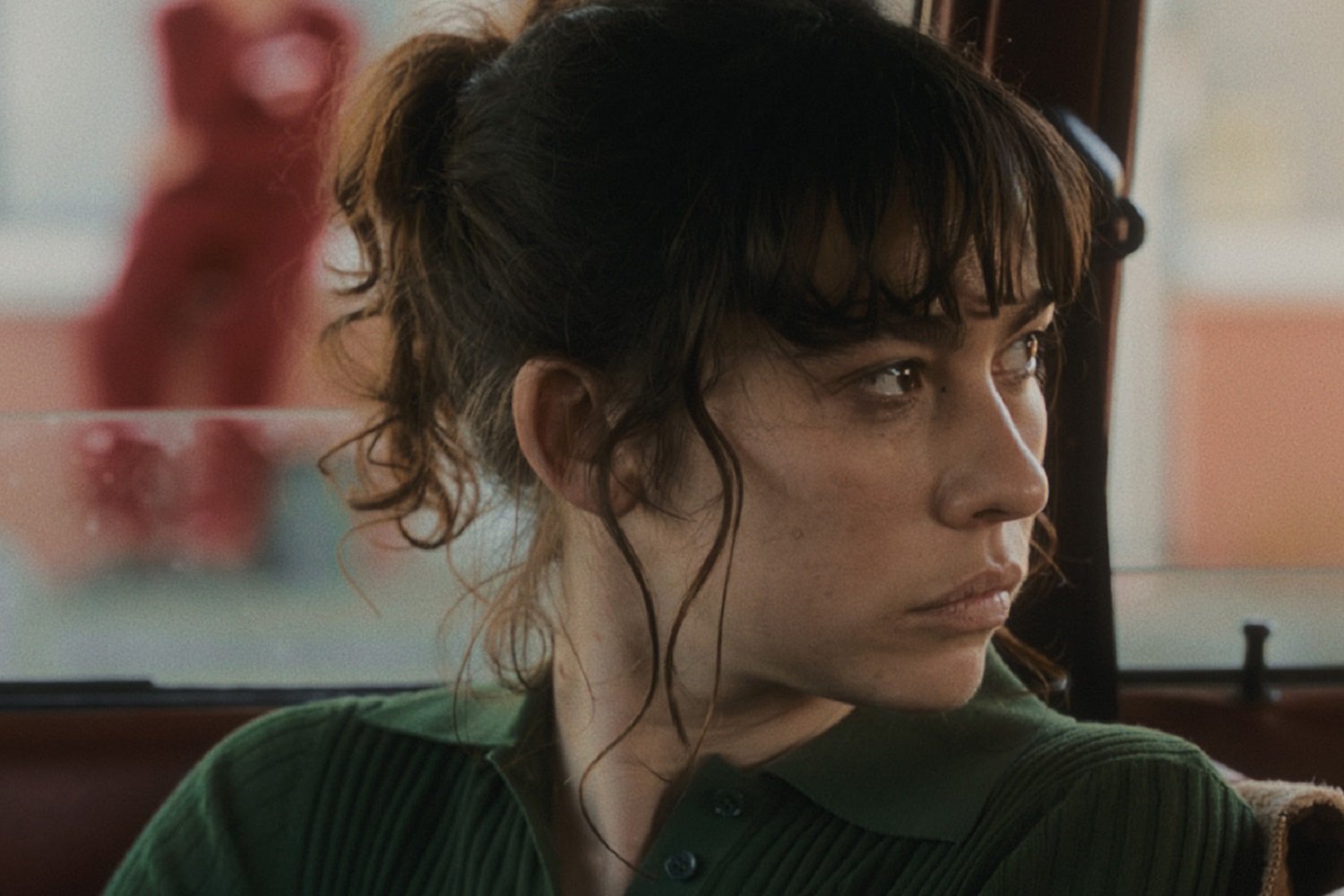
– Cristina Diz and Stefan Butzmühlen’s feature has the texture, performances and emotional seriousness of a strong period road movie, and strives to make its journey fully resonate
Greta Fernández in The Guests
Cristina Diz and Stefan Butzmühlen’s The Guests, which world-premiered in the New German Cinema sidebar of this year’s Munich Film Festival, is a road movie about love, death and displacement which relies on atmosphere and strives to turn its promising premise into a fully persuasive dramatic journey.
Set in 1973, the film follows Iria (portrayed by Greta Fernández), a Spanish migrant worker in Cologne, and Hajo (Jan Bülow), her German student boyfriend, at a time when private lives and historical upheaval seem to press against each other. When Iria’s mother Maura (Mercedes Castro) becomes terminally ill, the couple decide to take her back to Galicia by car, crossing borders, languages and political systems on a journey that should gradually expose the tensions of their relationship and the contradictions of the period.
It’s a strong starting point, and Diz and Butzmühlen clearly approach it with sensitivity. Their film is interested not only in the obvious culture clash between Spain and Germany, but in the unease of being caught between places, classes and emotional duties. Iria and Hajo aren’t just two lovers from different backgrounds: they’re also two people discovering, under extreme circumstances, the limits of what they can understand about each other.
The problem is that The Guests is more atmospheric than narratively efficient. Its opening third takes almost half an hour to establish a situation that could have been introduced to the viewer much sooner. The film’s quietness is not in itself the issue; many of its best moments are built on silences, glances and the physical awkwardness of people who have not yet found the words for what’s happening to them. But the pacing often feels under-shaped, with sequences allowed to drift well beyond their dramatic function. A stop at a petrol station and a countryside dance, for instance, both contain potentially revealing material, but they end up feeling stretched rather than explored.
This also affects the road-movie structure. The journey should ideally produce a small human map of 1970s Europe, but the microcosm of characters encountered along the way remains sparse and only lightly sketched out. The film gestures towards a broader political and social landscape but rarely gives these encounters enough density to become more than passing illustrations. Even the central practical premise — transporting an elderly woman in a comatose state by car for several days — requires a suspension of disbelief that the film doesn’t always earn.
Visually, however, The Guests is consistently impressive. The production design is precise without being over-insistent, while the photography has a tactile, period quality that avoids nostalgia and instead emphasises fatigue, dust, interiors and bodies in transit. Diz and Butzmühlen have a clear eye for texture, and the film’s world feels carefully inhabited.
The performances also do much to hold the piece together. Fernández gives Iria a guarded intensity, suggesting a woman whose grief is complicated by responsibility, anger and exile. Bülow’s Hajo is equally valuable, capturing the mixture of affection, confusion and youthful self-importance of a man who wants to help but doesn’t always grasp what’s being asked of him. Their timing together is often strikingly naturalistic; paradoxically, the actors’ rhythms feel more organic than the feature’s narrative transitions.
In its final third, The Guests appears to shift towards something almost spiritual, moving away from the early promise of a social road movie into a stranger meditation on death, memory and belonging. The change isn’t uninteresting, but it arrives too abruptly, as though the film has discovered another identity too late. Tragedy, comedy and metaphysical suggestion begin to coexist, yet the mixture never becomes especially flavourful. By the end, the resolution feels rushed and somewhat grafted onto the material rather than grown from it.
There is a delicate, ambitious film inside The Guests, and its best qualities — the two leads, the visual craft and the seriousness of its emotional intent — are far from negligible. But as a cinematic object, it remains hard to identify: too diffuse as a drama, too lightly populated as a road movie, and too sudden in its spiritual turn to fully convince.
The Guests is produced by Germany’s Match Factory Productions, in co-production with Spain’s Frida Films. The Match Factory are handling world rights.
