
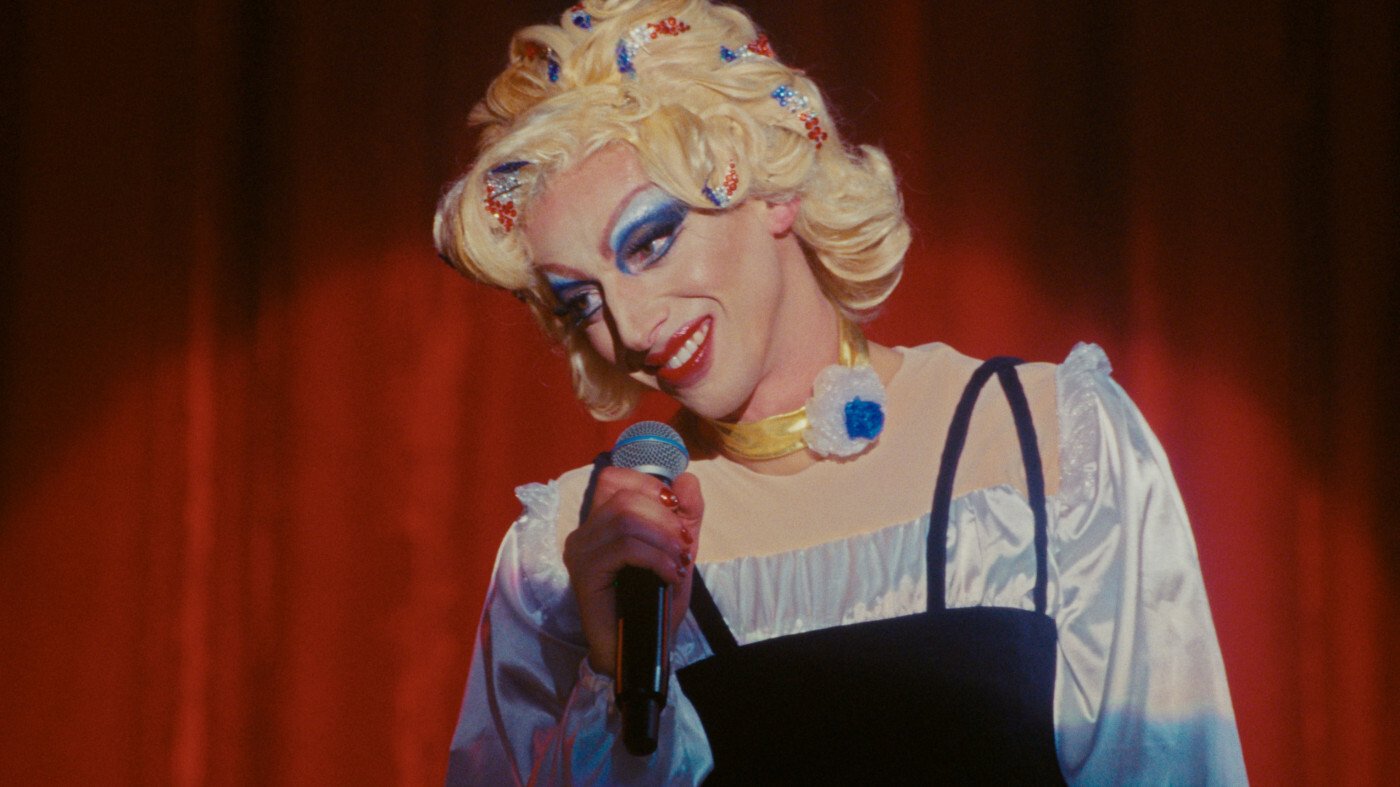
– In Šimon Holý’s warm, intergenerational dramedy, a son’s hidden drag persona becomes the catalyst for a widowed mother’s late-life reawakening and hard-won acceptance
Jan Cina in Chica Checa
Young Czech writer-director Šimon Holý’s Chica Checa, premiering in Karlovy Vary’s Crystal Globe Competition, marks a notable shift from the low-budget intimacy of his earlier work towards a warmer, more accessible, intergenerational dramedy. Following his loose “women trilogy”, Mirrors in the Dark, And Then There Was Love… and Hello, Welcome, Holý again returns to questions of female experience, family obligation and emotional repression, but this time through the perspective of a widowed mother in later middle age, whose emotional reawakening anchors the film’s broader, more audience-friendly register.
Zdena (Pavla Tomicová) is a widowed postal worker in a small Czech village, dividing her days between her job, repairs to a crumbling family home and visits to her bedridden dying mother (Věra Janků). When her son, Lukáš (Jan Cina), who lives and works in France, returns home, he learns that his grandmother has one last wish: to see Czech pop singer Helena Vondráčková one final time. Lukáš proposes an improbable solution: he will impersonate Vondráčková himself, drawing on the drag persona he has kept hidden from both his mother and grandmother. For Zdena, the plan is met with disbelief, not least because she is only now discovering that her son performs in France as the drag artist Chica Checa rather than working in a bank as she had been led to believe.
Holý has previously explored relationships within his own generation, often from a female perspective. And Then There Was Love… also examined intergenerational tension through a mother-daughter dynamic, with Tomicová at its centre, and some of those concerns are echoed here. Yet Chica Checa shifts the emotional focus onto a mother-son relationship, using Lukáš’s return not merely as a coming-out narrative but as the catalyst for Zdena’s own reawakening.
Although the film embraces a more mainstream mode of storytelling, it is far from a rambunctious comedy. Its humour is gentle and situational, while its dramatic force lies in Zdena’s gradual confrontation with grief, routine and unspoken prejudice. The film is ultimately less about Lukáš’s queer identity than about Zdena’s capacity to accept her son whilst also recovering a sense of possibility for herself. In that respect, Chica Checa becomes a melancholic, late-life, coming-of-age story as much as a tale of familial reconciliation.
Holý avoids the miserabilist register often associated with rural social drama, favouring instead a summer-lit, humanistic tone. The village setting isn’t used to exoticize Lukáš’s drag persona or to turn queer identity into a social problem. Even when Lukáš chooses not to hide himself from his mother’s neighbours and acquaintances, the film keeps the conflict intimate rather than communal. This restraint is one of its strengths: the drama is rooted not in public scandal, but in the private emotional labour of acceptance.
The film opens with a village party at which Zdena appears visibly ill at ease, a scene later counterpointed by her visit to Lukáš’s drag performance. That movement, from discomfort within her own familiar world to tentative openness in an unfamiliar one, neatly traces the arc of Holý’s protagonist. Anchored by Tomicová’s quietly expressive performance, Chica Checa offers a touching, hopeful portrait of a woman learning to see both her son and herself anew.
Chica Checa is produced by Silk Films in co-production with Arina, The French Connection and Czech Television. Pluto Film are handling international rights, while Falcon are overseeing the movie’s domestic release, set for 20 August.
