
– Damian McCarthy gets audiences trembling with a supernatural thriller skilfully playing with folk horror codes
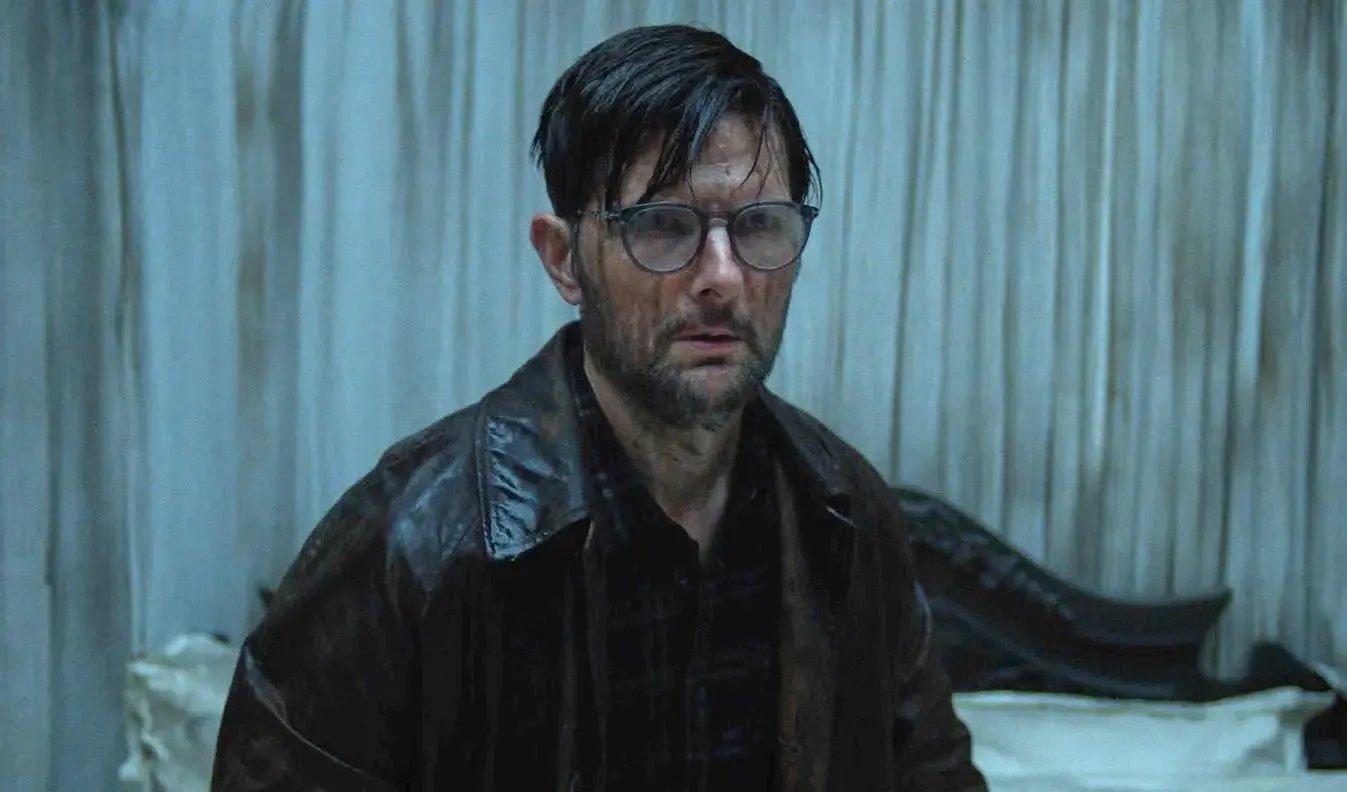
Adam Scott in Hokum
After two formally meticulous horror features, Caveat and Oddity, Irish director Damian McCarthy has premiered his latest work, Hokum, in SXSW and, more recently, in the International Competition section of the Neuchâtel International Fantastic Film Festival (NIFFF). It’s a surprising film, at times old-school but also strikingly modern, which deftly toys with the codes of folk horror, offering audiences a suspended moment of pure terror.
Hokum follows famous writer, Ohm Bauman (Adam Scott), as he temporarily decamps to a hotel in the Irish countryside to try to push forward a project he’s been struggling to finish (writer’s block?), but mostly to scatter his parents’ ashes in the surrounding unsettling forest. His decision to head to Ireland is sparked by a vision of his mother’s ghost endlessly reliving her honeymoon spent in this very place. To fulfil his tricky mission, the protagonist opts to stay at a timeless abode called the Bilberry Woods Hotel, a spectral spot where time seems to stand still. Surrounded by staff with a taste for all things kitsch and bizarre, the writer is gradually drawn into the underbelly of the hotel and sucked into a secret labyrinth populated by creatures which are nothing short of bloodcurdling.
Ohm catches the owner, Cob (Brendan Conroy), telling two children the tale of a witch who kidnaps kids, puts them in chains, and drags them into an underground realm where they’re tormented by the souls who dwell there. A kind of architectural mirror of the protagonist’s troubled unconscious, the mysterious residence also turns into a potentially deadly trap for him. These hard facts and long-buried secrets, tales of witches and ghosts from the beyond, are all part of the consciousness – or rather the subconscious – of this man who is trying to grapple with a grief he just can’t process. Is Ohm Bauman dreaming or is he perilously living out his dreams? As nightmares slyly break the surface to triumph over reality, the notorious honeymoon suite becomes the stage for the protagonist’s ferocious fight for survival.
A key figure in this story is Jerry (David Wilmot), whom Ohm meets in the woods while scattering his parents’ ashes. Jerry is a local, an outcast branded “persona non grata” by the community, who lives in his van and regularly drinks a milk-based brew laced with hallucinogenic mushrooms. Shunned by the townsfolk for allegedly killing his wife, Jerry proves a valuable ally to Ohm in the search for a truth that keeps slipping through his fingers. Rounding out the trio of misfits is hotel barmaid Fiona (Florence Ordesh), whom we discover to be the victim of a horrific femicide. It’s these two characters who inject the film with its subversive charge, turning a well-oiled, aesthetically alluring horror into a sharp social critique. Jerry and Fiona embody the bogeymen of a respectable, heteropatriarchal, moralising society which simply doesn’t tolerate difference. Jerry is marginalised because he’s (wrongly) accused of killing his wife and of having a relationship with nature which transcends reality (thanks to his potent mushroom-based potion), and Fiona because she spoils the façade of a heteronormative idyll. Both will pay with their lives for their thirst for freedom and otherness. Hokum seems to suggest that what we should fear isn’t the witch hidden inside the house (another archetype used to subjugate women within a heteropatriarchal society) but the narrow-mindedness of a world where non-conformity can prove costly – very costly.
Hokum was produced by Spooky Pictures (United States), Tailored Films (Ireland), Image Nation Abu Dhabi, Team Thrives (United States), and Cweatures Features (United States), and is managed worldwide by NEON.
(Translated from Italian)
