
– The Polish director argued that, despite potentially being shaped by strategy, audience anticipation still begins with a creator’s belief in the story
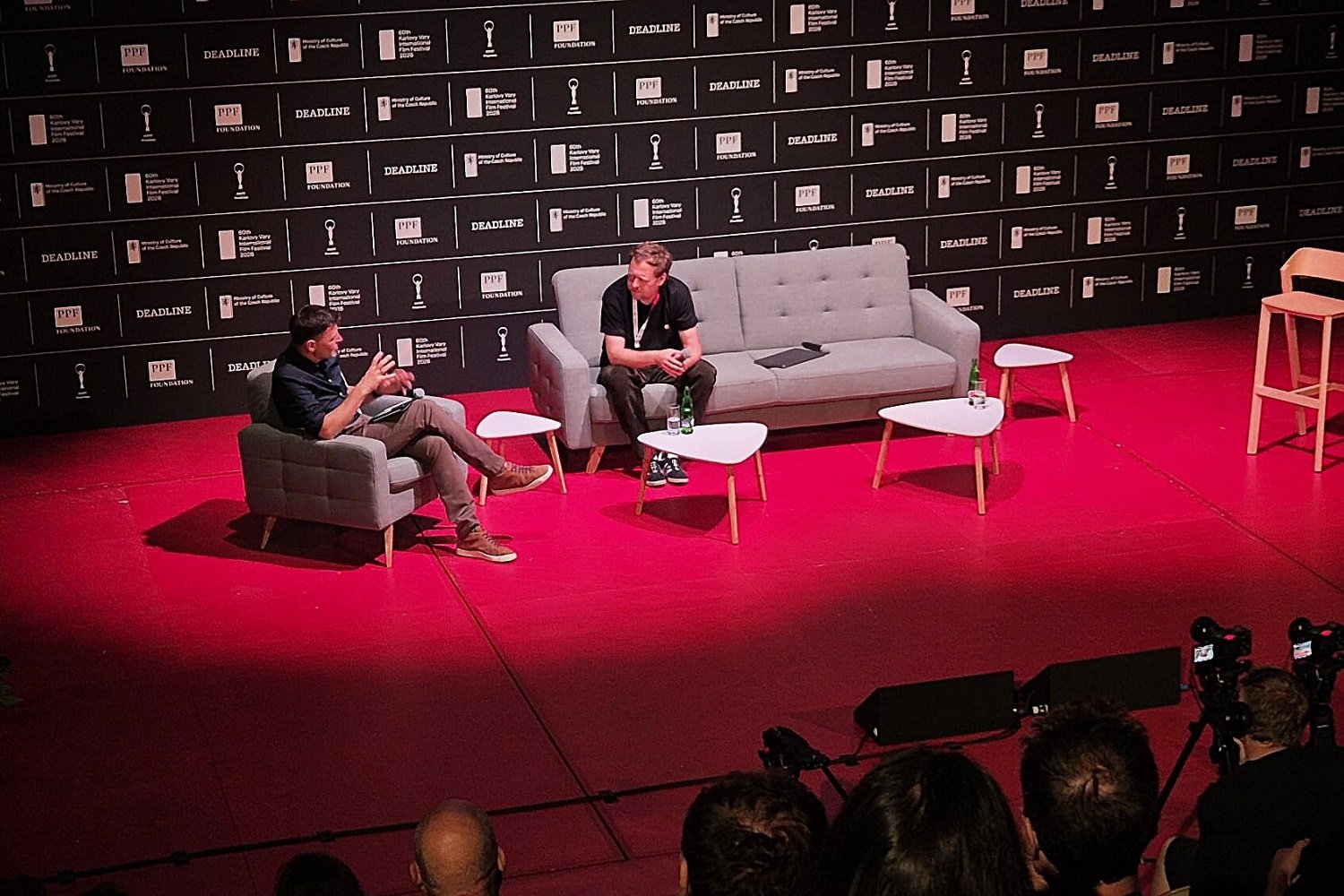
Saša Michailidis and Jan Holoubek during the talk
How does a series build an audience before it even exists? This was the central question behind “Marketing Starts in Development: How Great Series Build Their Audience Before They Exist”, a conversation held at Karlovy Vary organised in collaboration with Netflix and moderated by Saša Michailidis. The special guest was Polish director Jan Holoubek, whose recent work for the platform includes High Water and Heweliusz, two series rooted in traumatic events from his country’s recent history.
Michailidis opened by framing the discussion around a problem increasingly central to the television industry: why some original series arrive surrounded by expectation, while others disappear in a crowded marketplace. Holoubek’s answer was disarmingly simple. In the Polish context, he revealed, both High Water and Heweliusz were built on stories that already occupied a place in the national imagination.
“High Water was about the flood of 1997, so it was really important to a large part of Polish society,” he explained. “Heweliusz was the biggest maritime catastrophe in post-war Poland.” Rather than neutral subjects, he suggested, these were events which still carried collective memory, pain and curiosity. As a result, “there was a lot of buzz around it a long time before it was even shot.”
According to Holoubek, the success of these projects has been significant. “High Water, the series that was made before Heweliusz, was, I think, in 78 countries’ top 10; Heweliusz, I think was in around 65,” he enthused, before quickly insisting he doesn’t like “showing off”. Yet the figures helped set the tone of the conversation: these weren’t just local stories, they were Polish dramas capable of travelling internationally.
The ethical challenge, however, was just as important as the commercial one. Michailidis pressed Holoubek on the danger of turning national tragedy into entertainment, particularly when victims, survivors and families remain part of the living memory of an event. Holoubek credited screenwriter Kasper Bajon, who wrote both shows, with much of the work required to walk that line.
“When you do anything based on true events […] you have to somehow like all the characters that are in your show, even if they’re bad,” he revealed. “You have to somehow feel for them. Then your production becomes somehow objective, and you’re showing the situation, you’re not judging it.”
That position became especially clear when the conversation turned to Heweliusz. The series, Holoubek explained, was preceded by extensive research. “The screenwriter carried out a huge amount of research and he talked to the people who survived,” he continued. “I think, in this case, it took one year of research to build the story in a way that it didn’t hurt anybody.” At the same time, he stressed, the series couldn’t ignore the political aftermath of the catastrophe: “It shows the truth, what happened after the catastrophe […] how the country, how the government isn’t dealing with this huge tragedy properly, how it’s trying to shift blame, to make the captain who died responsible for it.”
The panel’s title might suggest a close connection between development and marketing, but Holoubek repeatedly pushed back against the idea that he personally engineers audience anticipation. “I don’t do that at all, to be honest,” he insisted. “I’m focused on doing my job, on shooting the best story the best way that I can, and that’s my way of communicating with the audience.” The rest, he added, is up to the producers and the streaming service.
That doesn’t mean he’s entirely detached from the process. After some teasing from Michailidis, Holoubek acknowledged that Netflix shows him posters, artwork and trailers, and asks for feedback. “It’s very nice that they always come up with the idea for the entire concept, what the artwork and the trailers would look like,” he conceded. “They show it to us, and they ask if we agree with it, if we like it.” In the case of Heweliusz, he added, they started to tease audiences roughly a year before its premiere, with information released gradually and carefully.
Strategies can also be quite strict. Holoubek recalled posting set photos from the first day of shooting, only to receive an insistent phone call almost immediately. “Please take it down, please take it down,” he remembered being told. “So there’s a huge strategy behind it, but I’m not the one who’s masterminding it.”
For Holoubek, the most powerful marketing tool is an old-fashioned one: the trailer. “Trailers offer a glimpse at the filming style, the storytelling, and so on,” he explained. But he insisted directors shouldn’t cut their own trailers. After months or years inside a project, he argued, they’re no longer able to judge what should be compressed into 30 seconds or one minute. “I think it’s better if somebody totally objective does it.”
The international performance of any series, Holoubek stated, is still hard to predict. He’d expected a centralised Netflix strategy but instead found that each country or region decides what to promote. The strong response to High Water in South America, he suggested, may have reflected shared experiences of crisis and governmental failure.
His advice to emerging filmmakers was therefore less about platforms than conviction. “You just develop the project you really believe in, that you’d love to see on screen,” he concluded. “You have to be your own audience.” His first project involved ten years of rejection, but, he insisted, “if you really believe in it, there’s a huge chance that, one day, someone else will believe in it too. And that’s when the magic starts.”
