
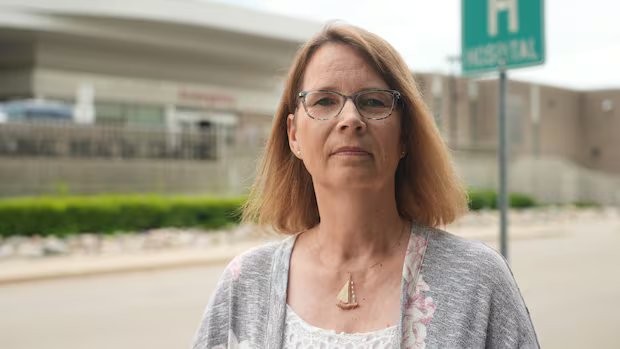
Susan Thiele says the emergency closure of the hospital six blocks away from her home in Dauphin, Man., is scary.
“I’m terrified,” she said Thursday. “I have had to rush over to the hospital a few times, to emergency.”
Thiele, who has melanoma and heart issues related to long COVID, is one of the people calling for a temporary field hospital in Dauphin after its hospital was closed indefinitely following flooding just over a week ago.
“I know it sounds crazy, but if the military can set up a hospital … there are empty buildings here. There’s halls that could be used. It can be done,” said Thiele, who also has a grandson with anaphylactic allergies.
“We need it here.”
Flooding in the basement of the Dauphin Regional Health Centre that took out power to the building also destroyed the HVAC system, officials said Thursday. The building was evacuated, with 54 patients displaced.
Dauphin, 250 kilometres northwest of Winnipeg, is in the badly flooded Parkland region of Manitoba.
The water was more than two metres deep in places, and as the basement dries out, there’s so much silt it’s impossible to walk in some areas, said Treena Slate, the head of Prairie Mountain Health, the regional authority that oversees the hospital.
“A lot of the electrical distribution system was damaged and will need to be replaced,” Slate said. “Our air-handling systems were also submerged and damaged, and so there’s infection control concerns around that … and also clean air control.”

After flooding closed the western Manitoba city’s hospital, it’s expected to be months before some areas of the facility can reopen. Officials say they’re working on providing more health-care services outside the hospital while Dauphin residents wait for repairs.
Assessments of what needs to happen to get the hospital operational again are underway, Slate said.
Until they know the full extent of the damage, they won’t know how long it will take to repair and replace the electrical and HVAC components in the hospital, she said.
Small hospitals in Ste. Rose du Lac, 40 km east of Dauphin, and Grandview, 45 km west, have extended their hours — Ste. Rose is now open 24/7 — and some Dauphin health-care professionals have shifted to work at those hospitals.
Alternative hospitals ‘probably at the max’
Dauphin Mayor David Bosiak said he’s heard the hospital will be closed for months, and he doesn’t think the small hospitals will be able to replace its services for an extended time.
The Dauphin hospital’s catchment area reaches at least a 200-kilometre radius and when it was open, it served around 50,000 people with an emergency department, maternity care, diagnostic services, cancer care, dialysis, surgical services, palliative care and in-patient rehab.
“The two small hospitals that are servicing the entire area now are probably at the max of what they can provide and do, and then the dialysis patients and the cancer patients that have been redirected, we don’t know where they’re going,” Bosiak said.
The town does have buildings that could be used for health care, and the clinic that adjoins the hospital is still operating, so he hopes they can resume services before the building is repaired.
Dr. Bittoo Malik, a radiologist who grew up in the region and returned to help build up Dauphin’s diagnostic program, called the closure of the hospital “catastrophic.”
She can’t do her job right now, because all of the services are down.

The doctors who work at the hospital are going to other centres to work, despite having flood damage to their own homes, and on a professional level, they are worried about their patients, she said.
She’s also worried about losing doctors to other places while the hospital is closed.
“Physician recruitment and retention in Manitoba in general is difficult — in a rural centre, even more difficult,” said Malik, who also represents area doctors as a Doctors Manitoba board director.
“If we start to see our physicians leave, it’s going to be very difficult to bring them back.”
She also wants to see services set up in different locations if it’s going to be months to get the hospital building operating again, as she’s been told.
“Think outside the box. Think outside the building,” she said. “See what we can do to work collaboratively to bring those services back to us.”
Federal minister visits
Northern and Arctic Affairs Minister Rebecca Chartrand, who represents the Manitoba riding Churchill-Keewatinook Aski, visited Dauphin Thursday to speak with officials and see the situation for herself.
She said she would talk to her counterpart Eleanor Olszewski, the minister of emergency management and community resilience, about a request for a field hospital.
“I know that the request went in. I think it went in today, so I am going to follow up on that personally.”
A spokesperson for Olszewski’s department said Thursday afternoon that a request for a field hospital hadn’t been received at that point, although they got a letter requesting “increasing temporary medical capacity.”
Thiele said her fears are double — she worries both about current health-care needs and the long-term viability of the hospital.
“We want the hospital open, and I know it can’t be there, but it has to be somewhere,” she said. “I don’t want to lose our staff, ’cause they are wonderful, and we probably won’t get them back.”
Thiele’s already had a health-care scare since the hospital closed.
She’s been helping people whose homes flooded and on Saturday night, she woke up with chest pains, a sore arm and “tingling everywhere.”
“I chewed a couple aspirin and then I just sat here for hours, just waiting till it went away, knowing it was probably just stress from everything, but it’s terrifying, ’cause where am I going to go? Who’s going to see me quickly?”
