
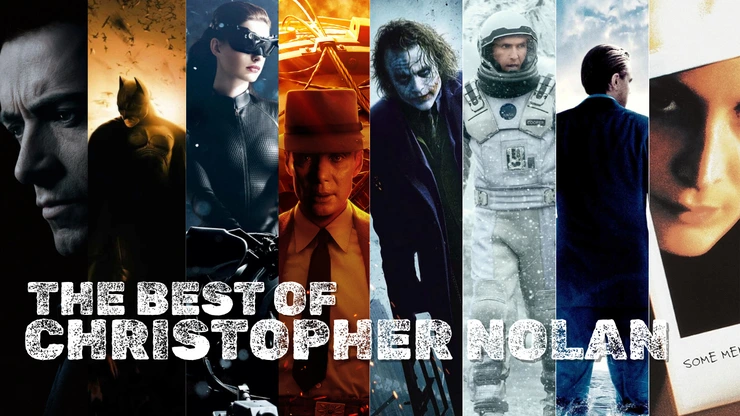
Christopher Nolan is a filmmaker beloved by many; his films are renowned for the way they subvert our understanding of time and for the scale at which he works on a technical level. Ahead of The Odyssey, I sat down to reflect on his career. Specifically, my favourites.
As a long-standing fan of superheroes and comic books, my introduction to him was Batman Begins, where my appreciation for Nolan, Christian Bale and Cillian Murphy began as a young girl. His films have received numerous nominations for awards at all levels, and The Odyssey remains one of the projected big hitters in next year’s awards race, a follow-up to his 13-time Academy Award-nominated epic biopic, Oppenheimer.
Nolan achieved his first two Oscars ever with wins for Best Picture and Best Director. I have tickets booked for the opening day screening of The Odyssey in 70mm IMAX at the BFI IMAX and am excited to see his take on an epic piece of literature that I have long loved.
10. Insomnia
Christopher Nolan is associated with high-concept and non-linear storytelling – his best films lean into it, and he is an incredibly successful, accomplished and talented director for good reason. But, Insomnia is very different and is proof that Nolan’s ability to execute his vision with precision is what makes him a revered filmmaker, rather than a reliance on the scale and complexity of his films. Robin Williams’s performance is akin to Kate Winslet’s and Jim Carrey’s roles in Eternal Sunshine of the Spotless Mind in the way it subverts our expectations of him. Casting him as the villain works because it is even more unsettling when he talks casually of murder and abuse, and the quiet eeriness to him is a far cry from that of an actor well-renowned for his larger-than-life comedic performances.
Pacino’s Dormer is exhausted throughout, a man who is slowly unravelling under the weight of his guilt, which positions him as the polar opposite of William’s Finch. He looks permanently tired; he becomes more desperate, and his descent into hallucinations and paranoia makes for a complex character study within the psychological crime thriller that is the film.
9. Batman Begins
One of the best superhero origin films ever. Batman Begins was the first Nolan film I ever saw. The decision to mix parts of Bruce Wayne’s childhood alongside his time with the League of Shadows and present-day allows us to get to know his character gradually. The payoff is worth it when he decides to go back to Gotham and decide to stop running away from his demons. Gotham is darkest and most eerie in his first Caped Crusader film, and it has a neo-noir and gritty appearance suiting its heavier themes.
Cillian Murphy’s performance as Scarecrow is incredibly underrated. Unsettling, intense and quietly terrifying, his ability to enact psychological horrors with little remorse, fuelled by his obsession with fear and control, is a great foil to how Wayne’s relationship with fear develops, namely his ambition to master it and use it against the criminals of Gotham.
8. The Dark Knight Rises
Following The Dark Knight was never going to be an easy feat for the third and last instalment in Nolan’s trilogy, which is Nolan’s great conclusion to the trilogy. The film was never going to be the chaotic and unpredictable menacing tone the previous instalment had, and no villain was going to live up to Ledger’s Joker. But it is an unfair comparison to make, as both films are achieving different aims. In The Dark Knight Rises, Nolan interrogates what happens when our symbols, the idols and heroes we look up to, break. When we are forced to confront reality, they are not gods but merely people.
Batman is broken, emotionally, by the loss of Rachel and the loss of purpose which came with being the symbol. Tom Hardy’s Bane arrives at the right time; his strength and focus are sharp and a far cry from Batman, who is rusty. He physically breaks Batman and proves that the suit is not everything if the man wearing it is vulnerable. His voice as Bane is incredible – he mixes the theatricality by over-emphasising certain syllables and elongating various words with a voice which is booming and works well with the mannerisms of the character. One of my favourite scenes across the whole trilogy is the showdown between Bane and his goons, the Gotham Police Department and Batman.
The stakes are incredibly high, and the slow movements towards each other before the fight breaks out in a high-energy clash bring an ending worthy of the tension built up. As Batman breaks Bane’s mask, there is a difference to his fighting style – Hardy becomes animalistic, and his punches, previously sharp, precise and unrelenting, become less targeted and feral. The only gripe I have with the film is that it reveals that Joseph Gordon-Levitt’s Blake is Robin. It was clear from his relationship with Bruce and the importance his character had that it would have been better left unsaid.
7. Tenet
Tenet is one of Nolan’s most ambitious and polarising films, focusing once again on time. A film you need to rewatch to deepen your understanding and appreciation of. It features in this list because it is a technically brilliant film (as many of his are) and feels like his take on Bond (similar to Inception), blending the concepts of time with a spy thriller. Time inversion was a tricky concept to follow, especially with the poor sound mixing when I first saw it in the cinema. But I grew to love it on a rewatch, particularly the second half. John David Washington is magnetic, confident, and so suave with impressive physicality – there are parts of his performance that you appreciate more on rewatches.
He never overplays the character and allows his character to be restrained; the ways in which he holds his weapons and moves through the film make for an understated performance. On a technical level, Hoyte Van Hoytema’s cinematography is incredible, and the decision to modify and custom-engineer IMAX 65mm cameras to capture the action sequences without excessive post-production modifications serves the film well. Tenet has some of my favourite action sequences and utilises Washington’s background in American football expertly.
6. Inception
Time-bending at its very finest, Inception is in the Top Five because, similar to Interstellar, it balances the science behind the mind-bending with the emotional story. It speaks deeply to anxieties around parenting and abandonment, as many of his films do, by providing Leonardo DiCaprio’s Cobb with an impetus to do the extraction. Haunted is the best word to describe Cobb, and he executes that guilt around leaving his children with expert directing and writing from Nolan. There is a lot of negative discourse around his portrayal of women and how he writes them, but in Inception, his choice to position Mal as the antagonist, as we see her from Cobb’s perspective, makes the reveal that she is the victim of gaslighting in Cobb’s intentional efforts to strip away her grip on reality and her autonomy more effective.
The action sequences are so well-directed, with a particular standout being the zero-gravity hotel hallway sequence. Joseph Gordon-Levitt’s commitment to doing his own stunts is impressive enough, with the scene serving to also depict what occurs across the other dream levels; the tension is high, and it is so gripping.
5. Interstellar
The beauty of Interstellar is how it is one of many films of Nolan’s which explore his anxieties around the parent-child relationship, but it is his most personal take on it. The relationship between Murph and Cooper is the film’s emotional anchor, driving the tension to complete the mission and get back. Time dilation is the most gut-wrenching and effective part of the film, as we see scenes of Cooper sobbing, watching his children grow up much faster before his eyes than his body ages. On a personal note, Murph, being a young girl who is Cooper’s intellectual equal and who shares his stubbornness, is refreshing to see in a landscape where young girls are socialised to be the opposite.
Interstellar is technically brilliant, with a story behind it which is both scientific and deeply emotional and is led by a strong and incredible lead performance from Matthew McConaughey, who, in my opinion, was one of the best of that year.
4. The Prestige
Magic tricks leave you in awe, keep you second-guessing what comes next and reveal themselves to stunned silence, which is exactly how I felt after watching The Prestige. A film which questions what we are willing to sacrifice to pursue greatness, in a similar vein to films like Whiplash, Black Swan and Sound of Metal. It features in the Top 5 because I truly believe it is one of his greatest films. The theme is as relevant today as it was then, with Hugh Jackman and Christian Bale’s performances selling their descent into the obsessiveness that strips away their identity in pursuing greatness. The ability of the Borden twins to pull off the “Transported Man” trick relies upon living a single existence. Indeed, the Batman star can vary his pitch and tone and carry himself according to the twin that he portrays.
It works precisely because it is a surprise on a first watch, and on a second watch, you can see where the switches occur and appreciate the subtle details in Bale’s portrayal of each twin. Jackman, however, is completely different, and he leans into his ability to be over-the-top and theatrical and charming, which works perfectly well to contrast with the Borden twins and his own difficulties with the grief of losing his wife, Julia.
3. Oppenheimer
Biopics are always hard to pull off. You could veer between being too sympathetic, too scathing or succumb to a structure that feels repetitive. Christopher Nolan’s Oppenheimer avoids all of the pitfalls of the modern biopic and is a film on the biggest and most epic scale. The writing is incredible, and the decision to have it in the first-person and follow Oppenheimer’s life in his conventional non-linear storytelling format is well-executed. Going from his early research, his time on Project Manhattan and the court case trials, and his political and psychological journey.
The court drama which unveils showcases the weaponisation of his history by the US government and the Red Scare McCarthyism era of the 1940s and 1950s, and how paranoia formulated much of US foreign and domestic policy. The performances across the film – from Emily Blunt, Florence Pugh, and Robert Downey Jnr are fantastic. But it’s Cillian Murphy’s silent intensity and focus on his intellectualism through subtle parts of his performance, such as the way he walks, his stare and his tautness, that make for a performance which is a far cry from the dramatic and grandiose performances the Academy often rewards.
2. The Dark Knight
The biggest mistake directors of recent superhero films have made is to try to replicate the energy and soul of Nolan’s Dark Knight Trilogy by shifting to darker colour palettes. The darker palette across all of the films speaks to the themes of surveillance, vigilantism, the nature of fear and trauma, and suits the Gotham in which Christian Bale’s Batman operates. Heath Ledger’s performance as the Joker will continue to go down in history as one of the best comic-book villains of all time. Ledger’s approach to the role was a sort of chaos, which is scary, because it has no reason. He is not bound to any particular moral code, and his actions in confronting the principles of life that we hold dear and which are unspoken. He is the perfect counterpart to Batman, who is defined by his mission to justice and rule. The film is well-crafted and feels more like a crime thriller than a superhero story.
The score, the cinematography from Wally Pfister and the colour palettes of blues and greens allow The Dark Knight to stand out from its predecessor. And most importantly, despite the Joker being captured at the very end, he wins. Harvey Dent (expertly played by Aaron Eckhart), Gotham’s White Knight, becomes corrupted (in a similar vein to Boromir’s corruption by the ring in Fellowship of the Ring), showcasing that the very best of us can fall to evil.
1. Memento
Given Christopher Nolan’s filmography, choosing a film to take first place was by no means an easy feat. But Memento is undoubtedly his best and my favourite of his. Mind-bending, enthralling and a film that keeps you on your toes, and his best that deals with the manipulation of narrative and time. The story is intricate and becomes unwoven for the viewer, as it does for Leonard Shelby. Time manipulation is a concept Nolan is no stranger to, and in Memento, it is utilised in its most psychological and emotional format. Guy Pearce’s performance balances the vulnerabilities of Leonard. His inability to remember makes him prey for opportunistic bad guys (Joe Pantoliano’s performance as Teddy is a highlight!) and there’s a nervous energy to him, which keeps the pace of the film.
I first watched this last year at the Barbican, accompanied by a screen talk with Guy Pearce, and was shocked to learn he hated his performance – it’s not a charismatic, loud or showy one, but it is an impressive one nonetheless.
The Odyssey is in cinemas from July 17th.
Discover more from
Subscribe to get the latest posts sent to your email.
