
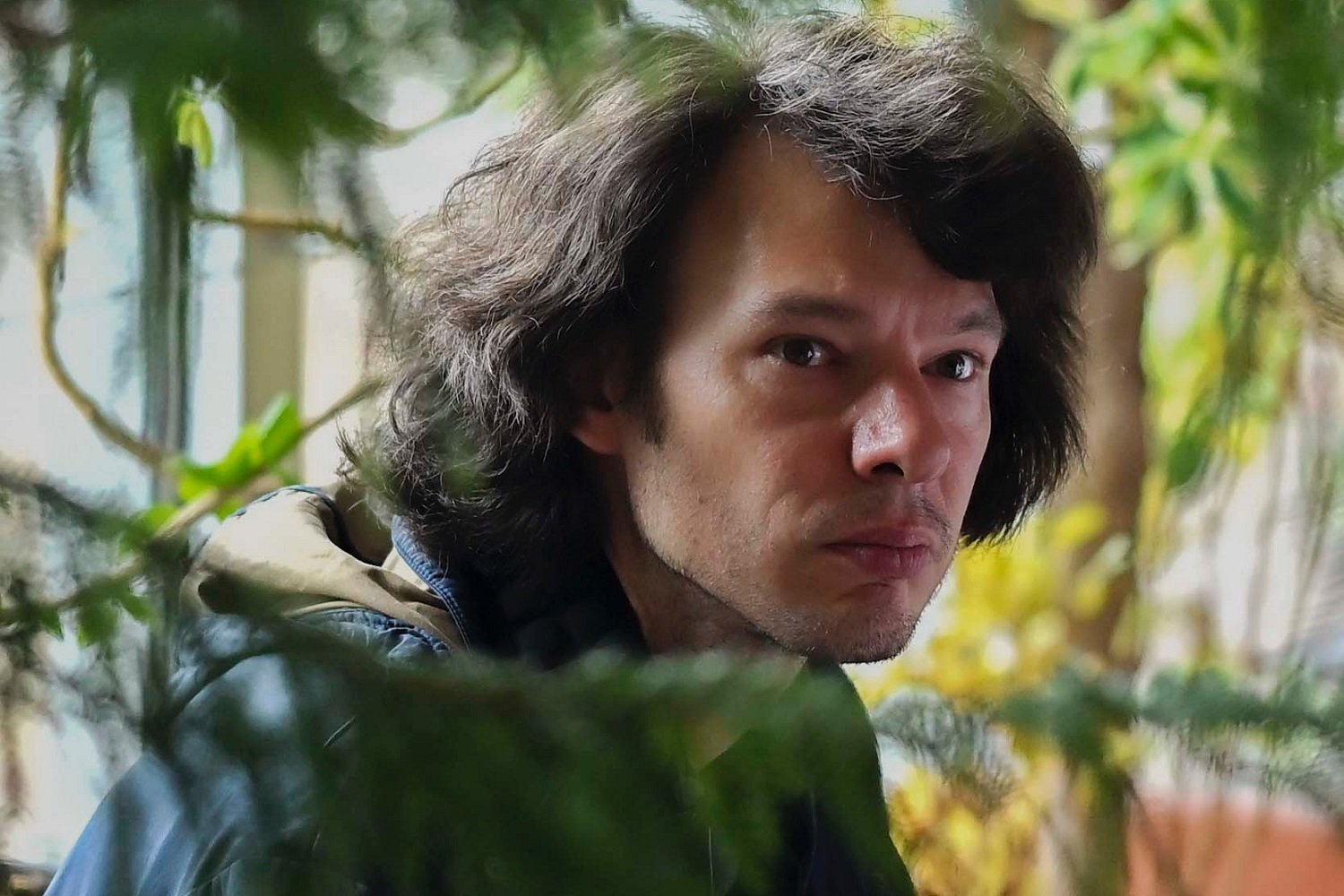
– The Czech director discusses moving from micro-budget filmmaking to a more structured production, his relationship with the mumblecore label and the search for “truth on the cinema screen”
Following his acclaimed 2019 debut Karel, Me and You, Czech filmmaker Bohdan Karásek returns with Everything As It Should Be, a dialogue-driven study of middle age, premiering in the Special Screenings section of the Karlovy Vary International Film Festival. The film confirms Karásek’s interest in intimate, conversation-based cinema. In discussion with Cineuropa, he talks about moving from micro-budget filmmaking to a more structured low-budget production, his relationship with the mumblecore label, female subjectivity, rhythm, visual restraint and the search for “truth on the cinema screen”.

Cineuropa: Your feature debut, Karel, Me and You, became something of a surprise domestic hit. Did your approach to filmmaking change for your second feature?
Bohdan Karásek: Everything As It Should Be was no longer made entirely through production self-reliance, and that makes a huge difference. We moved from a micro-budget and a crew of three or four people to a low-budget production with a crew of 15 to 20. The film was certainly better cared for technically and organisationally. Paradoxically, the need to save up wherever possible does not really decrease. But I hope that neither did the possibility of fine-tuning my own authorial sensibility in the search for “truth on the cinema screen”, which is what I was trying to do then, just as I am now.
In the Czech context, your work is often labelled as mumblecore. Did you consciously try to move away from that label?
First of all, the label has to be taken with a pinch of irony. That said, I still admire the original American mumblecore movement, so there is no reason for me to distance myself from it. On the other hand, I do not consciously align myself with it either. I am sure the mumblecore police would issue me quite a few fines.
The film touches on generational questions. Why did you choose the perspective of a generation on the threshold of middle age?
I did not focus on a generational perspective as such. As with my previous films, it probably emerged from my own perspective at the moment when I was developing each of them, so naturally certain motifs felt closer to me. That said, one very fundamental motif, the dilemma of making a lasting choice of partner, and the adult struggle with that dilemma, is, I think, relatively independent of age. It depends only on adulthood.
Why did you decide to primarily adopt a female perspective?
I am not really drawn to one perspective or the other, but rather to the dialogue between them. Within the narrative, I try to balance both points of view. At the same time, if I am working with what we call the main character, then I inevitably have to choose one perspective. I choose the one that is not my own. I suppose I am in a phase of trying to “understand the other side”, with all the narrative risks that such an “attempt at empathy” entails. And with the hope that the other side will see it precisely in that way: as an act of dialogue.
One of the dominant elements of the film is a long dialogue unfolding across several locations over an entire day. Why did you make this meeting so structurally significant?
The element of an encounter, often in some kind of “unusual” relationship configuration, is present in all of my films. In this case, it is a crucial moment in the overall narrative, but it was also important to embed it properly and show its circumstances. From a storytelling point of view, it is logical. In terms of proportion, it is asymmetrical. And both of those things interest me a great deal as a viewer, and therefore also as an author. At the same time, the structure remains fairly clean: the film ends in a similar way to how it began, albeit with everything that has happened in between.
The film has quite a contemplative pace. Could you elaborate on your approach to time and rhythm?
That is connected to the asymmetry of proportion. The film contains three scenes of roughly ten minutes each, taking place in a unity of place and, with a certain degree of compression, also of time. But the criterion for me always remains the same as it is for any storyteller, regardless of how mainstream or “arthouse” the work may be: does what I am showing feel interesting to me?
International festival audiences most often encounter Prague in Czech films, or sometimes rural locations. You set the film in Liberec and Jablonec and have said that it was important to avoid the “elitism of the capital”. How does this “non-Prague” urbanism shape the story?
Honestly, I think international audiences may not care, certainly less than Czech audiences would. A domestic viewer might be unsettled by questions such as why the story takes place specifically in Liberec. But if it were set in Prague, the city would define it unnecessarily for my taste. Prague is the capital of the country, but it is not the capital of life, stories, suffering or dilemmas. “I’m already allergic to all this centrism,” says one of the characters, Associate Professor Jakubík, in a scene that was cut from the film – now I almost regret losing this scene.
Your visual approach is austere, clean and subordinated to the actors. What is your directing philosophy when it comes to the camera?
I simply try to film the situation. I am more inclined to create dynamism through editing, the alternation and variation of viewpoints or simple camera movements, rather than through more sophisticated aestheticisation of the image. But all of that also stems from the basic “realist choice” of my storytelling: the unobtrusiveness of the style must, at least in my conception, correspond to the unobtrusiveness and subtlety of the content. I am glad that cinematographer Tomáš Uhlík and I agreed on this, and that, thanks to him, the image still has a consistent aesthetic quality and the film has a clear visual identity.
