
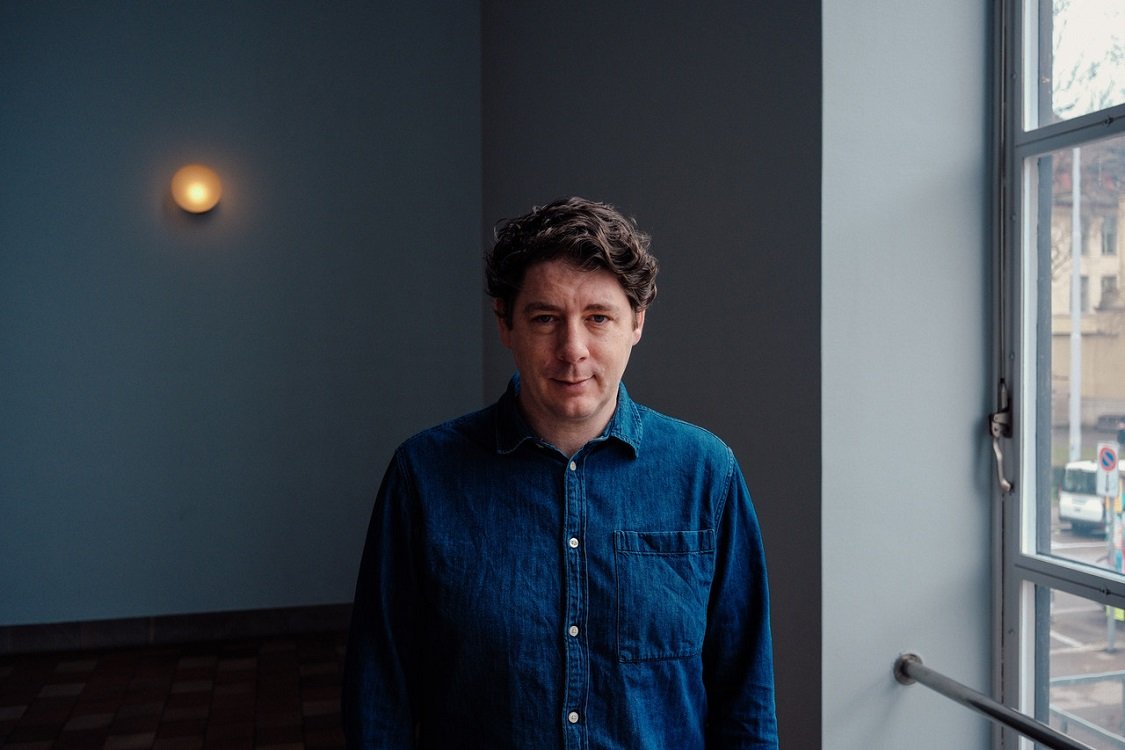
– The Swiss filmmaker discusses his first feature, which follows a working mother struggling to keep her children with her, and what audiences can take away from it
(© Jan Mettler)
Swiss filmmaker Jan-Eric Mack discusses his first feature, A Happy Family, presented in competition at the 60th Karlovy Vary International Film Festival.
Cineuropa: Was the character of the mother, or the story, inspired by real-life events?
Jan-Eric Mack: No, the story is entirely fictional. However, during our research we spoke with many people affected by poverty. We also met with representatives of the authorities, and along the way, we encountered countless stories that eventually found their way into the film.

You chose to tell the story from the mother’s perspective, rather than that of the authorities or the children. Why was that important to you?
That was clear from the very beginning; we always wanted to tell the story through her eyes. We saw that mothers are disproportionately affected by poverty, especially among the working poor, and we felt it was important to give them our full attention.
The screenplay was written by several people. Could you tell us a bit about that collaborative process?
We worked on the film for six years in total. The original idea came from Anna Schinz, who also plays the lead role. At first, the two of us discussed the concept, and she began the research. Later, Nikita Afanasjev and Eva Kienholz joined us. We’re friends, and we’re also collaborating on another writing project together. As our research expanded, it became increasingly clear that writing the screenplay collectively made perfect sense.
How did that collaboration work in practice?
The great advantage was that we all brought very different perspectives to the project. Anna contributed the actor’s perspective and approached the characters from within. Nikita and Eva both come from journalism and literary writing, so they brought extensive research experience. Then, there was my perspective as the director. We found it incredibly enriching to constantly challenge and broaden each other’s viewpoints. In practical terms, Anna and Nikita were primarily responsible for the research. Once that phase was complete, we moved on to the screenplay, where all four of us worked very fluidly. We all wrote, exchanged scenes, revised one another’s work, and kept refining the script together. It was a highly collaborative and organic process.
Anna Schinz also plays the lead role. Was that the plan from the outset?
No. Initially, we had written the character as being much younger. As the writing process evolved, however, we realised that this placed too much emphasis on the issue of young motherhood. It risked suggesting that she was struggling simply because she had become a mother at a young age. We therefore made the character older, which naturally brought Anna into the pool of possible actresses – quite pragmatically, really. At the same time, we asked ourselves whether it made sense for someone who had approached the material from such an analytical perspective to play the role herself. In the end, we felt it did. She already possessed a profound understanding of the character and the world of the film, rather than having to acquire it from scratch. Her challenge was to let go of that analytical distance, reconnect with the emotional core of the character and simply inhabit the role.
What would you say were the biggest challenges during the shoot?
We shot with a relatively small crew. Of our 29 shooting days, five were completed with a reduced unit. We had to remain very mobile because we were constantly on the move – especially with all the car scenes. We also made the conscious decision to film every car scene from inside the car. We wanted the audience to truly feel the claustrophobia of that confined space rather than observing it from the outside. It was both an artistic and a financial decision. We also worked across many locations, so in many ways the production itself became a journey alongside our protagonist. Another obvious challenge was working with children; filming with child actors comes with strict regulations, and unlike professional actors, children require a completely different approach and focus on set.
What do you hope audiences will take away from the film?
Whenever I make a film, my first hope is that audiences will be entertained, emotionally moved and able to connect empathetically with the characters and their story. Because this film also addresses a political issue, it was important for us to shine a spotlight on something Switzerland is rarely associated with: poverty. We wanted to reveal a side of the country that very few people know about and that is hardly ever discussed. That is even more true abroad, where Switzerland is often perceived very differently. But even within Switzerland, we’ve found that many people are unaware of how many are affected by poverty. We hope the film will encourage audiences to recognise that reality and to start talking about it.
