
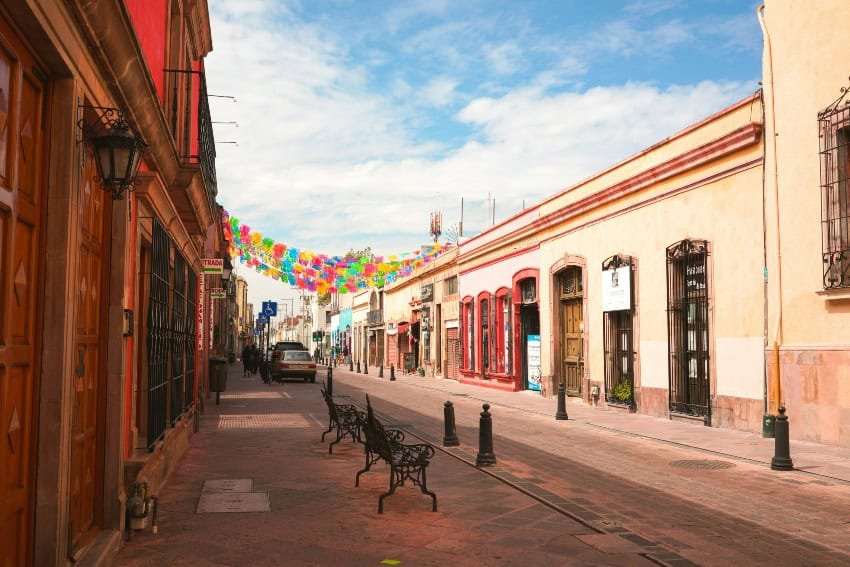
It was a Tuesday afternoon, three weeks after I arrived, when I stood waiting for change at a small panadería on Peña de Bernal and realized I had run out of language. The woman behind the counter had asked me something kindly, twice, and I had answered the wrong question both times. She smiled, gave me my change and moved on. I walked outside with a bag of conchas and the unmistakable sense that something in my life had rearranged itself while I was distracted.
The move to Querétaro had taken place a few weeks earlier in full professional life. I was still serving as Associate Dean, still finishing the revision of a book I had been working on for the better part of two decades, still carrying a clinical practice that would, by the country’s terms, be reshaped in ways I had only partly anticipated. The plan, such as it was, had been to bring my work with me, to settle in a slower corner of the world and continue. The city had a different reading of my plan.
Crossing an invisible line
You feel it the moment you stop being a person who is visiting somewhere and become a person who lives there. I had crossed that line at the panadería without noticing. The conchas had become Tuesday’s bread. I would buy them again on Friday. Within a month I would have an opinion about which baker on which block did them best, and that opinion would matter to me. The woman behind the counter would call me joven, which she does to everyone, but which I have come to receive as a small daily kindness.
James Hollis writes about the difference between the life we plan and the life that arrives. He has been my teacher in print for 30 years. I have used his framework with hundreds of patients, most of them in midlife, most of them sitting with the question of why the life they built so carefully has stopped feeling like home. I have understood his work the way a clinician understands a useful instrument. Querétaro put the instrument in my hand and asked me to use it on myself.
How life reshapes work
I had written my own book on this ground. “A Life Aligned” grew out of three decades of clinical practice, drawing on Hollis, on Jungian depth psychology and on Joseph Campbell’s idea of the journey we are each summoned to take. The revised edition came out in 2026, after the move. I had imagined the move as a tidy hinge between chapters. The book was finished. The new life was beginning. I would write more, see clients more selectively and build patiently in the city’s own time.
The reorganization showed up in the work first. México has its own grammar around clinical practice, and the work I had built my professional life around began to take a different shape, away from the consulting room I had known for 30 years and toward something more integrative. I started coaching. I started writing more. A second book, “Paradise (re)Discovered,” is now in editing, grown out of those questions. The work was reshaping itself around the life, rather than the other way around.
The cave you fear to enter
Every morning my street is filled with people walking their dogs. Older couples, women with small children in tow, men in their 70s with little dogs on long leashes, the young man who walks six dogs at once. They greeted each other at the corners. Buenos días. Buenos días. Some stopped to talk. Some only nodded. They moved as if the morning belonged to them. The choreography of it, repeated under my window every day, made my Southwestern professional confidence look slightly fevered. I caught myself, more than once, wondering what exactly I had been so busy doing for the past 30 years.

Joseph Campbell wrote that the cave you fear to enter holds the treasure you seek. The line has been quoted into uselessness, and it remains accurate and worth saying. In my clinical work, I have watched people stand at the mouth of that cave for years before going in. Sometimes they go in. Sometimes the cave eventually walks out to meet them. Either way, the threshold is real, and once it is crossed, the old map is of limited assistance.
Learning a new grammar

Querétaro has been my cave. I went in willingly, with a moving truck and a residency card and what I believed was a reasonable plan. The work waiting for me on the other side has had less to do with my professional life as I had organized it and more to do with the question of who I am when the institutional scaffolding falls away. Some mornings the answer arrives. Other mornings I am the man at the panadería who has answered the wrong question twice in a row.
For those who have come to Mexico and are sitting with something larger than logistics, I will say only what I have learned so far. The country has its own grammar. You learn it slowly, on its terms. The work it asks of you is real, and the way through it is through. The good news, which is also the difficult news, is that the cave is exactly the right size for the person inside it.
Mark Arcuri, PhD, is an integrative wellness coach, Associate Dean, and writer based in El Refugio, Querétaro. His first book, “A Life Aligned: The Journey to Allowing the Magic in Your Life” (A Life Aligned Press, 2026), is available in paperback, ebook and audiobook, and opens a trilogy on the inner work of transition. The second, “Paradise (re)Discovered,” arrives this fall. Learn more at drmarkarcuri.com.
