
– At Karlovy Vary, COO Kevin Chong argued that AI’s most disruptive promise may be less about replacing artists than restoring the scale of filmmaking that has largely vanished from Hollywood
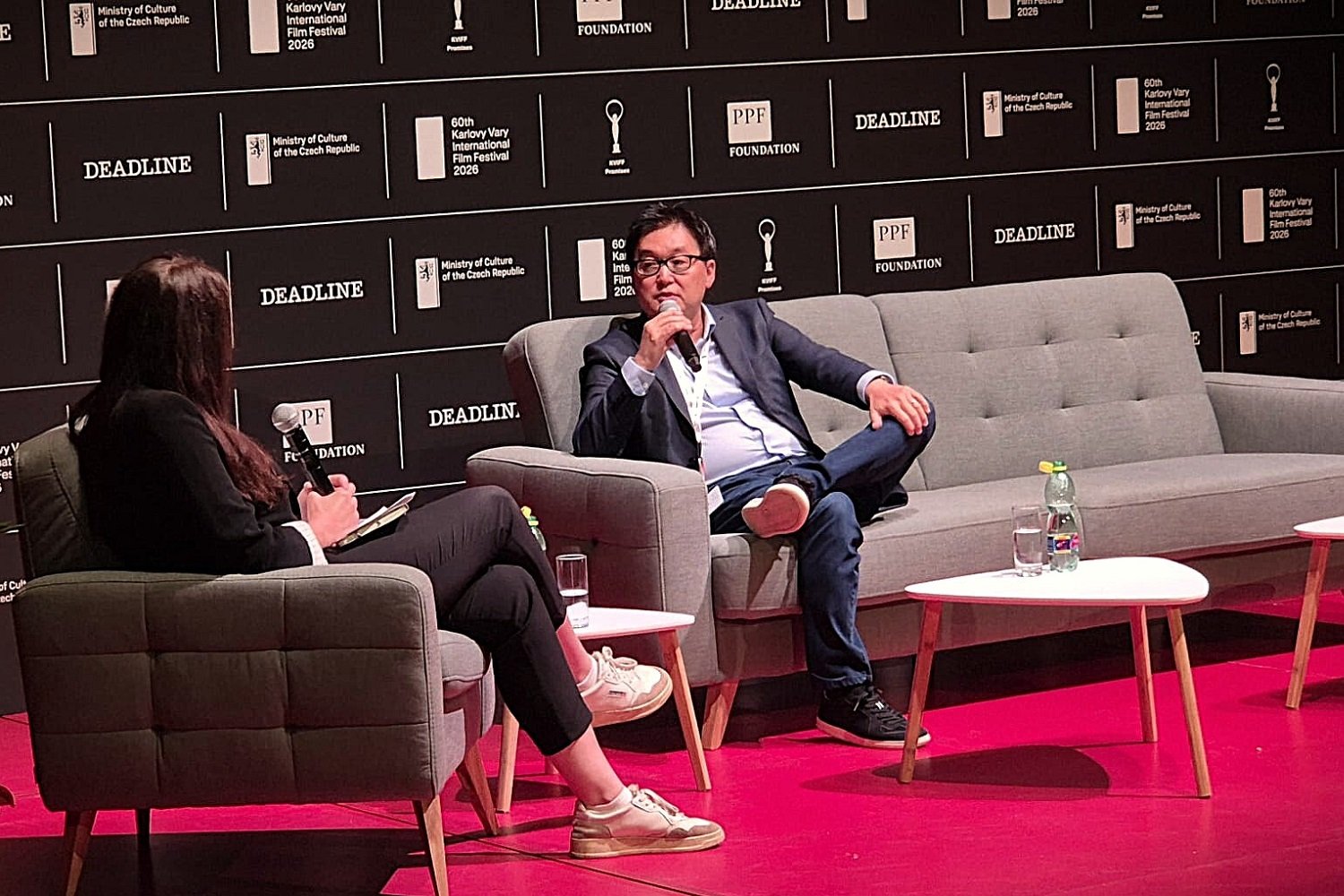
Diana Lodderhose and Kevin Chong during the talk
During Karlovy Vary’s KVIFF Industry fireside chat “The Next Studio: Building Stories in the Age of AI”, Kevin Chong, Chief Operations Officer of Utopai, set out the firm’s ambition to become what he described as an “AI-native studio”. The session, moderated by Deadline’s Diana Lodderhose, offered a rare window into how a young Silicon Valley-rooted company is trying to position itself inside the film business.
Utopai was founded around three and a half years ago by Cecilia Shen. Chong explained that the company began as an AI research outfit before moving, at the beginning of last year, towards commercialising its technology. Film, he said, quickly emerged as a natural focus because of what Utopai sees as a structural gap in the market.
“We found filmmaking to be a good area of focus,” Chong said, pointing to the decline of what he called the “missing middle market”: films in the $50 million to $200 million range that once formed a key part of Hollywood’s output. In his view, that segment was hit by several overlapping forces: the 2008 financial crisis, the collapse of the physical DVD market and the rise of streaming, which changed the economics of production and distribution. The result, he argued, is a polarised landscape in which the market is often split between very low-budget independent cinema and massive franchise productions.
For Utopai, the opportunity lies in helping filmmakers achieve the scale of those mid-to-high-budget films at much lower cost. “We didn’t start the company by asking, ‘How can we make AI movies?’” Chong said. “We started by asking, ‘How can we help storytellers make the best possible movies, and bigger ones?’”
Asked what differentiates Utopai from other companies entering the AI-film space, Chong stressed the company’s integrated structure. “We like to call [ourselves] an AI-native studio,” he said. “We have our own tech, our own production, and our own IP development. So we’re a full-stack studio.” Unlike traditional companies that may adopt AI as a VFX or post-production tool, he said Utopai tries to build technology into the process from day one, with engineers, writers, directors and actors working together.
The company is headquartered in Mountain View, California, with a team in Los Angeles, a production team in Spain, a recently acquired studio in Korea focused on IP development, activity in Japan around IP co-productions and anime, and a team in South America. Chong described Utopai as a company with both “Silicon Valley DNA and Hollywood DNA”, bringing together engineers from major tech firms and film professionals with studio backgrounds.
The company’s ambitions have also extended into sport. Lodderhose asked about Utopai’s recent investment from Carmelo Anthony’s Creative 7, and Chong said the company is also working with James Harden. This, he explained, forms part of a strategy to work with IP holders who may not previously have had the means to produce $100 million-scale films around their stories. “We want to reach as many storytellers as we can in that process, and sports is one of the areas we’re focusing on,” he said.
The conversation also addressed the scepticism surrounding AI in creative work. Chong said he had been surprised by the amount of optimism he had encountered among producers and directors over the past year. “I think a lot of the backlash is really coming from lack of understanding,” he pinpointed, adding that the industry needs more detailed conversations about what kind of AI is being used and how.
He was keen to draw a distinction between AI-assisted production and the replacement of human talent. According to Chong, all of Utopai’s feature-film and TV projects involve real writers, directors and actors. Even in animation, the company uses motion capture with real performers. “AI still doesn’t do acting very well,” he admitted, arguing that pacing and performance remain central to avoiding the “soulless” quality often associated with AI-generated content.
For live action, Chong said Utopai generally shoots performers physically, often on green screen, before blending that footage into AI-generated environments. In animation and photorealistic projects, some characters may be AI-generated, but their performances are still driven by human actors.
Utopai currently has around 25 projects in its pipeline, with three set to go into production this year and around three films due for release next year. Chong said the company’s first planned release, expected in February, is Korean-German arthouse film titled Half Moon. A larger period epic is also in the works, though he said details would be announced in the coming weeks.
On transparency, Chong said AI is already present in more films and TV shows than many viewers realise, and argued the industry should be clearer when it affects creative work. He cited IP clearance, fair compensation and accountability as essential safeguards. “AI is not making a movie,” he said. “The creative team is making a movie.”
Anime offered one of the clearest case studies. Chong said Utopai had expected resistance in Japan, but found producers and directors open to AI because demand is rising while animators are heavily booked. He stressed that the company’s process remains artist-led: storyboards, characters and key frames are hand-drawn, with AI assisting animation and refinement. “It’s really AI-assisted,” he said.
Chong also addressed concerns around IP protection. For each project, he said Utopai uses a separate instance of its model, ensuring that material developed for one client or studio is not made available to others. “We don’t take IPs or any assets from a project and then use that to train our model,” he said.
Asked where he would like the company to be in five years, Chong concluded: “Hopefully in five years, no one will be talking about AI movies. I hope they will just be talking about how great movies were made.”
