
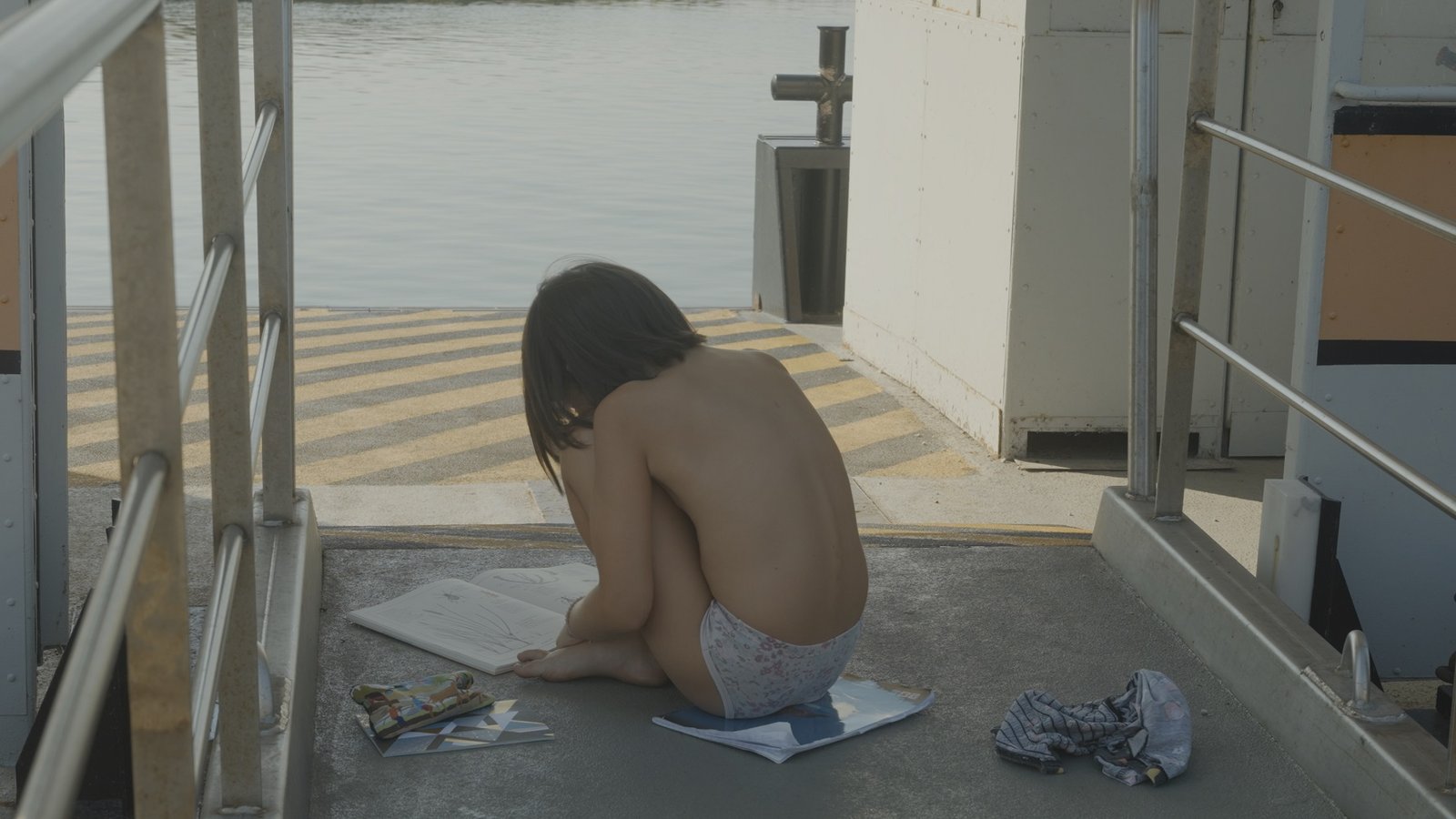
– Anna Marziano sets an intimate mother-daughter relationship – and a lawsuit asserting the right to environmental protection – against the backdrop of the Venice Lagoon which is under threat
As we build a world which is moving faster than our ability to listen to it, what kind of future are we handing down to our children? As growth consumes the planet, leaving murkier skies, frailer seasons and more exhausted lands in its wake, climate change no longer feels such a distant menace; instead, it casts its long shadow over each and every economic and political decision we make. It’s where these issues and our private lives collide, impacting the choices we make every day, that Anna Marziano positions her reflective work, Foam of Worlds, which came second to claim the Georges de Beauregard Award in FIDMarseille’s International Competition.
Antonia, played by photographer Laura Fantacuzzi, is a single-mother lawyer living with her daughter, Lena (Alea Lori Marziano), on the island of Sant’Erasmo in Venice. Stalling in a job where fewer and fewer clients can afford to pay fees, Antonia feels increasingly drawn to the wider legal battle to halt the climate crisis. As the radio reports on the arrest warrant issued by the International Criminal Court for Israeli Prime Minister Benjamin Netanyahu, who’s accused of war crimes and crimes against humanity, we witness a landmark victory for the KlimaSeniorinnen association: the European Court of Human Rights condemns Switzerland for violating the right to climate protection. Over the course of the film, we see the faces and hear the voices of real experts engaged in climate litigation – legal actions which demand governments or private companies respect the environment and the planet in terms of polluting emissions – including Professor of Comparative Constitutional Law and Climate Law Michele Carducci, a lawyer specialising in the protection of fundamental rights Sonia Sommacal, and Professor of Environmental Economics Carlo Giupponi, who’s based in Venice, the city most at risk from the rise in global sea-levels.
As a collective legal action is prepared, the viewer is introduced to typical legal concepts, such as a state’s sovereignty over its natural resources, which can’t be altered by international treaties, or the distinction the Strasbourg Court draws between climate mitigation, meaning the reduction of emissions; mitigation of the effects of climate change, meaning timely intervention around the causes of damaging effects; and adaptation, not to mention the notions of intergenerational equity and “future victim”.
Marziano, who oversaw the film’s cinematography with Armin Dierolf, captures the daily life of the mother and daughter, our two protagonists, immersing them in the briny haze of the Venetian lagoon, a cocooned atmosphere achieved by way of 16 mm stock and Rafael Toral’s music. As the camera lingers on the near-still waters of the canals, little Lena experiences her bond with the natural world around her with carefree serenity. The narrow Venetian streets, school, and time with her mother are all steeped in playfulness and tenderness. It’s no coincidence that the director shows Antonia reading Anne Dufourmantelle’s The Power of Gentleness, which defines this feeling as a secret transformative force which dispenses life, which affords power in relationships with others, and which can even turn pain into a creation promising relief and renewal.
Foam of Worlds was produced by the director herself in league with Flaneur Films (Germany) and Slingshot Films (Italy), the latter of which is also handling world sales.
(Translated from Italian)
