
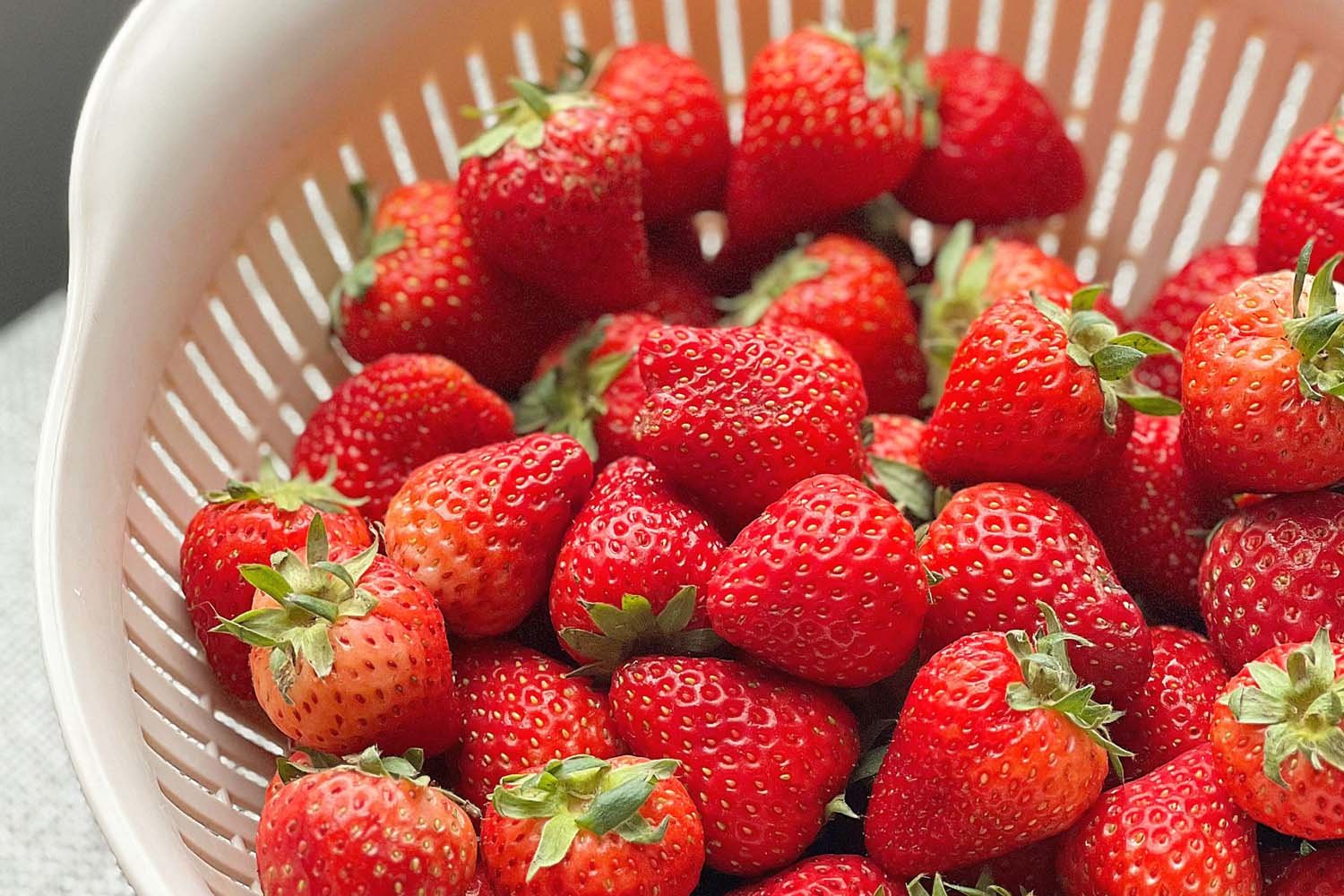
Most people rinse strawberries under cold water for a few seconds and consider the job done. That works. But there are two things worth knowing that most people do not: washing strawberries before storing them is one of the most common mistakes in produce handling, cutting shelf life significantly before you even start. And if pesticide residue is a concern, running water alone is not the most effective method available to you. Both are fixable with information you probably do not have yet.
How do you wash strawberries?
The short answer: Rinse strawberries under cool running water immediately before eating or using them, not when you bring them home. Do not remove the stem or hull before washing. Do not use soap, detergent, or commercial produce wash. For better pesticide removal, a baking soda soak (1 teaspoon per 2 cups of water, 12 to 15 minutes for most complete results) outperforms plain water, while a vinegar soak (1 part white vinegar to 3 parts water, 5 minutes) helps reduce surface bacteria and extend shelf life. Always dry thoroughly before refrigerating.
For how long strawberries last and how to store them after washing, see our companion post: how to store berries. For a complete produce storage reference, see our Food Storage Guide.
📋 How to Wash Strawberries: At a Glance
| When to wash | Immediately before eating, not on arrival |
| Basic method | Cool running water, 30 to 60 seconds |
| Best for pesticides | Baking soda soak (1 tsp per 2 cups water, 12-15 min) |
| Best for bacteria and shelf life | Vinegar soak (1:3 ratio, 5 minutes, rinse well) |
| Never use | Soap, detergent, or commercial produce wash |
| Hull removal | After washing, not before |
| Drying | Always dry before refrigerating |
🔑 Key Takeaways
- The FDA advises washing strawberries immediately before eating or using them, not when you first bring them home. Pre-washing introduces moisture that accelerates mold growth and can cut shelf life in half.
- Never remove the stem or hull before washing. Water and cleaning solutions enter the berry through the stem opening, diluting flavor, softening texture, and washing away nutrients.
- Do not use soap, dish detergent, or commercial produce wash on strawberries. The FDA explicitly advises against this: these products can be absorbed into the porous fruit and are not intended for internal consumption.
- Baking soda is among the most effective home methods for removing surface pesticide residues. A 2017 study in the Journal of Agricultural and Food Chemistry (UMass Amherst) found baking soda solution outperformed both plain water and bleach for pesticide removal from apple surfaces, with the lead researcher noting the method is applicable to other fruits. The study found 12 to 15 minutes of soaking achieved the most complete surface removal.
- Strawberries appear on the Environmental Working Group’s Dirty Dozen list every year, meaning they are among the conventionally grown produce items most likely to carry detectable pesticide residues. If pesticide reduction matters to you, the baking soda method is worth the extra 5 minutes.
- A vinegar soak helps kill surface mold spores and bacteria, which is why strawberries washed with vinegar (and dried thoroughly) often last longer in the refrigerator than those rinsed with water alone, though the exact extension varies by storage conditions and berry freshness at the time of washing.
The Most Common Strawberry Washing Mistake
Most people wash strawberries when they get home from the grocery store, put them in a container, and refrigerate them. This is the single most effective way to shorten their already short shelf life. Strawberries last only 2 to 3 days when washed before storage because the moisture introduced during washing softens the skin, creates an environment where mold spores can germinate, and accelerates breakdown of the fruit’s structure. For the full breakdown on why and how to extend that window, see our guide on how to store berries and our post on foods that go bad faster than you think, where raspberries and blackberries top the list.
The FDA and most produce food scientists recommend the opposite approach: store strawberries unwashed, and wash them only immediately before you eat them or use them in a recipe. This is the same reason you should not wash lettuce, carrots, or cucumbers before storing them.
⚠️ The One Exception
If you plan to use the vinegar wash method (described below), there is a case for washing at home before refrigerating: vinegar kills mold spores that are already on the berry surface, and properly dried vinegar-washed strawberries can actually last longer than unwashed ones. The key word is dried. Any method that leaves moisture on the berries before refrigerating accelerates spoilage. If you wash at home, dry completely with paper towels before storing.
Method 1: Plain Water Rinse (Fastest, Good for Basic Cleaning)
The simplest method is sufficient for removing visible dirt and most surface bacteria when you are eating the berries immediately.
✅ How to Do It
- Place strawberries in a colander with the stems still attached.
- Run cool water over them for 30 to 60 seconds, gently turning them with your hand so all surfaces are rinsed.
- Transfer to a clean paper towel and pat dry, or let air-dry on a clean kitchen towel for a few minutes.
- Hull or slice only after drying.
The FDA recommends rubbing gently under running water rather than soaking for quick cleaning, as soaking allows water to be absorbed into the berry through the stem opening and can waterlog the flesh.
Method 2: Baking Soda Soak (Best for Pesticide Reduction)
Strawberries appear on the Environmental Working Group’s Dirty Dozen list every year. They have thin skin and grow close to the ground, which makes them more likely to carry surface pesticide residues than many other fruits. If pesticide reduction is your goal, the baking soda method is the most effective home option available.
A 2017 study published in the Journal of Agricultural and Food Chemistry by researchers at the University of Massachusetts Amherst found that a baking soda solution was significantly more effective at removing surface pesticide residues than either plain water or a bleach solution. That study was conducted on apples, not strawberries specifically. However, the lead researcher, Lili He, described the baking soda method as a general approach applicable to other fruits and vegetables, because the mechanism is chemical rather than fruit-specific: baking soda is mildly alkaline (pH 8 to 9), and most surface pesticides are not stable in alkaline conditions, causing them to break down and rinse away more effectively. The same principle applies to apple cider vinegar’s effectiveness in produce cleaning: its acidity attacks different classes of surface contaminants.
✅ How to Do It
- Fill a large bowl with 2 cups of cool water.
- Add 1 teaspoon of baking soda and stir until dissolved.
- Add strawberries with stems attached and soak for 12 to 15 minutes. The UMass study found that 12 to 15 minutes was the point at which the two tested pesticides were fully removed from the surface. A shorter soak still outperforms plain water but provides less complete removal.
- Lift out and rinse thoroughly under cool running water to remove any baking soda taste.
- Pat dry completely with paper towels before eating or storing.
Ratio: 1 teaspoon baking soda per 2 cups water. Scale up proportionally for larger batches.
Time: 12 to 15 minutes for maximum surface pesticide removal. A 5-minute soak still outperforms plain water but does not achieve complete removal of the pesticide types tested in the research.
🔬 Important Limitation
The baking soda method removes surface pesticide residues effectively. It does not remove systemic pesticides that have been absorbed into the fruit flesh, because no washing method can reach those. The UMass study found that one of the tested pesticides (thiabendazole) had partially penetrated the apple flesh after 24 hours of exposure and could not be fully removed by any surface wash. Buying organic eliminates this concern entirely. For conventionally grown strawberries, the baking soda method is the best available option but is not a complete solution for all pesticide types.
Method 3: Vinegar Soak (Best for Bacteria Reduction and Shelf Life)
A diluted vinegar wash helps remove surface bacteria and mold spores from strawberries. Changmou Xu, assistant professor of food processing at the University of Illinois Urbana-Champaign, recommends vinegar as a food-safe, accessible method with natural antibacterial properties. The acetic acid in white vinegar creates an inhospitable environment for surface microorganisms including the mold spores that cause strawberries to go fuzzy.
The shelf life benefit is real: strawberries washed in a vinegar solution and dried thoroughly before refrigerating typically last longer than water-rinsed berries because mold spores on the surface have been killed before storage. For a practical breakdown of strawberry storage and shelf life, see our how to store berries guide. Extra strawberries are also perfect in our mixed berry smoothie or frozen for later use.
✅ How to Do It
- Fill a large bowl with 3 cups cool water and 1 cup distilled white vinegar.
- Add strawberries with stems attached.
- Soak for 5 minutes. Do not exceed 10 minutes as longer soaking can begin to affect texture.
- Lift out and rinse thoroughly under cool running water. This step is critical: without thorough rinsing, berries may retain a faint vinegar flavor.
- Spread on a clean paper towel-lined tray and pat dry. Let air dry completely before refrigerating.
- Store in a paper towel-lined container in the refrigerator.
Ratio: 1 part white vinegar to 3 parts water. Use distilled white vinegar with 5% acidity. Do not use apple cider vinegar: its sugars and variable acidity can encourage microbial growth and leave an off-flavor on delicate berries.
Method 4: Salt Water Soak (Best for Removing Bugs)
A salt water soak is particularly useful for farmers market or garden-fresh strawberries that may harbor small insects or debris in the surface texture. Salt draws out tiny bugs that can be difficult to see or remove with plain water rinsing.
✅ How to Do It
- Fill a bowl with 2 cups of cool water and dissolve 1 teaspoon of salt.
- Add strawberries with stems attached and soak for 5 minutes.
- You may notice small bugs floating to the surface. This is normal and is the point of the method.
- Rinse thoroughly under cool running water to remove salt residue.
- Pat dry before eating or storing.
What Not to Do When Washing Strawberries
⚠️ What to Avoid
- Do not use soap or dish detergent. The FDA explicitly advises against washing produce with soap, detergent, or commercial produce wash. These products are not intended for internal consumption, can be absorbed into the porous berry, and may leave residues that cause illness. Water and the methods above are all you need.
- Do not hull or slice before washing. Removing the stem before washing allows water and any cleaning solution to flow directly into the berry’s interior, waterlogging the flesh, washing out flavor compounds, and introducing potential contaminants into the cut surface. Always wash first, hull after.
- Do not wash before storing. Unless using the vinegar method with thorough drying, wash immediately before eating. Pre-washed, undried strawberries in the refrigerator go moldy significantly faster.
- Do not use hot water. Hot water begins to break down the delicate cellular structure of strawberries and accelerates softening. Always use cool or cold water.
- Do not scrub with a brush. Strawberry skin is too fragile for a produce brush. Gentle rubbing with fingers under running water is sufficient and does not damage the berry.
- Do not use commercial produce washes. The FDA has not recommended commercial produce wash products because their effectiveness has not been comprehensively tested. The home methods above are supported by peer-reviewed food science research.
Strawberries and the Dirty Dozen
Strawberries have ranked at or near the top of the Environmental Working Group’s Dirty Dozen list for multiple consecutive years, meaning they are among the conventionally grown produce items most likely to contain detectable pesticide residues based on USDA testing data. The EWG’s 2025 analysis confirmed strawberries remain one of the highest-residue fruits available in US grocery stores.
This does not mean conventionally grown strawberries are dangerous to eat. The USDA and FDA both note that pesticide residues on produce are typically well below established safety thresholds. But if reducing pesticide exposure is a priority, strawberries are one of the items where it makes the most sense to either buy organic or use the baking soda wash method.
How to Wash Strawberries for Specific Uses
For storing several days ahead: Vinegar soak (1:3 ratio, 5 minutes), thorough rinse, complete drying, paper towel-lined container in the refrigerator. This method extends shelf life significantly over plain water rinsing.
For baking or cooking: Plain water rinse is sufficient. Pesticide residues on the surface are largely destroyed at baking temperatures, and the texture change from soaking is less relevant when berries are being cooked down. Hull after rinsing.
For farmers market or garden strawberries: Salt water soak first to remove insects, followed by a thorough rinse. Vinegar soak optional if planning to store. These strawberries often have no commercial pesticide treatment but may carry more natural soil and surface debris than grocery store berries.
Frequently Asked Questions
How do you wash strawberries?
Place strawberries with stems attached in a colander and rinse under cool running water for 30 to 60 seconds, gently turning them so all surfaces are rinsed. Pat dry with a paper towel and hull after washing. For better pesticide removal, use a baking soda soak (1 tsp per 2 cups water, 5 minutes, rinse well). For better bacteria reduction and longer shelf life, use a vinegar soak (1 part white vinegar to 3 parts water, 5 minutes, rinse thoroughly, dry completely).
No, unless you are using the vinegar method and drying them completely before refrigerating. The FDA advises washing produce immediately before eating, not at the time of purchase. Pre-washing introduces moisture that softens the skin and allows mold spores to germinate, cutting shelf life significantly. Store unwashed in a paper towel-lined container in the refrigerator and wash only when you are ready to eat them. See how to store berries for full storage guidance.
Does washing strawberries with vinegar work?
Yes. A vinegar and water solution (1 part white vinegar to 3 parts water) helps kill surface bacteria and mold spores, which is why vinegar-washed strawberries that are dried thoroughly before refrigerating often last longer than water-rinsed berries. Changmou Xu, assistant professor of food processing at the University of Illinois Urbana-Champaign, confirms vinegar is safe, food-grade, and has documented antibacterial properties. The key steps are thorough rinsing after the soak (to remove any vinegar flavor) and complete drying before refrigerating.
Does baking soda remove pesticides from strawberries?
Better than plain water, yes. A 2017 study in the Journal of Agricultural and Food Chemistry found baking soda solution outperformed both plain water and bleach for removing surface pesticide residues. That study used apples; however, the lead researcher Lili He described the baking soda method as generally applicable to other produce. Use 1 teaspoon of baking soda per 2 cups of water and soak for 12 to 15 minutes for the most complete surface removal, then rinse thoroughly. The baking soda is mildly alkaline and breaks down many common pesticide compounds. A shorter soak still outperforms plain water. Neither baking soda nor any other method can remove systemic pesticides absorbed into the fruit flesh.
Can you wash strawberries with salt water?
Yes. A salt water soak (1 teaspoon per 2 cups water, 5 minutes) is particularly useful for removing tiny insects and debris from the surface of farmers market or garden strawberries. Rinse thoroughly afterward to remove salt residue. The salt water method is best for insect removal rather than pesticide or bacterial reduction: for those goals, baking soda and vinegar are both more effective than plain water, though the relative performance between baking soda and vinegar for pesticide removal varies by pesticide class.
Should you remove the stem before or after washing strawberries?
Always after washing. Removing the stem before washing creates an opening where water and any cleaning solution can flow directly into the berry’s interior, waterlogging the flesh and diluting flavor. Wash with stems intact, then hull immediately before eating or using in a recipe.
Can you use dish soap to wash strawberries?
No. The FDA explicitly advises against washing produce with soap, detergent, or commercial produce wash. These products are not intended for consumption and can be absorbed into porous fruits like strawberries. Water-based methods (plain rinse, baking soda soak, vinegar soak) are all you need and are supported by food safety authorities.
Washed and undried strawberries stored in the refrigerator last 1 to 2 days before deteriorating. Washed, thoroughly dried, and stored in a paper towel-lined container: 3 to 5 days. Vinegar-washed, thoroughly dried, and properly stored: longer than plain water-washed, exact duration varies by berry freshness and storage conditions. Unwashed strawberries stored correctly last 5 to 7 days. The best practice is to store unwashed and wash only before eating. See how to store berries for full guidance.
Are strawberries on the Dirty Dozen list?
Yes, consistently. Strawberries have ranked at or near the top of the Environmental Working Group’s Dirty Dozen list for multiple consecutive years based on USDA pesticide testing data. This means they are among the conventionally grown produce items most likely to carry detectable surface pesticide residues. The USDA and FDA note that residue levels are generally below established safety thresholds, but if minimizing pesticide exposure is a priority, buying organic or using the baking soda wash method are the most effective approaches.
If you need washed and ready strawberries ahead of time, use the vinegar soak method (1:3 vinegar to water, 5 minutes), rinse very thoroughly, and then dry completely with paper towels. Line a storage container with paper towels and spread the dry berries in a single layer. Refrigerate for up to 24 hours before serving. Do not hull until ready to serve: hulled berries dry out faster and lose visual appeal. For larger party quantities, the mixed berry presentation in our mixed berry smoothie works well as a make-ahead element.
Does rinsing strawberries with water remove pesticides?
Plain water removes some surface pesticide residues, particularly those that are water-soluble and sitting on the outer surface. Changmou Xu of the University of Illinois Urbana-Champaign notes that running water is “a pretty effective way to remove dirt and some pesticides, but it may not eliminate all residues.” For better pesticide removal, the baking soda method (1 tsp per 2 cups water, 12 to 15 minute soak for best results, thorough rinse) outperforms plain water significantly, based on a 2017 peer-reviewed study in the Journal of Agricultural and Food Chemistry. That study was conducted on apples, and the lead researcher indicated the approach is applicable to other produce. Neither method can remove systemic pesticides absorbed into the fruit flesh.
Further Reading
Better Living may earn commissions through affiliate links and may occasionally feature sponsored or partner content. If you make a purchase through our links, we may receive a small commission at no cost to you.
