
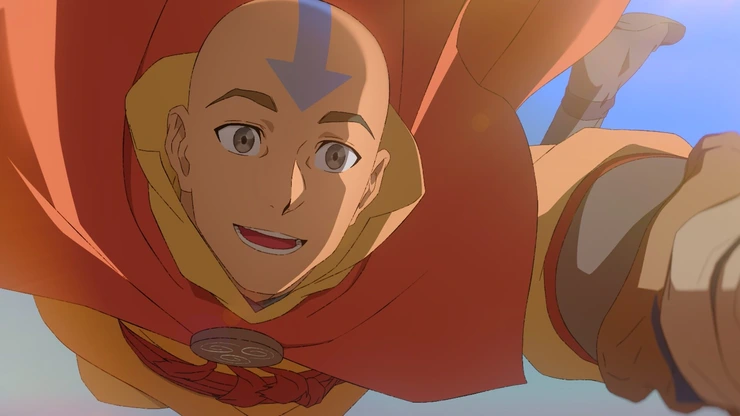
For fans of The Last Airbender, its first animated theatrical release would be momentous. 2010’s live-action offering from M. Night Shyamalan left a poor taste, and for a while, it seemed the franchise was destined for the small screen forever. So, when Avatar Aang: The Last Airbender was first announced in 2021, even the most sceptical fan tuned in.
The film is the first from Avatar Studios, a new division of Nickelodeon entirely dedicated to The Last Airbender. Unfortunately, Avatar Aang faced numerous delays, likely due to an online leak in April 2026, which may also have led to the film’s theatrical run being cancelled. Instead, it found a home directly on Paramount+.
Although such controversy could be considered a bad omen, Avatar Aang manages to pull through as a rather enjoyable film. Bolstered by stellar animation and delightful callbacks to the original series, this sequel picks up thirteen years after the end of the Hundred-Year War. Now an adult, Aang (Eric Nam) embarks on a global quest to discover an ancient power that could save his culture, the Airbenders, from extinction.
Franchise veterans will be aware of the series’ vast, quite complicated lore, but the film uses clever techniques in an effort to make it entirely accessible to a first-time viewer. Flashbacks and backstories take up entire scenes, filling in the gaps for Avatar newbies, seemingly condensing three entire seasons of television. It works, mostly. Whilst the film does achieve its goal of being understandable, the pacing can sometimes feel hindered by constant gap-fillers for stories once told.
However, the film’s major strength is its visuals. The seamless blend of 2D and 3D animation gives Avatar Aang an immediate sense of depth. Made vibrant with colour and movement, each location truly does feel alive. With a focus on the four elements, it’s no surprise how crucial environments are to the narrative. Wherever Aang is, he feels tested both mentally and physically. Creative choreography gives forests, deserts and mountains character, perhaps a symbolic nod to Aang’s inner conflict. The action sequences as a whole feel incredibly large-scale, and the lack of theatrical presence stings the most here. Each fight scene feels like a grand finale, only to up the stakes by the next.
Aang himself feels as charmingly boyish as ever, despite his adult body. The chemistry with Katara (Jessica Matten), Sokka (Román Zaragoza) and Zuko (Steven Yeun) is very much alive. Little humorous quips provide levity and remind fans of how endearing these characters are. Tagah (Dave Bautista), an Airbender discovered by Aang, adds an intriguing dynamic to the group. It’s a shame that the dialogue, like most animated features, feels a little overdone. The exposition is often heavy-handed. Some lines feel unnecessary when the film’s visuals so gorgeously capture what’s going on.
Avatar Aang, although marketed for a younger audience, deals with some quite serious themes. Issues like diversity are brought up with the presence of all four Bender groups living in harmony. Further, the inner battle within Aang himself is incredibly layered. The character has a clear motive: to redeem himself. The narrative lends Aang the opportunity, even if the plot itself feels a little simplistic.
Ultimately, Avatar Aang is a pleasing viewing experience. The action and animation go hand-in-hand in warranting an entire studio committed to the franchise. Whilst the dialogue and elementary plot hold the film back, it carries enough quirk and excitement to satisfy its legion of fans. If only the film could’ve been brought to more than just two cinemas worldwide. The only way from here is up.
On Paramount+ now / Eric Nam, Dave Bautista, Jessica Matten, Román Zaragoza, Dionne Quan, Taika Waititi, Geraldine Viswanathan, Steven Yeun, Ke Huy Quan / Dir: Lauren Montgomery / 12A
Discover more from
Subscribe to get the latest posts sent to your email.

