
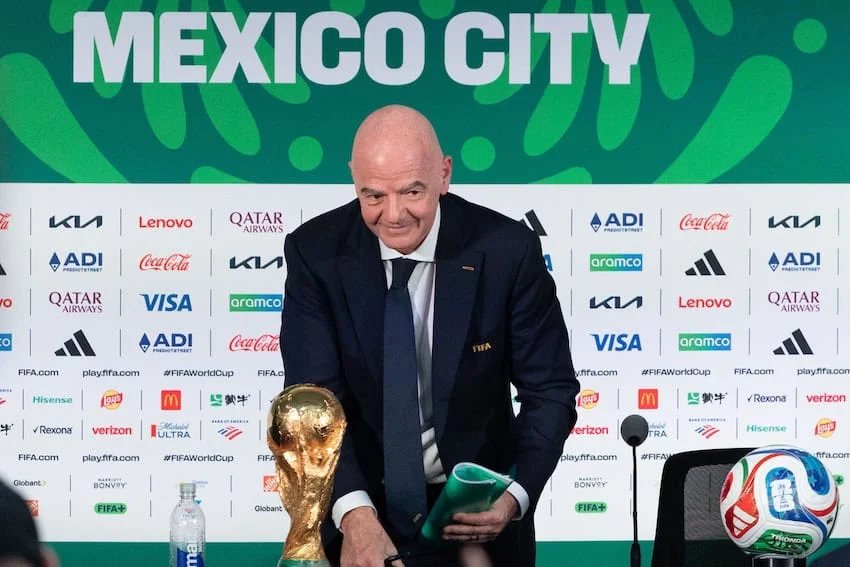
The Mexican Football Federation (FMF) is breaking ranks with its fellow soccer federations in the United States and Canada by refusing — for now — to reject FIFA’s plan to bring private investors into the World Cup’s commercial rights.
While the plan being pushed by FIFA President Gianni Infantino has drawn ire worldwide, the FMF said on social media it is undertaking a “process of study and analysis to make the decision that best suits the development of Mexican soccer,” without endorsing Concacaf’s swift rejection.
VIDEO | ⚽️ Infantino asegura que la creación de la filial comercial (FFE) es “una oportunidad para crecer” que podría elevar hasta 40M$ la ayuda a cada federación. pic.twitter.com/f7fLnCt91N
— EFE Deportes (@EFEdeportes) July 30, 2026
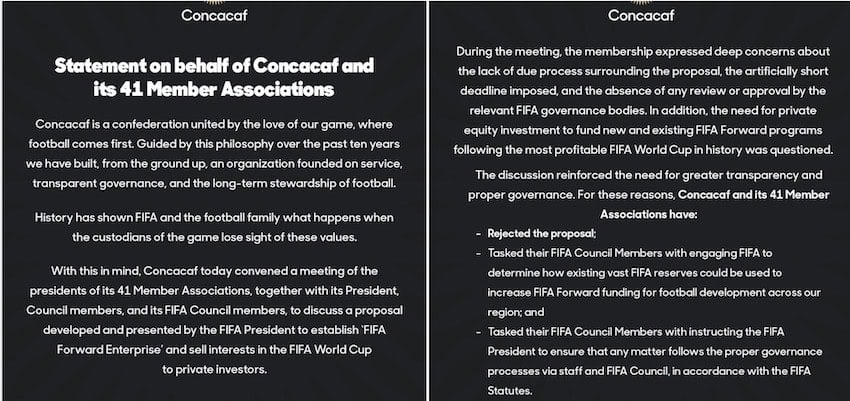
Concacaf, the Confederation of North, Central America and Caribbean Association Football, held an urgent meeting this week in which the presidents of its 41 member associations “rejected the proposal” and voiced “deep concerns” about “the lack of due process” and an “artificially short deadline.”
Concacaf includes Mexico, the U.S. and Canada, the co-hosts of the recently completed 2026 FIFA World Cup. The rejection of the proposal was supported by the U.S. and Canada.
The regional confederation questioned why private equity is needed after “the most profitable FIFA World Cup in history” and pointed to FIFA’s “billions of dollars in reserves and no debt.”
The project Infantino is promoting calls for the creation of FIFA Forward Enterprise (FFE), a commercial subsidiary that would run events such as the World Cup and Club World Cup and sell minority, non‑controlling stakes to outside investors on a $20 billion valuation.
FIFA says FFE would raise up to $4.2 billion by working with J.P. Morgan and long‑term investors including Thrive Capital, an investment firm created by Joshua Kushner, brother of President Donald Trump’s son‑in‑law Jared Kushner.
The 211 member federations are being offered a one‑time $20 million payment plus a jump in regular FIFA Forward development funding from $8 million to $20 million for the 2027‑30 cycle, with further increases later.
FIFA says the additional money would support infrastructure, coaching, national teams, competitions, and women’s and grassroots soccer.
In a clarification posted on X, FIFA said “nobody is selling football” and argued that FFE would remain fully owned and controlled by FIFA, with governance and the global match calendar unchanged.
The backlash has been swift. The 55 member associations of the Union of European Football Associations (UEFA) voted unanimously to boycott the World Cup and all FIFA competitions if the project goes ahead.
UEFA said football “is not FIFA’s to sell” and warned that “the soul and governance of football are not assets to trade — especially with zero transparency as to who gains financially.”
In its vote Thursday, Concacaf cited the absence of any review by FIFA’s own governance bodies, but stopped short of threatening a boycott.
It tasked its FIFA Council members with pushing FIFA to tap existing reserves instead and to run any future plan through proper procedures under the FIFA statutes.
FIFA has promised to open working groups so federations can review more details before a Sept. 19 deadline, leaving Mexico to weigh whether to join with its confederation’s stance or support the proposal.
On Friday, the story took some more turns. Infantino’s senior adviser, Carlos Cordeiro, resigned, saying “I cannot stand by while FIFA considers selling a stake in the World Cup” and calling the $20 billion commercial subsidiary “a bad deal for soccer.”
In a separate statement, FIFA chief operating officer Kevin Lamour said staff had been “deceived” by Infantino’s lack of openness and argued the plan is “the project of one person” that “must not go ahead.”
With reports from Mediotiempo, ESPN Deportes, TUDN, Proceso and Associated Press
