
This story idea came from audience members, like you, who got in touch with us. Send us all of your questions about data centres and the environment. We are listening: ask@cbc.ca
In 2026, AI seems to be everywhere — and some Canadians are questioning whether they want the massive buildings that power it humming away in their backyards.
Canada has bet big on AI, and part of that push is a boom in planned or proposed AI data centres, which require vast amounts of water and energy.
Proponents say the facilities could help secure Canada’s future as an AI leader. But the rapid pace of development has some communities hitting pause. In Ontario, Oakville voted in August to impose a one-year moratorium on data centre construction, while Mississauga is set to vote in September on a similar moratorium. Councillors there brought forward the motion after a data centre the size of three football fields was proposed.
On Thursday and Friday, hundreds of people turned up at town halls to demand answers from Alberta’s technology minister over the province’s plans for AI data centres.
Many CBC readers have also reached out with questions about the sudden spike in data centres being built in Canada.
Here’s what we know.
What are data centres?
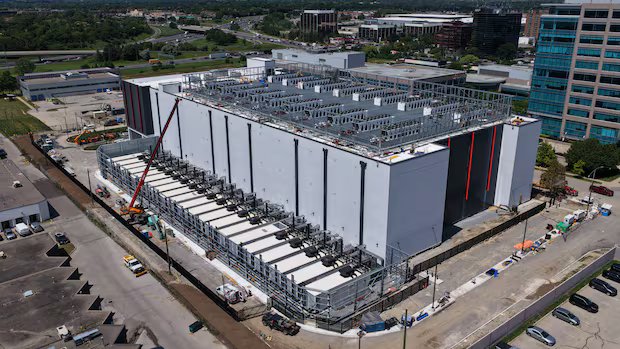
A data centre is a facility that houses and powers computer servers, networking equipment and other technology needed for computing and storing data. Any time we visit a website or watch a movie online, a physical server processes that request for us.
But the AI data centres making headlines today are much larger and more energy-intensive than traditional data centres. They use more powerful computer chips — graphic processing units, or GPUs — driving up energy consumption and requiring more intensive cooling systems to manage the resulting heat.
“For an older style conventional cloud facility, we might have a couple of megawatts moving into that building, but for AI facilities, it’s much more common to see hundreds of megawatts,” Anne Pasek, Canada Research Chair in Media, Culture and the Environment at Trent University, told CBC News.
These facilities can span thousands of square feet, with “hyperscale” data centres becoming more common. Definitions of hyperscale vary: some place the threshold at 50 megawatts, others at 100. Just 50 megawatts is enough electricity to power 37,500 homes.

“The facilities we’re building for AI are just bigger and bigger, both in terms of the footprint that they have in the lands they occupy, in terms of the energy bills and water impacts that potentially come with them,” Pasek said.
Why are so many being built in Canada suddenly?
Demand for AI has skyrocketed in recent years, and Canada is looking to establish itself as a leader in the field, hoping to attract investors and give the economy a boost.
In 2024, up to $700 million was dedicated specifically to leveraging investments in new or expanded data centres.
Prime Minister Mark Carney unveiled Canada’s national AI strategy in June, dubbed “AI for All,” promising at least $2 billion in new investments. One stated goal is to increase AI adoption among Canadian businesses from 12 per cent today to 60 per cent by 2034.

Prime Minister Mark Carney unveiled the government’s long-delayed strategy on artificial intelligence, pledging 250,000 AI-related jobs and billions for training programs, but little in the way of privacy and safety details.
Supporters say wider AI adoption is inevitable and Canada is better off staying ahead than being left behind.
“It’s a facet of modern life,” Martin Karsten, a professor of computer science at the University of Waterloo, told CBC News Kitchener-Waterloo on Aug. 18. “As long as we are all very interested in using these [AI] services, I think we have to accept the fact that these data centres keep coming.”
But many communities are pushing back, citing concerns about water, energy and health. Critics also question whether data centres bring enough local economic benefits to offset those concerns, saying they provide a temporary boost in construction jobs but do little to spur secondary industries.
Some experts have warned that the rush to fund AI could be a bubble that could burst, potentially leaving AI data centres as stranded assets. Some companies that embraced AI are now pulling back in the face of rising costs, raising questions about the technology’s return on investment.
Canada currently has only five hyperscale data centres with a capacity of at least 50 megawatts, but 159 facilities were proposed or under construction across the country as of July, according to a recent York University study. Of those, 116 are expected to have a capacity of more than 100 megawatt capacity — a first in Canada.
The study found the scale of the industry is ramping up rapidly. Over 200 new projects have been announced, with an average capacity of 122 megawatts — more than ten times the average capacity of Canada’s 194 active sites.
While most active data centres are in Ontario, followed by Quebec and British Columbia respectively, the majority of proposed projects are in Alberta. If all are built, Alberta’s share of total data centre capacity in Canada would rise from three per cent to 93 per cent.
“If you look at the location of the data centres, we can see that the amount of electricity that the average new data center would use is as much as some of the communities where they’re going to be located in,” Alexander Carlo, a postdoctoral researcher at York University’s Schulich School of Business and one of the study’s authors, told CBC News.
Data centres accounted for 4.4 per cent of U.S. electricity demand in 2023, according to the U.S. Department of Energy, which predicts this share could rise as high as 12 per cent by 2028.
During a heat wave or snowstorm, electrical grids may struggle to handle the added load from a data centre, Pasek said, increasing the risk of brownouts. There are also concerns that the additional strain could increase consumers’ power bills.

A boom in hyperscale AI data centres in Canada is coming, promising economic opportunity and tech sovereignty, but as CBC’s Nora Young explains, there’s a growing resistance to the impact the massive, power-hungry facilities have on local communities.
How do data centres affect water sources?
Computing equipment generates a lot of heat, so facilities use water to cool it. Many cooling systems then evaporate that water to expel the heat, meaning it may not return to the water cycle in the same place.
“They can pull water from a watershed, that water can evaporate off, become a cloud, that cloud will float away, and will become rain in a totally different region where that water doesn’t get returned to the [original region’s] watershed,” Pasek said.
Smaller-scale operations can draw tens of thousands of litres a day, while hyperscale operations can draw more than a million.
A 2025 report by the U.K. Government Digital Sustainability Alliance found that a single 100-megawatt hyperscale facility could consume about 2.5 billion litres of water annually — enough to serve 80,000 people.
Some areas can absorb that demand, but in a drought-stricken regions, it could pose a problem.
“We are already water bankrupt in many places around the world. So adding an extra pressure on the system, even if it’s small, can have significant impacts,” Kaveh Madani, director of the United Nations University Institute for Water, Environment and Health, told CBC News in August.

As resistance to AI data centres grows, industry leaders say there are ways to build more community-friendly facilities. For Radio-Canada, Anaïs Elboujdaïni examines the water concerns and explores the arguments for a more sustainable approach in Canada.
Ontario Premier Doug Ford said in August that the province’s data centre framework would prioritize closed-loop cooling systems, which reuse water and cut down on intake compared to evaporative systems.
Are there health risks with living near data centres?
Experts say there can be, but the risks vary depending on the data centre’s size, design and power source, meaning that different data centres can carry vastly different risks.
Air pollution
Data centres can draw electricity from local grids, but it can take years to fully connect them. As a result, many are now being designed with on-site power plants fuelled by natural gas or methane gas. When powered by fossil fuels, data centres produce emissions that contribute to climate change as well as a type of air pollution called fine particulate matter, also known as PM2.5.

“We do know that exposure to fine particulate matter increases the risk of all kinds of [negative] health outcomes, from respiratory, cardiovascular and neurocognitive,” Francesca Dominici, a professor of biostatistics at Harvard Chan School of Public Health, told CBC News. She added that chronic exposure to air pollution can also increase annual hospital visits and worsen asthma.
An independent analysis she worked on with EmPower Analytics Group examined a specific AI data centre steps from a residential area in Northern Virginia and found its eight natural gas turbines and 51 diesel generators could result in $53 million to $99 million US a year in health-related damages.
Studies have suggested that chronic exposure to PM2.5 may also be linked to a higher risk of lung cancer.
Noise pollution
Like other industrial buildings, data centres produce noise around the clock from fans and backup diesel generators. They can also emit a low-frequency hum, and chronic exposure can cause stress, sleep problems and long-term health complications, Dominici said.
According to NBC News, residents have filed at least 15 lawsuits in 12 U.S. states over constant data centre noise in the past three years.

Some Toronto councillors and residents are pushing back against two proposed data centre projects in Etobicoke and Scarborough. As CBC’s Naama Weingarten explains, they are concerned about potential noise, electricity demand and water use.
Concerns have also been raised that closed-loop cooling systems could affect water quality if wastewater is mismanaged. Much remains unknown about the overall risks, Dominici said, which is why she believes development should be paused to give researchers more time.
“There has been a race to build these AI hyperscalers without really thinking through about what could potentially be the negative health impact on the surrounding community,” Dominici said.
Are there alternatives to traditional big-box data centers?
Experts say it’s a question of trade-offs. One option is to make data centres more sustainable.
The health risks associated with air pollution, for example, can be mitigated if a data centre and its backup power systems use wind and solar instead of fossil fuels.
“If you could make the facilities optimally efficient and power them with renewable energy, either in the moment or stored in batteries or other types of storage, we’d be making some real progress there,” Daniel Bresette, president of the U.S.-based Environmental and Energy Study Institute, told CBC News.
But that approach is more expensive, meaning developers may have little incentive to adopt it without regulations or community pressure. Most new projects in Alberta are set to use natural gas, including a $13-billion AI data centre project announced by Meta last month.

Reducing noise pollution through design can also be costly. Some regions in the U.S. are introducing zoning restrictions based on noise pollution and requiring developers to conduct noise studies before construction.
Locating AI data centres in more remote areas can also reduce risks to the general population, but it could shift those impacts onto rural and Indigenous communities.
A proposed $70-billion gas-powered data centre in northern Alberta is currently being challenged by nearby Sturgeon Lake Cree Nation, which says it was not properly consulted about a water license.

The United Nations University Institute for Water, Environment and Health has released a report that examines the environmental impacts of AI data centres. It comes as Prime Minister Mark Carney unveiled his new AI strategy that includes plans for ‘large-scale’ data centres throughout the country.
Another option is to spread AI computing capacity more broadly rather than hyperscaling it, Pasek said, in order to “break up the burden” on communities.
The third option is to “rethink fundamentally what we want AI to be,” she said. This could mean a return to smaller, open-source development rather than massive AI projects that, in her view, are profitable only if the technology is pushed onto businesses and Canadians.
