
Mexico spent the week of June 29 to July 3 living through one of its most emotional moments in decades. El Tri’s win over Ecuador didn’t just end a 40-year World Cup curse — the celebration inside Mexico City Stadium was so intense that it triggered seismographs normally used to monitor earthquakes.
Out in the streets, crowd sizes swelled with every match, and the optimism — branded with the coy slogan “¿Y si sí? (What if, yes?) — is contagious. But the week wasn’t only about soccer. Washington delivered an unwelcome message on the USMCA, two new political parties won certification and fresh numbers emerged on Pemex, the peso and President Sheinbaum.
Didn’t have time to catch this week’s top stories? Here’s what you missed.
USMCA hits a roadblock, but remains in force
The United States announced on July 1 that it would not renew the USMCA for another 16 years, as Mexico had hoped, with U.S. Trade Representative Jamieson Greer saying Washington wouldn’t accept the pact “in its current form.”
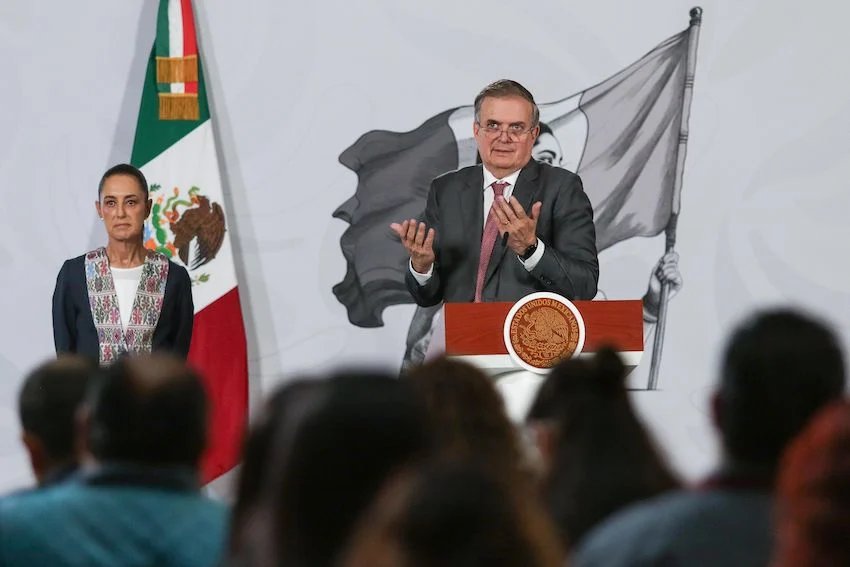
That triggers a process of annual reviews through 2036 rather than an automatic extension. Economy Minister Marcelo Ebrard was quick to reassure Mexicans the following day, telling reporters the treaty “remains in force from now until 2036,” even though the U.S. rejected Mexico and Canada’s push to extend it to 2042. Ebrard said Mexico’s priority in a third round of bilateral talks, set for July 20, will be reducing Section 232 tariffs on steel, aluminum and vehicles, noting that 85% of Mexican exports still enter the U.S. tariff-free under the deal.
Two new political parties are born
Mexico’s electoral authority, the INE, granted national registration to two new parties: Somos México, a group with roots in the “marea rosa” (pink tide) protest movement, and Construyendo Sociedades de Paz (PAZ), an heir to the defunct Christian-right Encuentro Solidario party.
Both will appear on the 2027 midterm ballot after clearing steep signature and assembly thresholds. The INE denied registration to two other contenders, México Tiene Vida and Que Siga la Democracia, over irregularities.
El Tri’s historic win fuels Mexico with optimism
Mexico’s 2-0 win over Ecuador on June 30 was, in soccer terms, the biggest result in 40 years — El Tri’s first World Cup knockout victory since beating Bulgaria at the same stadium in 1986. Goals from Julián Quiñones and Raúl Jiménez sent Mexico into the Round of 16 unbeaten and unscored upon through four matches. At her Wednesday press conference, President Claudia Sheinbaum called it a source of pride for all Mexicans while also expressing solidarity with the families of three (now four) people who died of suffocation amid the crush of celebrants near the Angel of Independence.
She argued that the joy on display — and the warm welcome given to foreign fans — is doing more for Mexico’s image abroad than any tourism campaign could. That optimism has a dollar figure attached: business chamber Concanaco Servytur estimated the tournament had generated a $1 billion windfall in its first 13 days alone, mostly from spending at bars, restaurants and retailers in the three host cities, though economists cautioned that much of that is simply households redirecting existing spending rather than new income for the country.
1 million celebrants crowd Mexico City’s Angel — with new limits for Sunday
Mexico City authorities estimated that more than 1 million people flooded Paseo de la Reforma after the Ecuador win, with the crowd concentrated around the Angel of Independence spilling all the way to the historic center. The revelry lasted until sunrise — but it also turned deadly, with four people dying of asphyxiation in the crush.

Ahead of Sunday’s Round of 16 match against England, Mayor Clara Brugada announced the city will cap access around the Angel at roughly 25,000 people, deploying thousands of officers to redirect fans to additional giant screens along Reforma once that limit is reached. Brugada has acknowledged that the spontaneous gatherings at the monument weren’t part of the city’s original World Cup safety planning.
Bilateral cooperation on security and trade continues
Mexico consults on new Indigenous and Afro-Mexican rights law
The government began a formal consultation process with more than 16,000 Indigenous and Afro-Mexican communities on a proposed General Law on the Rights of Indigenous and Afro-Mexican Peoples, which Sheinbaum set in motion at her Monday press conference.
The law, expected to reach Congress on Oct. 12, would give legal force to a 2024 constitutional reform recognizing Indigenous and Afro-Mexican peoples as “subjects of public law” with their own legal personality and the ability to directly manage federal funding. It’s expected to benefit some 25.8 million people across 69 Indigenous groups and Afro-Mexican communities nationwide.
The latest edition of the MND Sheinbaum Index™ registers 5-point jump
Mexico News Daily’s monthly performance tracker scored the Sheinbaum administration at 64.8 out of 100 for May, a 4.8-point jump from April and the index’s best reading yet. Inflation eased to 3.94% annually, its lowest level since January, while the pace of the homicide decline accelerated after three months of slowing. Economic growth remained the weakest pillar, even after improving from a preliminary 0.3% year-over-year reading in April to 1.1% in May, still short of the 2% benchmark the index treats as neutral.

Business roundup
Pemex is now importing more petroleum products than it exports for the first time in 36 years. Through the first five months of 2026 the state oil company shipped out 431,801 barrels of crude a day while bringing in 507,227 barrels of refined fuel, spending roughly $1.6 billion a month on foreign gasoline, diesel and jet fuel.
Foreign exchange analysts polled by Reuters expect the peso to trade at just under 18 to the dollar a year from now. That median forecast of 17.78 implies a modest 1.6% depreciation from the peso’s June 30 closing rate near 17.50.
The ultra-luxury St. Regis Costa Mujeres resort opened north of Cancún with a $250 million investment. The 213-room property, developed by Marriott International and AB Living, adds to a wave of high-end openings reshaping the Costa Mujeres corridor of Quintana Roo.
This week’s good news
Mexico News Daily
This story contains summaries of original Mexico News Daily articles. The summaries were generated by Claude, then revised and fact-checked by a Mexico News Daily staff editor.
