
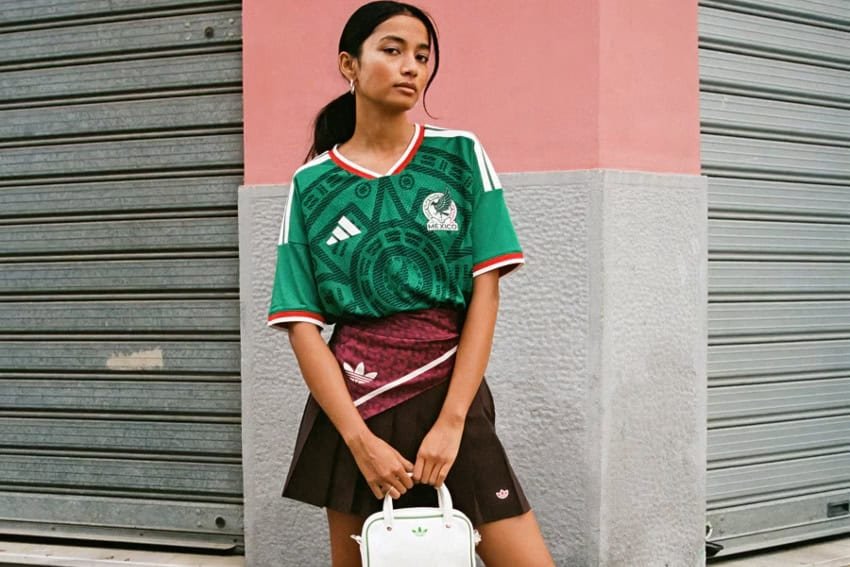
Now that the World Cup is underway, green soccer jerseys seem to be on at least half of the people I see when I go out. I don’t have one myself — I’m missing the gene that makes one able to enjoy team sports — but I like them. They’re nice.
When it comes to the price for these shirts, they run the gamut from a mere 100 pesos for a decent knock-off to upwards of 5,000 pesos, depending on the specs. The “official” jerseys are made by Adidas, and start at about 1,700 pesos. While I’m also missing the gene (and the bank account) that makes me feel excited about fashion, I can understand people wanting something extra special to commemorate the occasion. I mean, they look great!
One of the things Adidas has done to make the jerseys extra special is to partner with Someone Somewhere, a B Corp company (more on that later).
The concept, honestly, is lovely: have real, live, Mexican artisans do the embroidery. It’s a way to show two kinds of Mexican pride: in the team and in the traditional artistry behind the jerseys! The designs are pretty, and they’re special. And expensive.
Unfortunately, there’s been some controversy behind this feel-good story. Influencer Tatiana Bernaldez began speaking about it on her Instagram page. Another influencer, Luz Valdéz, has also spoken up and was quoted several times in a recent New York Times article about the topic.
So what’s the controversy?
The accusation is that Someone Somewhere, a Mexican enterprise that has special certifications as a socially and environmentally responsible company, was pretending to be much better do-gooders than they actually were in serving as the intermediary between Indigenous artisans and Adidas, a multinational company whose valuation exceeds US $36 billion.
I agree with this assessment. Their glossy promotional reports paint an incredibly rosy picture — one that seems much rosier than the reality. While there’s a lot of big talk about “lifting people out of poverty,” the reality is that the jobs they give artisans mostly consist of low-paid gig work.
It’s enough to make me give some major side-eye to a company that brags about such a lofty social mission.
Because at those rates and with no job stability, no one’s getting lifted out of poverty for very long. According to the New York Times article, workers’ average incomes fluctuate between US $35 and US $350 a month. That’s hardly life-changing compensation — even for rural Mexico — especially for such incredibly skilled work.
Really, Someone Somewhere and Adidas are just playing the game of capitalism the same way all companies play the game of capitalism: spend as little as possible to get as much profit as possible. In that sense, there’s nothing special about them. If they weren’t trying to promote this do-gooder image, it might not have ever become a debate in the first place.
But they did promote it, and now, here we are.
There’s a lot to unpack here
Start with the fact that low wages are typical of Mexico, and that there’s often a lack of knowledge regarding labor law and market value among employees, which further marginalizes communities.
Then there are activist influencers, who care deeply about what they’re talking about, but who are also making a living from how much attention they can get.
Let’s start there.
@byfernandohh What do you think of the allegations surrounding the jerseys? Follow for more! H/t @Luz Valdez @Imagen Televisión ♬ original sound – Fernando Hurtado
Ms. Valdéz, in the style of passionate and energetic young activists everywhere, is not letting this go. She’s been a thorn in the side of these companies, and of the writer who published the New York Times article. While I don’t feel sorry for the companies at all, I disagree that the article was dishonest or showed her in a negative light. It was, however — like most things in life — complicated.
Why? The women he interviewed — the artisans themselves — essentially refuted her arguments. They were happy, they said. They enjoyed the jobs and were being paid fairly, they said. There was no mistreatment at all, and all these influencers should back off and mind their own business instead of using their story to gain followers and fame.
Youch.
Mexico, labor laws and the free market
Her response was essentially that just because workers said they were happy didn’t mean it wasn’t exploitation. With this, I agree. Producing clothing that’s sold for thousands of pesos while creating it by low-paid gig work with no employee-level stability or benefits is, objectively, exploitative. Especially when it’s by these particular companies.
I’ve written before about how difficult it is in Mexico to hire official employees. It’s costly and hard, and Mexican labor laws are quite strict. So when companies are able, it behooves them to hire people as “freelancers” or independent contractors instead. Pretty much everywhere in the world, if they’re allowed to do so, they do so. It’s just so much cheaper, and for many companies, it can make the difference between having a business and not having a business.
That said, the companies in question are not tiny mom-and-pops with low and tight profits. They could afford to make these women well-paid employees, and they choose not to. Again, this is what most companies do. But most companies don’t act like they’re saving the world by presenting these jobs as if they were gifts.
It’s true, these women might otherwise be making much less money in the limited jobs available to them in their tiny communities. But giving someone pennies for their work when someone else would give them only one penny does not make you an excellent entity who’s heroically destroying the injustices of capitalism.
As someone who has done skilled “gig work” for most of her career, I feel pretty qualified to speak on this point.
Life as a freelancer or ‘gig worker’
Almost all of my jobs have been as a “freelancer” — another word for an independent contractor. What this means all over the world is that a company “hires” you to do a specific job. You do the job, turn it in, and they pay you for it. You’re not an employee, so you don’t have benefits or guaranteed hours, nor do they have any obligation to continue to hire you. You also have to figure out and pay your own always-elevated taxes, which for me personally is the most painful aspect of it all.
And while one of the supposed “advantages” of being a freelancer is that you set your own rates, this is never the case … unless, of course, you’re a true freelancer, like say, a wedding photographer, rather than simply a misclassified employee. Rather, the company says “this is how much we’re willing to pay for this work; take it or leave it.”
And of course, you take it, because sometimes you can either stand on principle or pay the rent.
In the case of the artisans, it’s not like there are a ton of great career opportunities in their tiny communities. Like Valdéz, I was skeptical of how highly they sang the praises of their jobs. But when it’s literally the best gig in town and they’d probably like more work in the future, what else would they do — especially with the eyes of the international community upon them?
The ‘milkers’ and the ‘milkees’

They might not be labor law experts, but they can tell a better deal from a worse one — however unfair it may still be. And if that’s all there is, they want to keep it. I mean, it’s not like the influencer has a plan to employ them. And if a couple of the artisans decided to speak out publicly, what would that mean for their future job prospects?
You’ve heard the sexist phrase, “Why buy the cow when you can get the milk for free?”
As a freelancer, you are the milked cow who can sell the milk when they need milk, at the price they set. If they are not obligated to make a more formal commitment to you, they will not, because again, that is how capitalism works. With any luck, they’ll need milk on a regular basis, and they will like your milk enough to keep coming back.
The least these lofty-minded companies can do is stop making people think they’re buying the cows.
In the meantime, the fight for dignified work and pay limps along as well as it can, the usual suspects both winning and losing. As for us, deciding what and where to buy is as much “activism” as we can muster most of the time. At the very least, let’s work on buying directly from artisans at fair prices. It’s literally the least we can do.
Sarah DeVries is a writer and translator based in Xalapa, Veracruz. She can be reached through her website, sarahedevries.substack.com.
