
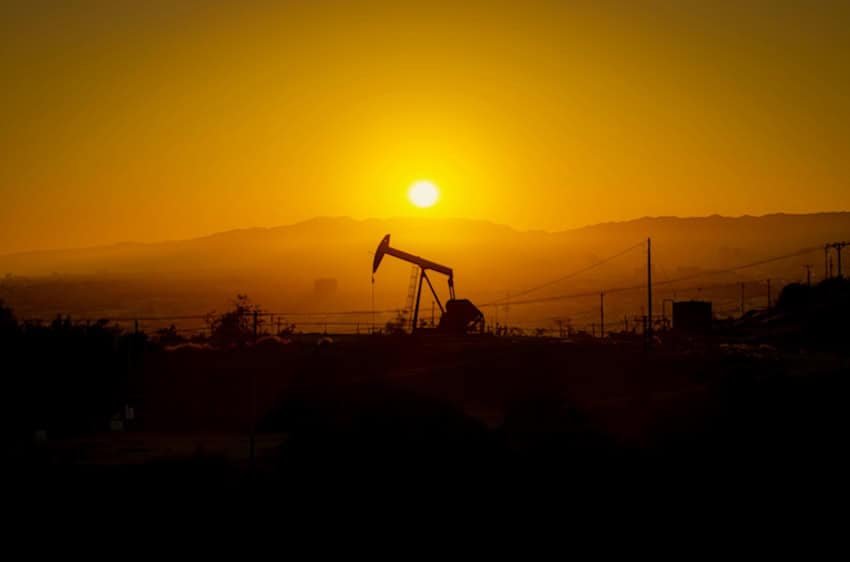
For the first time in 36 years, Pemex is now purchasing more petroleum products from abroad than it is exporting.
Through the first five months of the year, the state oil company shipped out 431,801 barrels of crude oil per day while importing 507,227 barrels per day of petroleum products.
Against the backdrop of the Iran war and rising hydrocarbon prices, Pemex spent US $1.6 billion per month to purchase gasoline, diesel and jet fuel abroad from January through May.
The expenditures represent 32% more than it earned from selling oil during that same period: US $1.09 billion.
Pemex in the spotlight
The oil company’s troubles were highlighted by the Mexican Institute for Competitiveness (IMCO) two months ago in a report noting that Pemex recorded a net loss of 46 billion pesos (US $2.6 billion) during the first quarter of the year.
IMCO identified a 25% drop in the value of crude exports and a 39% decrease in export volume as issues and that trend has continued.
During the first five months of the year, foreign sales of Mexican crude oil — Maya, Olmeca, Istmo and Zapoteco — were 35% lower than during January-May 2025.

Even more alarming, crude oil exports have maintained a downward trend for three years, falling 16% annually in 2024 and 20% annually last year.
While imports of petroleum products have also declined, they are falling at less than half the rate of exports.
Between January and May 2026, these imports shrank by 17% year-on-year, and have also fallen in each of the last three years, but at a slower pace: 5% in 2024 and 7% in 2025.
As would be expected, the drop in oil exports has impacted Pemex’s bottom line. Through May, earnings were 13% lower than the previous year, and the oil company’s account books have experienced four years of annual declines: down 26% in 2023, down 81% in 2024 and down 32% in 2025.
Pemex has been dealing with production issues
While the oil company produced just under 1.66 million barrels per day of liquid hydrocarbons in May — a 0.3% increase over April and a 1.3% increase year-on-year — production of crude oil slumped.
Pemex produced an average of just 1.36 million barrels per day of crude oil, a monthly decline of 0.7% and an annual drop of 0.6%.
🛢️#Pemex no ha logrado revertir el declive en su plataforma de producción. En el 1T2026 produjo apenas 1.368 MMbd de crudo, su menor nivel en décadas. Sin resolver sus problemas estructurales, difícilmente Pemex revertirá su declive. 🔎 #PemexEnLaMira: https://t.co/Ud036mma30 pic.twitter.com/vynrjyjZYS
— IMCO (@imcomx) July 3, 2026
Of more concern, the crude oil production in May was the fourth lowest for a single month since Pemex began keeping records, surpassing only poor performances in December 2014, October 2025 and November 2025.
At the same time, Pemex’s seven refineries were also underperforming. Crude processing fell to 941,150 barrels per day in May, its lowest level since May 2015.
Compared to April (1,067,812 barrels of crude oil processed per day), that represents a 12% decrease. As such, Pemex used just 47.5% of its installed refining capacity in May.
As a result, the federal government has transferred more than 100 billion pesos (US $5.7 billion) to Pemex through June to strengthen its financial position and help it meet its debt obligations.
This comes a year after the government injected 94.5 billion pesos (US $5.4 billion) during the first six months of 2025.
With reports from El Economista and El Financiero
