
In 2005, inspired by a friend who collaged, I began using a sketchbook. Coincidentally, that same year, my husband and I bought an old adobe house in Guanajuato. Not long after, I sat in our Mexican kitchen while waiting for a delivery, and depicted the church outside our window with collage and colored pencil. It was surprisingly easy, because a church is basically a rectangle with an arc on top, with two intersecting lines for each cross.
Pleased with the result, I started venturing out, taking photos of images around town that appealed to me, using them as models for my drawings. Opportunities were everywhere! Domes, houses, narrow streets, murals, artwork in galleries, and so on.
That was the beginning. Little did I know that living in Mexico part of the year would have a profound effect on what, 20 years later, has become a rich and robust art practice.
Expanding my palette
Back then, I was intimidated by wet media like oils, acrylics and watercolor, so I stuck to collage and colored pencil. But finally, during the coronavirus pandemic, I overcame my anxiety. Today, I paint with watercolor several times a week, give talks on creativity, write an illustrated blog about my art process and have even sold a few paintings.
Wherever I am, I paint. At La Manzanilla beach last winter, I couldn’t help but paint a pelican after watching in amazement the aggressive vigor with which the pelicans swooped down to scoop their prey. Two years ago, at another beach, Lo de Marcos, north of Sayulita, I painted a cat squatting on my sandal as I ate dinner in an open-air seafood restaurant. In Guanajuato, I painted a quinceañera leaning against the balcony of a cafe near our home, and early one morning, an albañil carrying a huge load of bricks on his back.
When I leave the city in the spring, returning to the apartment we rent in Eureka, California, I paint what I’ll miss, like the view of the church or our patio with the bougainvillea flowering. Sometimes I paint the reverse, too. For example, I painted my paddleboard, since I love floating around the bay near our California apartment.
Why Guanajuato, and Mexico, inspire art
Several foundational aspects about Mexico have helped to shape my painting style. For instance:

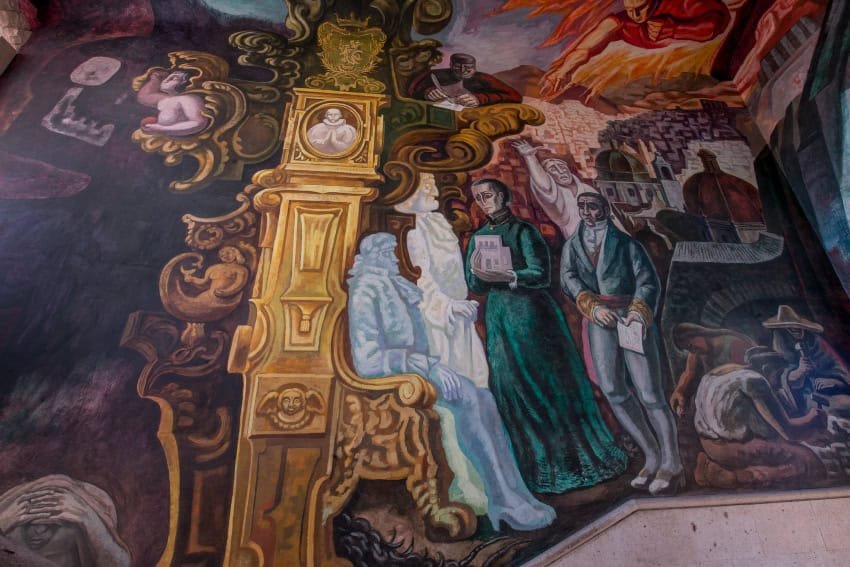
The city of Guanajuato itself. A few years ago, while walking around town one afternoon, I noticed a mural of Guanajuato and took a picture of it. The city isn’t that difficult to draw, because the hills above town are simply curves, and the houses that seemingly tumble down the steep slopes of the town toward the former ravine are blocky Cubist shapes. Since then I’ve painted many houses and buildings.

Another influence is the way spirituality in Mexico is soaked into the culture, in a way that inspires even a skeptic like me. In addition to churches, I’ve painted several versions of The Virgin of Guadalupe, none of which look exactly like the traditional representations of her. In one, her face looks like stained glass; in another, I painted small churches throughout her robe.
A third influence is the artistic form of Mexican magic realism, epitomized in the works of artists like Frida Kahlo and Leonora Carrington, who each gave me permission not to paint realistically but to be as offbeat, asymmetrical and illogical as I wanted. Ribbons connecting clouds? Why not? A woman climbing a ladder made of yarn, up to the sky? Sure!
A country rich in vibrant colors
In fact, I much prefer not to paint an accurate rendering of an image, but rather my own loose interpretation – technically called “abstract” painting – because I don’t have to be as precise, and I can hide my mistakes more easily. A house can still look like a house, even if it’s nonlinear (although, of course, it would eventually collapse if it were actually built that way). I find it more fun to draw this way, anyway.
The fourth, and probably the biggest way that Mexico has affected my art is that the whole country, and Guanajuato in particular, is saturated with color. Guanajuato’s houses drip with shades that vary wildly, from turquoise to tangerine, lavender to lime. In fact, my love of vibrant colors helped me overcome my inner critic because they are so compelling that they drown out whatever negative thoughts are lurking in the wings of my mind. As a mentor says, “Color is my candy.”
Painting and the flow state
Back in 2005, I had no idea how much painting would affect my mental state. It calms me when my emotions are swirling, helps me focus if I’m distracted, and wakes me up if I’m lethargic. And it has given me something I rarely experienced before — a flow state. Much as I love writing, painting is the activity where even a compulsive watch-checker like me loses track of time.
I’m deeply grateful to Mexico for the opportunities that helped to nurture my creativity and sustain a painting practice that I’m not sure would have developed so consistently elsewhere. I call these everyday opportunities that unexpectedly arrive ofertas. They do indeed feel like the divine manna that I never had to earn, but which was given freely.
Louisa Rogers and her husband Barry Evans divide their lives between Guanajuato and Eureka, on California’s North Coast. Louisa writes articles and essays about expat life, Mexico, travel, physical and psychological health, retirement and spirituality. Her recent articles are available on her website, authory.com/LouisaRogers.
