
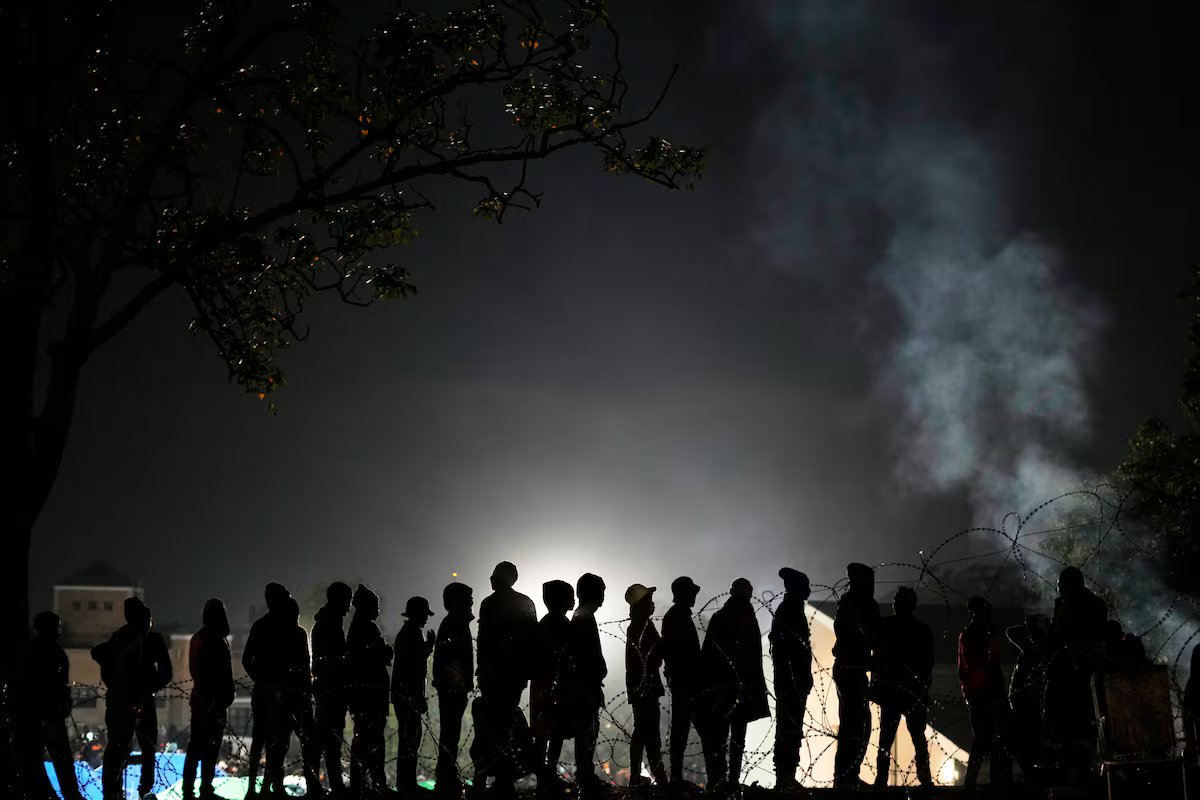
For decades, the West has told itself that the fear of immigrants is a matter of skin color, religion, culture, or different continents. But one only needs to look at South Africa today, where a new wave of xenophobic violence is demonstrating that the mechanism of rejecting the other isn’t always about phenotypes.
In a country where the Black majority suffered for decades under the oppression of apartheid – a system imposed by the white minority – mobs of Black South Africans with xenophobic views are accusing migrants and asylum seekers (who are also African and Black) of stealing their jobs, overwhelming hospitals, monopolizing public aid and committing crimes.
The violence has left hundreds of homes burned, thousands of displaced people camped out in the streets, as well as several migrants murdered. The most recent case occurred on June 19, when a 29-year-old Malawian man was stoned to death in the city of Pietermaritzburg during an anti-immigration protest. Xenophobia has also fueled mass deportations and forced President Cyril Ramaphosa to intervene as June 30 approaches. This is the deadline that has been set by anti-immigrant groups for undocumented immigrants to leave the country and for the government to take action, under threat of a national strike.
South Africa is no stranger to dealing with anti-immigrant sentiment. The country – one of the African continent’s largest economies – is a magnet for those seeking to escape poverty in countries like Zimbabwe, Mozambique and Malawi, or wars such as the one being fought in the Democratic Republic of Congo. Since Nelson Mandela ended apartheid in the early 1990s and championed an open South Africa, hundreds of thousands of immigrants have found employment in the country’s mines.
The idea, however, was not well received by all of society, which was already grappling with its own problems stemming from decades of racial discrimination. Hence, this openness ultimately gave rise to a violent series of xenophobic flare-ups. Back in 2008, at least 62 people died and 150,000 were forcibly displaced, in one of the most serious episodes. And there were other peaks of violence in 2015, 2019 and 2021, the latter resulting in more than 300 deaths.
The latest wave of violence against migrants began in mid-March and intensified at the end of May. Ghana raised the alarm when it reported that 300 of its citizens had requested to return to Accra, the capital. In the following days, hundreds more people from Nigeria, Mozambique and Malawi also expressed their desire to return to their home countries, after suffering repeated threats and attacks from groups of citizens demanding the mass expulsion of foreigners.
Organizations that defend the rights of migrants emphasize that foreign workers have become scapegoats in a country where the unemployment rate exceeds 30% and hits the Black South African population particularly hard.
In the small coastal town of Kleinmond – just under 200 miles from the much larger harbor town of Mossel Bay – entire families have sought refuge in the town hall, in order to escape the citizen patrols that roam the streets demanding documentation from people who, to them, look like foreigners. A 49-year-old Mozambican man named Lado Amido – who arrived in the country this past February in search of work – told Reuters: “People came to my house, knocked on the door and then took all my belongings.” On Tuesday, June 23, in Boksburg, a city on the outskirts of Pretoria, protesters once again vandalized businesses run by foreigners.
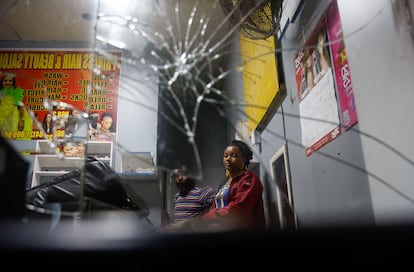
Among those who want to leave, there are examples of how xenophobia not only affects newcomers, but also people who have lived in South Africa for decades. These immigrants speak the local languages and have built their lives in the country. One of them is Leanne Sefu, a Congolese woman who arrived in South Africa as a child. She recently worked in a beauty salon in Durban that was vandalized by a group of protesters. “From the salon, I always saw the protests… but the situation worsened when they started attacking us,” she explained to the television network News Central.
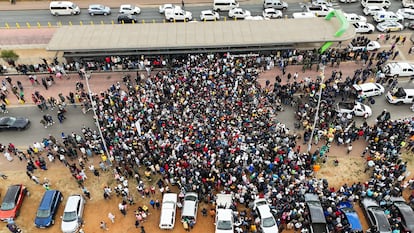
Days later, in a shantytown in Mossel Bay, dozens of shacks – inhabited by migrants – were set on fire by an angry mob. At least five Mozambicans died, according to the government in Maputo. Two more later died in a traffic accident while fleeing the country.
Since then, a kind of migrant hunt has been unleashed, leading thousands to leave their homes for fear of reprisals. Durban has become the epicenter of tensions. As of June 24, 8,000 Malawian citizens had departed the city, heading back to their country. The previous week, violence erupted when police fired rubber bullets and stun grenades at several groups of migrants camped out in the open air. They had attacked the officers, throwing stones and sticks, due to frustration over the delay in processing their return applications. However, the authorities deny any such delay.
Foreigners who haven’t been repatriated yet are being housed in two temporary accommodation centers in Durban and one in Pietermaritzburg, all set up by the government. These structures are currently sheltering around 20,000 people, as explained by Siyabonga Hlatshwayo, the spokesperson for the South African Red Cross Society in Durban, who spoke with EL PAÍS by phone: “We’re distributing food, blankets, mattresses, clothing, baby food, psychosocial support, free Wi-Fi and phone chargers.”
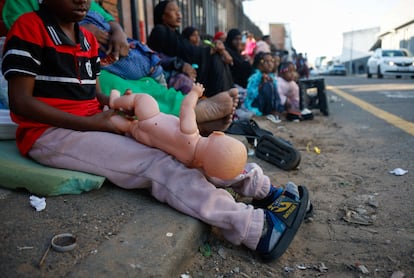
Among the campers there are numerous women and children. Covered with blankets, they’re sleeping out in the open, surrounded by bags and suitcases. There are also pregnant women and women in labor: according to South African media, at least 17 babies have been born in these makeshift settlements in recent weeks, a fact confirmed by the Red Cross spokesperson.
Many of these migrants, Hlatshwayo explains, say that they don’t want to leave because they’ve been attacked, but rather out of fear of the June 30 ultimatum. In his opinion, the situation is worsening: more and more people are arriving at the evacuation centers. “Many people are leaving their homes and asking to be repatriated.”
The March & March movement
The accusations being heard these days in South Africa are identical to those made by anti-immigration movements in Europe and the United States: that foreigners take jobs, overwhelm public services and increase crime.
Behind this rhetoric and the citizen mobilizations is an organization that presents itself as a defender of South Africans who are against irregular immigration. Known as March & March, the group has found a platform on social media that’s being exploited by figures with significant media appeal, such as the actor Nkosikhona Ndabandaba, the radio host Ngizwe Mchunu, as well as the anti-immigration activist Jacinta Ngobese-Zuma.
“South Africans, in their majority, have expressed that they are no longer comfortable living with people [who] they don’t know, who are in the country illegally […] We miss the days [when] South Africa was, you know, South Africa… where you would walk on the streets and there [weren’t] 50,000 people selling [things] and you fall off the streets… and nobody in government sees that as a problem,” Ngobese-Zuma criticized on Wednesday, June 24, in a televised press conference.
The result of this campaign is that ordinary citizens across the country now feel justified in taking matters into their own hands. They’re demanding identification from suspected immigrants, evicting them from their homes, or assaulting them if they cannot immediately prove their legal status. However, even presenting your papers can be insufficient, judging by numerous reports from people who are legally residing in the country and claim to have been attacked or intimidated.
A diplomatic problem
Ghana, Mozambique, Nigeria and Malawi have launched repatriation programs for their citizens. In addition to the 8,000 Malawians who have already returned to their country, more than 1,000 Nigerians have requested assistance to return home, while Ghana has already received 300 nationals. Mozambique has also received hundreds of its citizens from the areas most affected by the violence. Ethiopian authorities are also considering how to assist their citizens.
South Africa’s Department of Home Affairs claims that they haven’t been idle, having deported more than 100,000 people who were in the country irregularly over the past two years, while intercepting another 500,000 who were attempting to cross the border without documents. Yet, the escalation of violence has transcended borders and, like a snowball, is growing to the point of threatening to become a diplomatic problem for Pretoria. Several foreign ministries across the continent have expressed their concern, prompting South Africa to dispatch diplomatic envoys to explain the measures being taken. Ghana has requested that the situation be debated at the African Union.
The situation has spiraled so out of control that it has forced President Ramaphosa to intervene. In a televised address to the nation on June 7, he condemned vigilantism and xenophobia. “We have also said that responsibility for enforcing our laws rests with the state and the state law, and that no individual may stop any person to demand documentation or proof of identity or nationality,” he warned.
The president argued that the country’s economic problems cannot be solved by attacking foreigners, but said that he understood the public’s concerns. He promised to strengthen controls on irregular immigration and tighten immigration policies. Days later, the president spoke again, insisting that the violence is damaging South Africa’s image and harming its relations with the continent.
Meanwhile, the clock is ticking toward June 30, the date that xenophobic groups have turned into an ultimatum. However, they haven’t explained what will happen afterward. And thousands of people don’t know if they’ll be able to continue living in the country that they have called home for years, or if they will have to leave with nothing but the clothes on their backs.
“The truth is, we’re confused,” the Red Cross spokesperson admits. “We have no reliable information about what will happen that day.”
Sign up for our weekly newsletter to get more English-language news coverage from EL PAÍS USA Edition
