
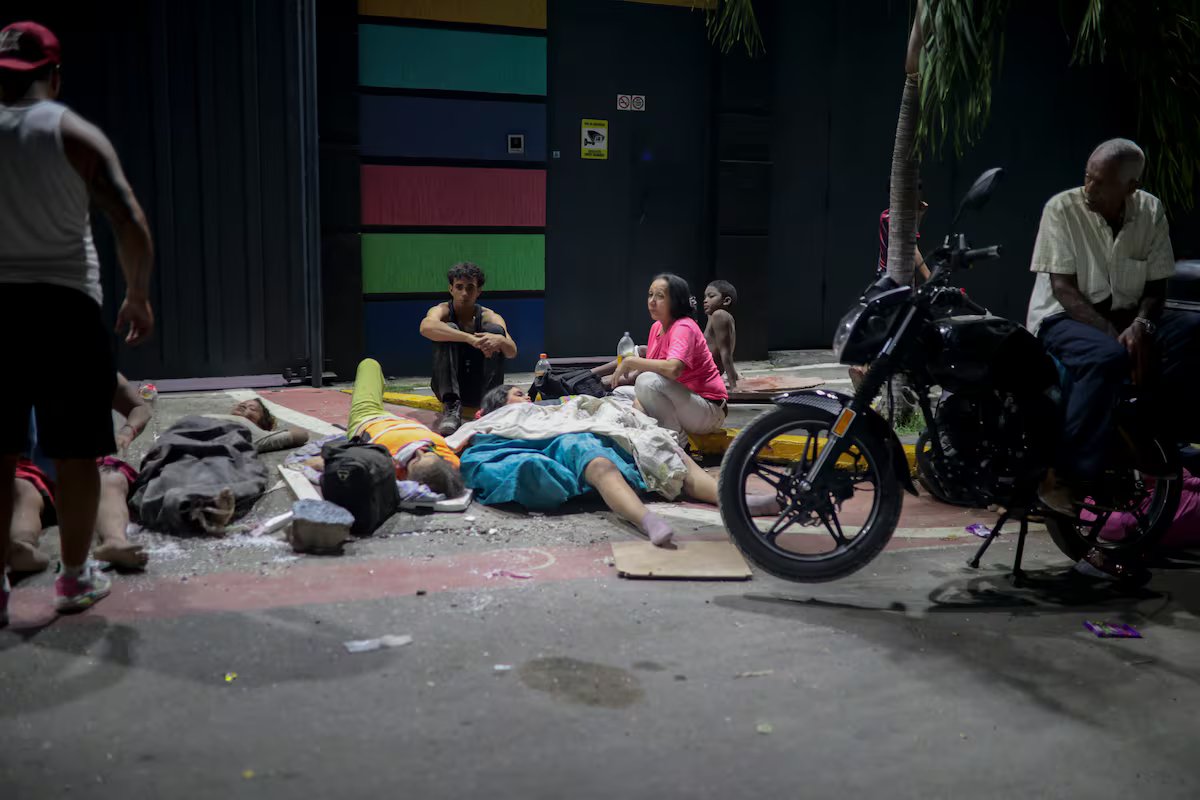
In La Guaira, Venezuelans are bracing for a second night out in the open. Those who lost their homes and those who fear returning to buildings cracked by Wednesday’s back-to-back earthquakes have set up a vast makeshift camp in the streets. Families are sheltering on highway medians, in parks, and in stadiums. The casualty figure kept rising throughout Friday, up to 920 deaths according to the government, which placed the number of injured at upwards of 3,000.
Aftershocks raise fears that things could get worse, if that were possible. Some areas remain without power or phone signal, while in others, power is intermittent. An army of volunteers has set up hundreds of collection centers to gather supplies for those affected and prepare food for them. Apps have been created to locate missing people and to report damage.
Nightfall also brought looting. While security forces are focused on collapsed residential buildings, some people in the commercial areas of Catia La Mara have taken advantage of the disaster to carry off whatever remained in the shops. Swarms of motorcycles were seen hauling away refrigerators — defying any law of physics — televisions and bulk packages of food. They merged calmly into traffic jams caused by debris blocking the roads, with traffic being self-managed by drivers in the absence of functioning traffic lights due to power outages.
In other neighborhoods, such as Caribe and Caraballeda, where the earthquake damage has been greater, the same scenes were seen. Those assisting rescuers have also reported looting.
Acting President Delcy Rodríguez visited the disaster zone on Thursday. The first international rescuers from the Dominican Republic also arrived. “We hope to recover as many people alive as possible,” Rodríguez said from Macuto. Her brother, Jorge Rodríguez, president of the National Assembly, said the quakes affected eight hospitals and forced their evacuation. He also reported 20 damaged shopping centers and 68 damaged public facilities.
In the afternoon, a woman wept in desperation, pleading for machinery. Her sister was buried beneath the few-meter-high mound into which the 12‑story tower where she lived had been reduced. “A machine, please. I need my sister — she’s down there.” In another building in La Guaira, home to half a million people, a man stared into nothingness as he stroked a body covered by a blanket, lying beside two others.
In the streets, lines of people walked dragging suitcases, refrigerators, mattresses. Wherever you looked, someone was crying. June 24 is a public holiday in Venezuela: those who were not at home had been out celebrating the San Juan festivities, beating drums.
In the Catia La Mar area, in La Guaira state, people have not stopped searching for their families and their dead since the two quakes brought tragedy back to the coastline, which had already been devastated by a landslide in 1999. They searched with machetes, hammers, sticks, car jacks. With their bare hands, alongside their neighbors. The official presence of rescue teams is barely noticeable at the disaster’s ground zero.
In another social housing complex in La Guaira, the Luisa Cáceres de Arismendi development, Jesús Bonasil, 45, described a movie-like escape from his collapsing building, in which he managed to save his mother and his dog. “I lived on the 10th floor and felt everything starting to fall. A wall in my apartment collapsed onto the washing machine, and through that gap I was able to get out. When I came out, I was at about the level of the second floor — everything else had fallen below.”
The death toll continues to rise as the hours pass and rescue efforts advance. On Thursday night, the government raised the number of dead from 188 to 235. Meanwhile, the number of injured from Wednesday’s two earthquakes rose from 1,520 to 4,300.
Caracas: Collapsed buildings and survivors
In Caracas, at least four residential towers have collapsed and dozens of buildings show cracks and structural damage. People are calling for machinery and manpower to move the rubble. The solidarity networks that Venezuelans have built to cope with everyday crises have been activated to carry out inspections, lend equipment, and search for the missing.
At the Petunia Residences in Los Palos Grandes, a 14‑story tower has been reduced to a stack of six crushed floors. There is still hope of pulling people out alive. Some have even managed to communicate by phone with relatives trapped under the rubble.
Drills and heavy machinery are already in the area to break through concrete and make it easier to clear debris. But on social media, people are still calling for tools and equipment to speed up rescue efforts in other collapsed buildings across Caracas, where survivors remain trapped and bodies have yet to be accounted for.
As the hours pass, the number of affected buildings in Caracas continues to rise, particularly in the San Bernardino area, where Alazne Solabarrieta Lecea, a 65‑year‑old Spanish woman, died. In that area — where three buildings collapsed and another 30 have suffered severe damage — rescuers have managed to save 25 people.
Sign up for our weekly newsletter to get more English-language news coverage from EL PAÍS USA Edition
