
If a country had to pick a moment to strike back with targeted countervailing tariffs at the Trump Administration’s habitual bad-faith trade bargaining, surely it would be difficult to imagine a better moment than the day after Labour Day 2026.

As is now well understood by almost everybody on both sides of the world’s longest undefended border, tariffs are going to hit us all regardless of whether we live in the United States or Canada.
But unlike the president of the United States, Canada’s head of government isn’t facing a crucial mid-term election only two months later. That’s long enough for Canadian counter-tariffs that really bite to noticed south of the Medicine Line, but gives the American administration a couple of weeks to think about the implications of that.
One would think it would be a powerful incentive for Donald Trump to TACO and send his negotiators back to the table without the last-minute attack on Canadian sovereignty that killed the deal Friday night.
A little earlier and the likely American counter-counter response might have hurt too much. A little later and it might have been too late for American voters to notice before the mid-terms. To paraphrase Dr. Johnson, it remains to be seen if this is enough to concentrate Mr. Trump’s mind, what’s left of it, wonderfully.
This probably explains why Canadian provincial and federal leaders of all political stripes immediately closed ranks behind Prime Minister Mark Carney, the leader who had the awful responsibility of deciding whether or not to pull the plug on “negotiations” with a government that was neither capable of making an agreement nor sticking to it.

Why, even federal Conservative Leader Pierre Poilievre appears to be on side, vowing in a social media statement Saturday that “Conservatives will always put our country first.” He added, “Conservatives support action to protect Canadians and our industries targeted by these unfair U.S. tariffs.”
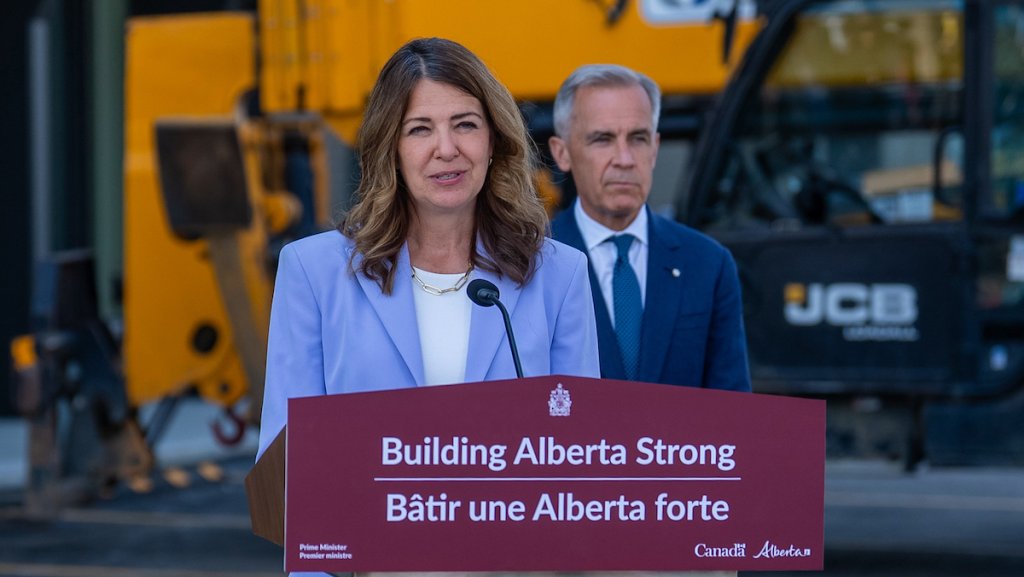
There was only one exception. It was Alberta Premier Danielle Smith, of course.
Ms. Smith piously insisted tariffs are always a terrible thing and Canada should immediately roll over and let the United States have its way with us.
On her Saturday morning bi-monthly radio program, Alberta’s United Conservative Party premier reluctantly agreed that Mr. Carney was right to withdraw from bargaining.
But she indicated she wanted no part of taking effective countermeasures – especially if Canada’s richest province has to do its part and feel some of the pain along with everyone else.

“I know, emotionally, it feels good to retaliate, I get that, but let’s remember what happens when we retaliate,” she complained to a softball question pitched by the radio program’s tame host.
A statement on social media late Friday evening came closer to what she likely really thinks: “Alberta will continue to advocate for a strong tariff free relationship between Canada and the U.S.,” she said. “I will be urging the federal government to restart negotiations as soon as possible.”
So while Ontario’s Conservative Premier, Doug Ford, said “Ontario is ready to do its part,” his Alberta Conservative counterpart tacitly indicated, forget about it.
Rob Anderson, Ms. Smith’s chief of staff and some would say the province’s de facto premier, tweeted similar sentiments just after midnight Saturday morning. “Don’t give in to knee-jerk actions that feel good in the moment but only hurt ourselves,” he whinged. “We need to be smarter not more tough guy-er.”
Mr. Anderson, of course, is one of the authors of the Free Alberta Strategy that is driving Ms. Smith’s separation referendum in October, and I’m sure he worries that an excess of Canadian patriotism in response to Mr. Trump’s trade depredations may set back the Alberta separation/U.S. assimilation project which has been successfully flying largely under the public radar.

Interestingly, back on Aug. 15, a week before the negotiations between Canada and the U.S. fell apart, a story in The Globe and Mail included an interesting hint about how the Trump Administration views the Smith Government’s pressure on Ottawa to permit pipelines to be built of every point of the compass.
“The U.S. is demanding a right of first refusal on Canadian critical minerals; that Canada complete its purchase of U.S. F-35 fighter jets; that Ottawa buy U.S. tech such as radar planes as part of joining Mr. Trump’s planned Golden Dome missile defence system; and that Washington receive some guarantee on future supplies of oil and gas,” the story said, citing both Canadian and U.S. sources.
This suggests, one would think, that the Trump government – which clearly would like to end all Canadian trade with China, and possibly Europe as well – would not look with favour on a Canadian pipeline to B.C.’s North Coast to ship Alberta heavy crude to Asia (read China).
How would Ms. Smith feel about that? Probably not as bad as you might imagine, dear readers, since her devotion to Mr. Trump and his MAGA ideology is well known, her separation machinations appear to be motivated as much by a wish for U.S. assimilation as actual independence, and her abiding hatred of the things like public health care that make Canada a better country to live in than the United States.
It’s interesting to note that in light of Mr. Poilievre’s complaint in early August that Mr. Carney was giving away too much to the Americans, U.S. Vice-President JD Vance has made it obvious the Trump Administration would prefer Ontario Conservative MP Jamil Jivani as leader of Canada’s federal Opposition party.
Mr. Vance and his college pal Mr. Jivani, it must be noted, seem like a real pair of weirdos, probably not fully trusted by either of their bosses.
Be that as it may, calling “this guy Pierre Poilievre, who is the leader of the Conservatives in Canada” a “non-entity” at a, Aug. 9 fund-raiser in Southampton, New York, Mr. Vance lauded Mr. Jivani, “this, like, random MP who has a good relationship with us” for his behind-the-scenes advocacy. It’s pretty obvious where Mr. Vance got his impression of Mr. Poilievre.
Despite the Canadian Press reporter who received a recording of the event stating that Mr. Vance meant Mr. Jivani’s advocacy for Canada, this is not actually clear from the context provided in the story.
Mr. Poilievre’s response to his MP’s apparent effort to undermine his leadership was lame, telling CP he’s asked all his MPs with contacts in the U.S. to “fight for tariff-free trade.” He’ll have to do better than with undeclared rivals that if he wants to keep his job.
