
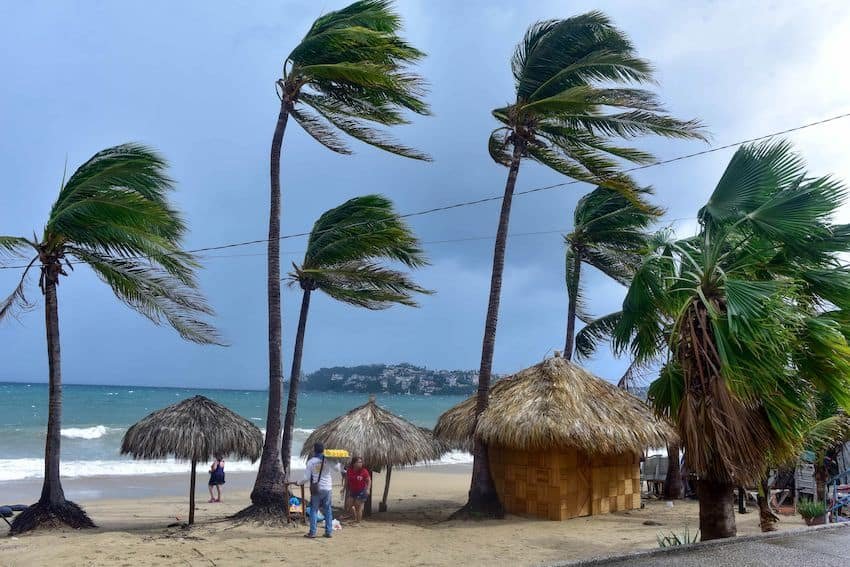
State, federal and local governments began coordinating civil protection strategies last week following Wednesday’s presentation of the 2026 hurricane forecast by Mexico’s National Meteorological Service (SMN).
The SMN is predicting from 18 to 21 storm systems in the Pacific Ocean (including 4 or 5 major hurricanes) and between 11 and 15 storms in the Atlantic Ocean (up to 2 major hurricanes).
The forecast for the Pacific Ocean, which reflects above-average cyclonic activity, was broken down as nine to 10 tropical storms, five to six Category 1 or 2 hurricanes and four to five Category 3-5 (major) hurricanes.
The forecast for the Atlantic Ocean, which affects Mexico’s Gulf and Caribbean coasts, sees seven to eight tropical storms, three to five Category 1 or 2 hurricanes and one or two Category 3-5 (high intensity) hurricanes.
Climatology studies from 1991 through 2020 reveal an average of 15 storm systems in the Pacific each year and about 14 in the Atlantic.
Hurricane season in the Atlantic officially begins on June 1, and starts on May 15 in the Pacific.
The SMN also said it is monitoring the El Niño-Southern Oscillation (ENSO) phenomenon, which has the potential to transition into El Niño during the May-July period.

The ENSO is expected to persist and strengthen during the peak of the tropical cyclone season (August to October), with a 25% probability of developing into a very strong El Niño event.
On April 22, the federal government convened a National Civil Protection System (CNPC) meeting to coordinate “a joint effort to strengthen nationwide strategies and consolidate a culture of prevention in the face of the challenges of global warming.”
More than 1,200 members of the CNPC participated, including representatives of the 32 state Civil Protection agencies, as well as members of the Defense Ministry, the Navy Ministry and the National Water Commission (Conagua).
Mexico expands emergency phone alerts to include extreme rain ahead of hurricane season
At the meeting, CNPC director Laura Velázquez outlined the fundamental pillars of the emergency response plan, the most important of which, she said, is to strengthen storm monitoring capabilities and early warning systems. This will be achieved by continuous surveillance in conjunction with the SMN and Conagua, as well as international organizations such as NOAA (the U.S. National Oceanic and Atmospheric Administration).
Another key strategy is direct mitigation, which will include river cleanup and slope stabilization.
Presently, an early start to hurricane season is not expected, but officials warned that storm activity outside the official period cannot be ruled out. They urge the public to follow civil protection recommendations and pay attention to warnings issued by the relevant agencies.
With reports from ADN 40, Quadratín Quintana Roo and Debate
