
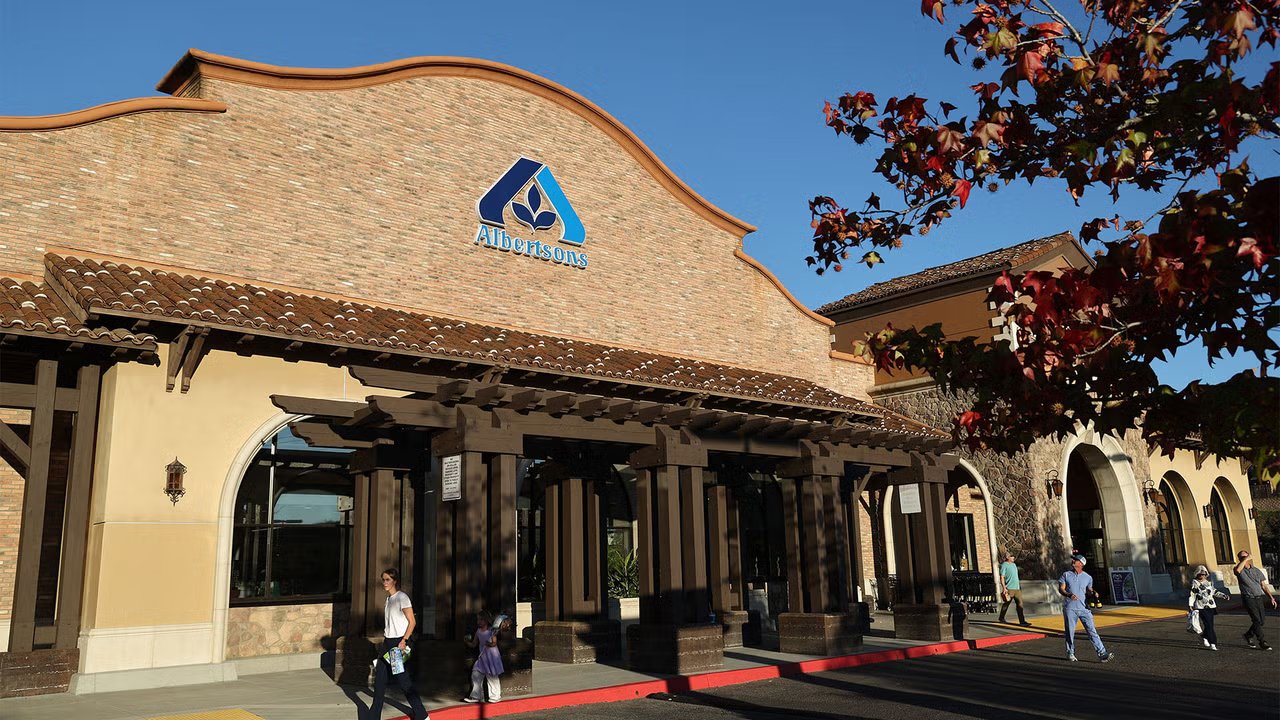
Shoppers in local communities across several states may discover that they have fewer supermarkets to choose from this year.
Grocery giant Albertsons Companies has continued to close stores in recent months as reevaluates its store footprint in the wake of a failed merger with The Kroger Company.
So far in 2026, at least a dozen locations have closed or have been marked for closure, according to an analysis of local media reports, online review platforms, and Albertsons’ own store locator tools.
The closures have impacted stores across Albertsons’ portfolio of grocery and supermarket chains, including Acme, Balducci’s, Randalls, Safeway, and Vons, in addition to banner Albertsons stores.
More than half of the closures were in California and Texas, with locations also shuttered in New Jersey, Connecticut, Nevada, and Washington, D.C.
As reported in April, Albertsons ended its 2025 fiscal year with 2,244 physical stores, a net decline of 26 when compared to the previous year.
Grocery store closures can have an especially corrosive impact on local communities. Researchers have long documented the rise of food deserts in low-income areas, which they attribute in part to industry consolidation.
Despite this latest round of closures, Albertsons tells Fast Company that it expects to end its 2026 fiscal year with a net positive store count.
Why is Albertsons closing stores?
Albertsons spent two years planning to be acquired by its competitor Kroger in a $25 billion deal that would have created a 5,000-store grocery behemoth.
But the companies abandoned the proposed merger in December 2024 after it was blocked by courts.
During that two-year process, Albertsons had slowed down the potential optimization of its physical store footprint, a spokesperson told Fast Company when reached for comment, but that process has since resumed.
“[Our network positioning] includes opening new stores in areas with strong demand and long-term opportunity, while also making the difficult decision to close some locations,” Albertsons said in an emailed statement. “In these cases, we work to place as many associates as possible in other stores.”
The company did not say how many locations it expects to close this year, or how many jobs might be lost. It says it anticipates a net increase in stores for its current fiscal year, which ends in February 2027.
Kroger has also been closing locations across its store portfolio since the merger fell apart, as Fast Company reported in March.
Which Albertsons stores have closed in 2026?
According to our analysis, 11 of the 12 locations listed below have closed in recent months, with the additional location expected to close in August. The list, which includes stores across several Albertsons-owned chains, may not be a full count.
When reached by Fast Company, Albertsons did not comment on specific locations or elaborate on whether additional closures are expected.
Acme
- 455 NJ-23, Sussex, NJ 07461
- 481 River Rd, Edgewater, NJ 07020 (closing in August)
Albertsons
- 1260 E Ontario Ave, Corona, CA 92881
- 6700 West Fwy, Fort Worth, TX 76116
- 1155 N Main St, Euless, TX 76039
- 1300 E Flamingo Rd, Las Vegas, NV 89119
Balducci’s
- 1385 Post Rd E, Westport, CT 06880
Randalls
- 5161 San Felipe St, Houston, TX 77056
Safeway
- 1601 Maryland Ave NE, Washington, DC 20002
- 231 W Jackson St Hayward, CA 94544
Vons
- 2345 E Valley Pkwy, Escondido, CA 92027
- 522 Orange St, Redlands, CA 92374
Is Albertsons in trouble?
Albertsons has definitely faced its share of recent troubles. In addition to its failed merger, the grocery giant reported a net loss of $481 million during the fourth quarter of last year.
This loss was largely due to a $774 million lawsuit settlement, related to allegations that Albertsons pharmacies did not do enough to prevent opioid abuse. In reaching the settlement, Albertsons admitted no wrongdoing.
Albertsons saw its all-important “identical sales” metric grow by a modest 2% last year, while digital sales were a bright spot—up 21%.
More broadly, supermarket chains have faced rising competition from the likes of big-box retailers like Walmart and Costco, and e-commerce giant Amazon. This survival-of-the-fittest grocery environment is one of the reasons why Albertsons and Kroger wanted so badly to merge in the first place.
Shares of Albertsons Companies Inc (NYSE: ACI) have tumbled roughly 27% over the past 12 months. The stock was trading at $16.21 when the markets closed on Friday and has far underperformed the S&P 500 this year.
This story is developing and may be updated with additional locations and details.
