
“Usually, after a suicide, people ask themselves why it happened; our characters do, too, but we never give a definitive answer”
– We spoke to the duo behind the German film, which adopts a particularly delicate approach to the topic of suicide
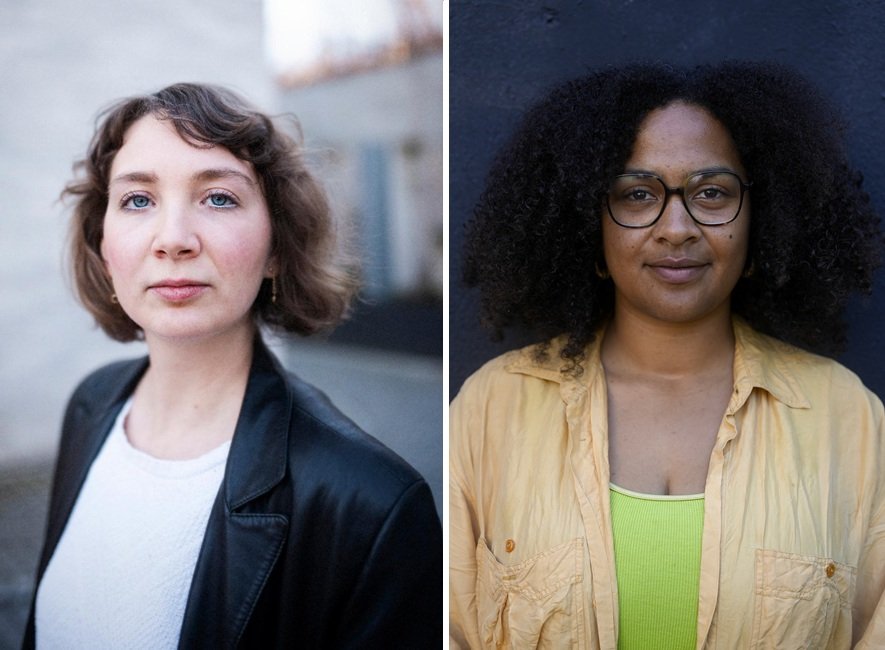
l-r: Alisa Kolosova (© Petite Machine) and Judith Rose Gyabaah (© Maverick Films)
Cineuropa sat down with Alisa Kolosova and Judith Rose Gyabaah, the director and screenwriter of I Spy with My Little Eye, which world-premiered in the International Narrative Competition at this year’s Tribeca Film Festival.
Cineuropa: What is the reasoning behind the title of the movie?
Alisa Kolosova: In German, we had a completely different title from the very beginning: Ameisen fressen kein Halva, or “Ants Don’t Eat Halva”. We really liked that – it was almost poetic – but it didn’t quite work in English, so we needed a new English title. When the film was finished and we had this strong edit with the three different time periods, we realised this was actually the core of the movie.
That scene wasn’t originally intended to be at the beginning of the film. In the script, we had this “I spy with my little eye” game in the middle of it, and afterwards, we realised that this is actually what everything is about in a more metaphorical way. Those two friends, Yalda and Lou, ask themselves the questions: “What did we miss at the time? What might we have overlooked?” And still, we wanted a title that would not be too heavy, because it’s still an uplifting, hopeful story.
Judith Rose Gyabaah: About three years ago, I received a package full of letters from my late mother. Reading them, I gained fresh insights into the way she nurtured her friendships because that is something she had devoted herself to from her childhood up to her adult years. At that moment, I knew that I wanted to write a story inspired by those letters, and also to dig deeper and gain a different perspective on the question of why her suicide happened. That’s how I started to write the story, and it was obvious to me that I should do the project with Alisa because we have been friends for almost 20 years now, and we discovered filmmaking together, so it felt very natural and organic that we would tell this story about friendship together.
Alisa, you’ve said the film is hopeful despite focusing on suicide: did you ever worry that it would become overly sentimental during writing or shooting? Were there any films that influenced you?
AK: Definitely. For example, Aftersun by Charlotte Wells. It’s a strong example of a film about a depressed father on holiday with his daughter, told from her perspective. We had a similar challenge: showing Solveigh through her friends’ eyes as they remember her with love and worry, and reflect on moments they may not have understood or times when they may not have noticed something was wrong. Saskia Rosendahl, the actress playing Solveigh, was great in showing her also as a loving mother and a good friend, and not only through her depression.
JRG: Usually, after a suicide, people ask themselves why it happened. Our characters do, too, but we never give a definitive answer, because there rarely is one. This aspect of the plot was important. What makes the story hopeful is childhood itself: despite difficult experiences, the friends support each other, find ways to cope and build a bond that endures into the present.
How did the editing process shape the original script? How did decisions like adding flashbacks and shifting between past and present change your initial version of the story?
AK: The original script basically depicted each time period in chronological order most of the time. In the editing process, we realised that sometimes it needed more of an associative approach, where we follow the characters closely. Yalda, for example, recalls specific moments from her childhood with Solveigh, and gradually, the film shifts to Lou’s perspective. At times, it becomes deliberately unclear whether a scene is solely Lou’s memory or a shared memory between them.
JRG: Whilst the script was much more chronological, through the editing, you follow the story in a much more emotional way – the flashbacks are triggered by the emotions of the characters. The editing process created a film quite different from the script, but it works perfectly because it’s much more emotional and associative.
Could you tell us anything about your upcoming projects?
AK: We are working on different projects, including one feature together. I’m also working on my own feature, a story inspired by my upbringing in a Russian household that follows a young teenager struggling with an alcoholic father and coping through magical realism. We’re also in early development on our next feature together, again exploring the complexities of friendship, this time shifting from our mothers’ generation to our own experiences today, including the darker sides. Finally, I have a documentary in post-production; it is co-directed with a colleague in Germany and follows survivors of the Siege of Leningrad as they share traumatic World War II memories of St Petersburg, while confronting how the Russian government uses them for propaganda.
