
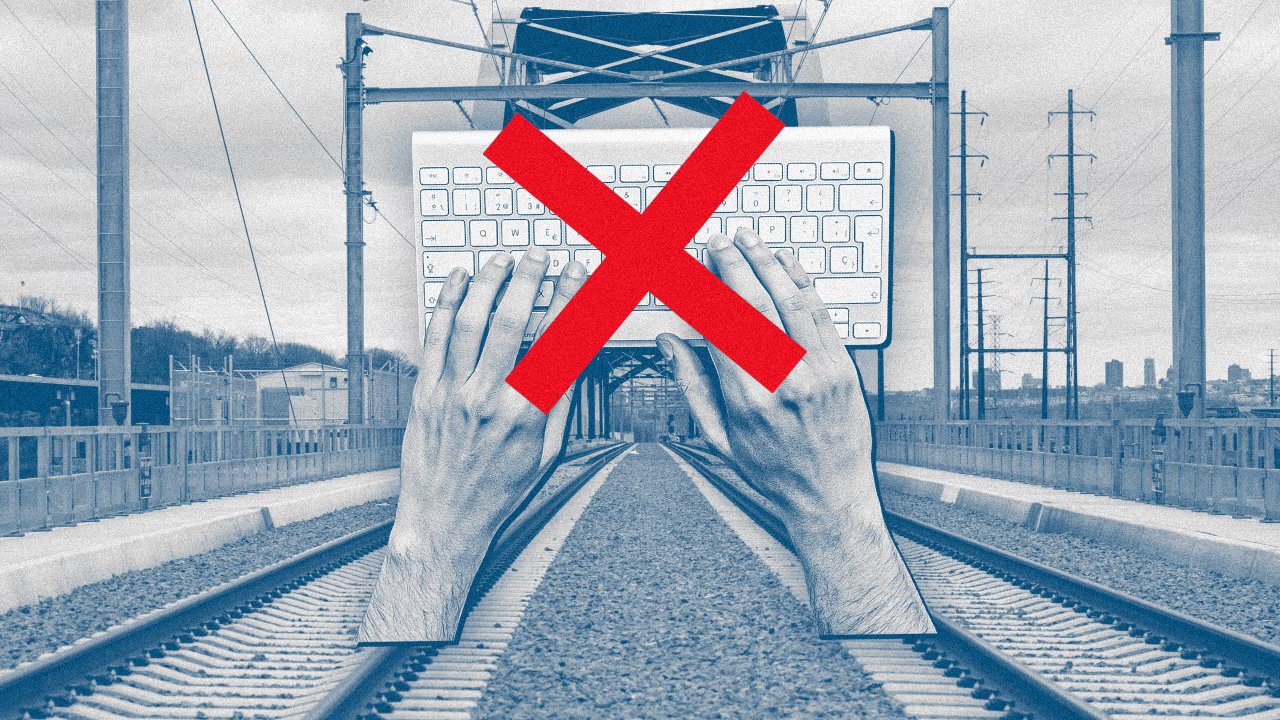
From meetings on beaches to working form home while the laundry is on spin cycle, technology and remote work policies have allowed anyone to work from anywhere—except maybe an Amtrak train.
That’s the conclusion many users on social media have determined following a post from Amtrak’s X account, where the national railroad company tried co-opting the abbreviation for work from home (WFH).
“[Why] WFH when you can WFTHETRAIN?” the post said.
Social media users quickly offered a flurry of answers, although not necessarily positive ones.
“Because a significant portion of the north east regional like has bad signal for my hotspot and I’ve been to hostels in Nicaragua that had better WiFi than yours,” a user said on X.
As of midday on Wednesday, the post had more than 200 replies.
Putting aside the fact that “WFTHETRAIN” rather defeats the purpose of an abbreviation, many commenters took the opportunity to highlight their personal issues with Amtrak’s trains.
Of the hundreds of quotes and responses to the post, a large percentage of users referenced the train’s inconsistent and unreliable Wi-Fi around the Northeast line, and exorbitant ticket prices.
One user shared thoughts from personal experience, saying, “as a professional north east regional enthusiast @Amtrak really needs to up their Wi-Fi game before they start this advertisement campaign.”
Others turned to humor to make their point. “Because amtrak’s Wi-Fi is powered by a hamster with three legs running on a wheel,” one user said.
“That Wi-Fi is hot trash, babes,” another added. “Stop playing in our faces.”
Since going viral, the company has started to reply to customers complaining about the Wi-Fi with what appear to be bot responses.
When it came to ticket prices, users also spoke up, with one saying “because the train is $200 from new york to DC, susan.”
Another user simply responded to the post with a screenshot showing prices for an Acela round trip priced at $321 and $523. For reference, flight tickets from New York City to Europe can range just slightly above that price range, despite those routes crossing a literal ocean.
Most of the responses were good-natured and comical, but Amtrak’s post does highlight a degree of tone deafness in its social media account, which has consistently tried to lean into Gen Z humor with lowercase copy, and lots and lots of emojis.
“This perfectly captures the level of awareness and sensitivity to customer experience you’d expect from a government monopoly,” a user on X said.
Fast Company reached out to Amtrak for comment.
Beaten tracks
Despite the backlash, Amtrak remains an important institution.
While the United States is not particularly well-known for its railroad, especially in comparison to other major cities in Europe or Asia, Amtrak does offer one of the only non-car alternatives to commuters and travelers, especially in the Northeast.
Last year, the company’s ridership reached 34.5 million customer trips, a 5.1% increase from the year before, and an all-time record for Amtrak.
And some users acknowledged the company’s importance, coming to Amtrak’s defense.
“i don’t think we should be taking our frustrations out on amtrak itself when the federal government could always invest more into railway transportation,” a user said. “Amtrak is our ALLY! our COMRADE! our FRIEND!”
