
– The Ukrainian director discusses her psychological drama rooted in loss, exploring how families of Ukraine’s missing soldiers live inside trauma
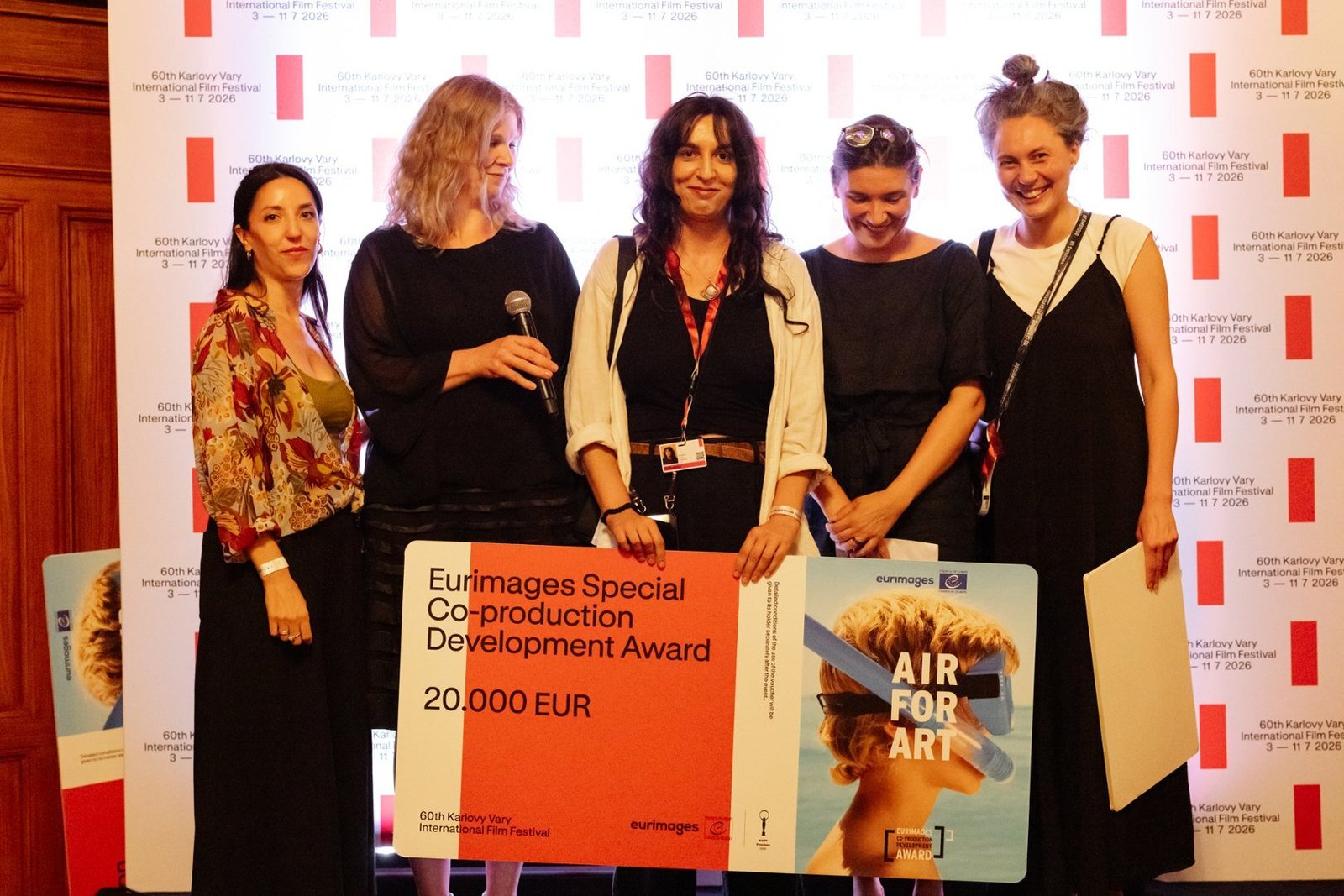
l-r: Anastasia Tykha (centre) e Darya Bassel (right) (© Karlovy Vary Festival Film Servis)
Anastasia Tykha’s Ukrainian feature debut Reminiscence, produced by Darya Bassel of Moon Man, won the Special Eurimages Co-Production Development Award at KVIFF Promises and also received the Connecting Cottbus Award (see the news). The director and producer discuss shaping a psychological drama around ambiguous loss, families of missing soldiers and the lingering trauma of the Russian-Ukrainian war, while developing the project as a European co-production with festival potential.
What was the starting point for Reminiscence?
Anastasia Tykha: It was a long process, and it started from something very small and personal — a feeling. We live in challenging times, and each of us has a different perception of time. On one hand, it passes very quickly, with so many things happening. On the other hand, when you go through trauma, you can feel trapped inside time. That’s connected to Sasha, the main character, who is going through ambiguous loss because her brother went missing in action during the earlier years of the Russian-Ukrainian war. It was important to me that he disappeared in 2018, and that the story takes place in 2021, before the full-scale invasion. At that time, not all of Ukrainian society was directly affected by the war, because it was localised in the east. But some families knew exactly what war was. Because their experience wasn’t widely shared, they were even more isolated – not only by loss, but by the fact that society didn’t know how to approach them. The idea had been with me for a long time, but it really took shape during a writers’ retreat in Spain in 2024. We’re still in development, and many things are changing, but the essence is there.
Is Sasha based on a specific person?
AT: No, she is not based on one person. I come from documentary filmmaking and work with Babylon’13, which has followed the war since 2014. Much of my practice is connected to this subject, and I have met many people whose stories involve trauma. With this project, I wanted to explore the feeling of time. Ambiguous loss is very difficult to represent because it is about absence. How can you speak about absence? These families are caught in that hollow. They cannot properly grieve, but they also cannot return to their previous lives. We interviewed women whose loved ones are currently missing in action: sisters, mothers and wives. We did not use those stories directly. We wanted to understand the emotional background, how people live, how they cope, and what similarities exist in their experiences.
How are you approaching the film’s form?
AT: Structurally, the script is quite classical, the whole story is told through Sasha’s perspective. Visual and sound language are therefore extremely important. We needed to show how she experiences time, how she is frozen by trauma, and how she eventually moves towards healing. I use elements of magical realism to enter Sasha’s subjective reality. The central symbolic image is ball lightning. It is a real natural phenomenon that’s very rare and still not fully explained by scientists. We researched it and spoke with VFX artists about how to create it and give it a distinct presence. For Sasha, it’s tied to a childhood memory she shared with her brother – a charged sphere of energy and tension that appears at several of her most emotionally difficult moments.
Sound is also central to the project.
AT: There’s a storyline involving audio cassettes Sasha finds at home – something she and her brother recorded themselves as children. It’s nothing dramatic, more like a childhood prank, but the voices carry her back into her past life, to a time when she felt safe. That comes from my own experience: my sister and I recorded ourselves on old cassettes when we were children. Fifteen years later, I found them and listened. It was astonishing – you hear yourself speaking from the past. Because time had acted on the tape, we sounded like ghosts. We could hear the acoustic weight of time. That feeling will be part of both the story and the sound design.
How would you define the genre?
AT: It’s a psychological drama. The central conflict is between Sasha and her mother, who are traumatised by the same event, but in different ways. Sasha is paralysed by fear after her brother’s disappearance. When she returns home, she sees her mother’s actions as attempts to let Yan go, as if she no longer believes he’ll come back. Yet, as the story unfolds, we realise they share the same hope: both believe he’s alive. Their trauma simply takes different forms, and their inability to speak openly deepens the conflict between them. Healing can begin only once they find a way to put that trauma into words.
How far along is the project now?
Darya Bassel: We’re in MIDPOINT Feature Launch, and Anastasia is working on the script. She was also selected for the Göteborg Film Fund residency for Ukrainian filmmakers, which runs in August and September and aligns well with MIDPOINT. We plan to have a first draft by October, then pitch in Cottbus in November. Ideally, we’ll apply for production financing in Ukraine next year, if conditions allow. We’re also planning on one or two European co-producers. We’ve had good conversations with a Finnish producer, and are also considering Poland or the Czech Republic. I’ve already co-produced two films with Czech partners, so I have some connections there. If financing goes to plan, we hope to shoot in Ukraine in 2028, with a possible release in 2029.
What kind of partners are you looking for?
DB: At the moment, we are focused on creative development. Later, we will look for a sales agent. Anastasia is a first-time feature filmmaker, so the right partners are very important. I see Reminiscence primarily as a festival film, but I also believe it can reach audiences beyond the festival circuit because it addresses fundamental human vulnerability while offering hope for healing.
