
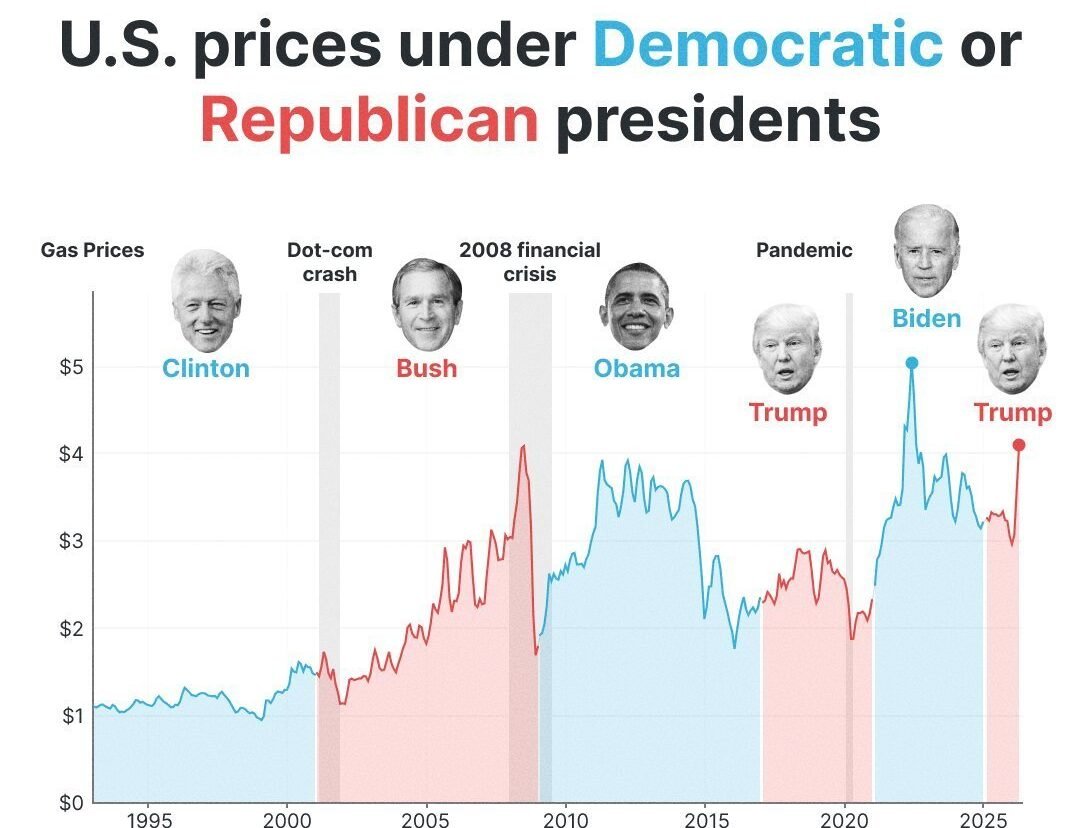
Anthony Pompliano recently posted a statement that cuts against the grain of typical political discourse around energy costs. The crypto entrepreneur and financial commentator shared a simple but pointed observation on social media: gas prices don’t care which political party holds office.
Pompliano credited the insight to @cryptorand, a user within the cryptocurrency community, suggesting this perspective has been circulating among financial-minded observers. The post drew 208 likes and 19 retweets, indicating moderate but measurable engagement with the topic.
This marks an unusual foray into political commentary for Pompliano, who built his reputation primarily through cryptocurrency advocacy and entrepreneurial ventures. His social media presence typically focuses on Bitcoin adoption, financial markets, and investment strategies rather than partisan political issues.
The statement arrives during a period when gas prices have become a recurring flashpoint in American political discourse. Politicians across party lines routinely claim credit for falling prices or assign blame for increases to their opponents. Pompliano’s observation suggests this framing misunderstands the underlying economic forces.
Gas prices respond to a complex web of factors that operate largely outside the direct control of elected officials. Global oil markets, refinery capacity, seasonal demand patterns, and geopolitical events all play significant roles in determining what consumers pay at the pump. The president’s party affiliation represents just one variable among many, and often not the most decisive one.
Data from the past several decades supports this perspective. Gas prices have risen and fallen under administrations of both parties, often following patterns that correlate more closely with global economic cycles than domestic political calendars. The 2008 financial crisis, the COVID-19 pandemic, and various Middle Eastern conflicts have all moved gas prices more dramatically than typical policy changes.
Pompliano’s comment also reflects a broader trend among certain financial commentators who emphasize market fundamentals over political narratives. This approach tends to view economic outcomes as the result of complex systems rather than simple cause-and-effect relationships between political decisions and consumer prices.
The timing of this statement carries additional weight given ongoing debates about energy policy and inflation. Both major political parties have made gas prices a central talking point in recent campaigns, with each side offering different explanations for price movements and promising different solutions.
The crypto community’s interest in this topic isn’t entirely surprising. Many cryptocurrency advocates have developed a skeptical view of traditional political and financial institutions, preferring to analyze economic phenomena through the lens of market forces rather than political rhetoric.
Pompliano’s decision to credit @cryptorand rather than claiming the insight as his own also fits a pattern common in the crypto space, where ideas often circulate and evolve through community discussion before gaining broader attention.
The moderate engagement with the post suggests the observation resonated with Pompliano’s audience without generating significant controversy. This measured response might reflect a growing fatigue with highly partisan explanations for economic phenomena.
Whether this perspective will gain traction beyond crypto and financial circles remains to be seen. Political incentives strongly favor simple explanations that assign clear responsibility for complex problems. The idea that gas prices operate independently of political control challenges this framework in ways that might prove uncomfortable for politicians of all stripes.
Pompliano’s statement represents more than just another social media hot take. It points toward a different way of thinking about the relationship between politics and economics, one that prioritizes understanding complex systems over assigning political blame or credit.
