
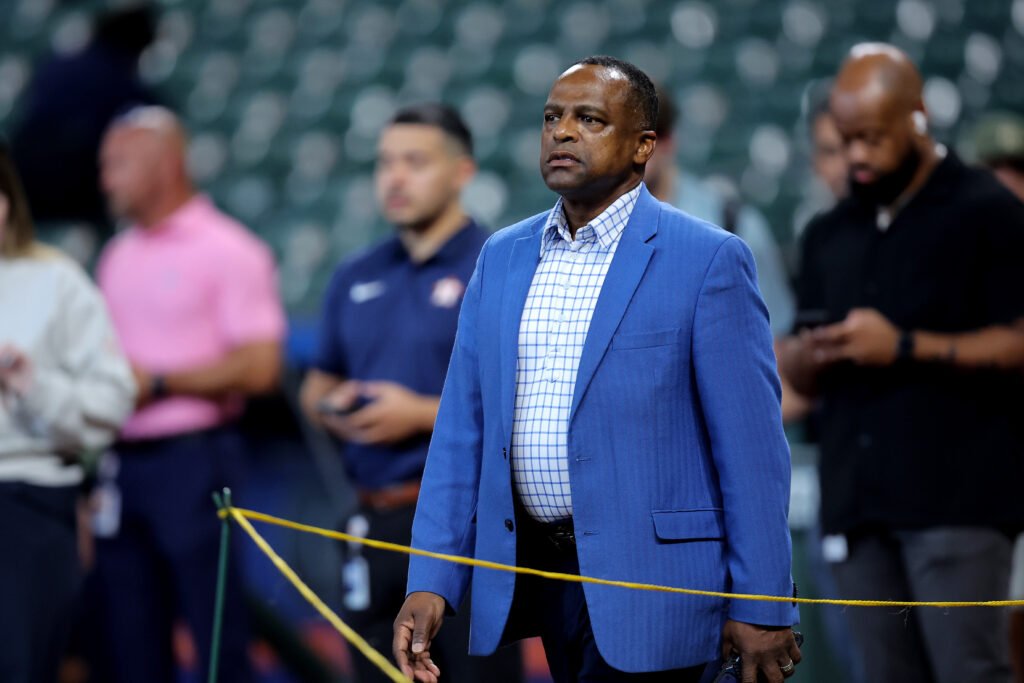
The Astros announced they’ve mutually agreed to part ways with general manager Dana Brown. Per the team’s press release, Brown’s duties will be “transitioned” to assistant GMs Charles Cook, Gavin Dickey and Connor Huff and to senior advisor Jeff Bagwell. Owner Jim Crane will oversee baseball operations during the transition period.
“Over the past four seasons, Dana has helped our organization win two division titles and has led our baseball front office through key scouting, draft and development efforts,” Crane said in a statement within today’s release. “On behalf of the Astros, I want to thank him for his commitment, energy, and contributions to our organization. We wish he and his family the best.”
Brown offered his own statement:
“I want to thank Jim Crane for the opportunity to serve in my first role as an MLB general manager. The Astros organization and the fans have welcomed me and my family, and I am grateful to have called Houston home for the past four seasons. I wish the organization well and I look forward to the future as I continue my 36-plus years in professional baseball.”
Brown was hired as Houston’s general manager back in Jan. 2023. The ‘Stros spent the bulk of that offseason operating without a true general manager in place. Despite having won the 2022 World Series under former GM James Click, Crane reportedly only offered Click — whose contract expired after said World Series — a one-year contract extension. Click declined the offer and has since gone on to take a vice president role in the Blue Jays’ baseball ops department.
Crane and Bagwell spent the bulk of that offseason doing the team’s heavy lifting in baseball operations. It notoriously did not go well. The Astros signed first baseman Jose Abreu and setup man Rafael Montero to pricier-than-expected three-year contracts that immediately went south: $60MM for Abreu and $34.5MM for Montero. Abreu was released before the contract’s halfway point. Montero logged a 4.94 ERA through just 105 1/3 innings in the first two seasons of the deal. Brown managed to dump a portion of the contract’s remainder on the Braves in the final year of the deal but had to part with a pitching prospect (Patrick Halligan) to get Atlanta to take on that cash.
Brown joined the Astros after those transactions were on the books. The former Braves scouting director spoke often early in his tenure of wanting to engineer an Atlanta-esque wave of extensions over the team’s core, but that vision never really came to pass. The ‘Stros did quickly extend righty Cristian Javier on a five-year, $64MM deal, but extensions for current and former core players like Jeremy Peña, Kyle Tucker, Hunter Brown, Alex Bregman and Framber Valdez never materialized. Another Jose Altuve extension — five years and $125MM, covering the 2025-29 seasons — was hammered out in 2024, though contracts of that magnitude for franchise icons are often orchestrated as much by ownership as the baseball operations staff (if not more so).
Some of that lack of extensions for the core was due to Crane, who seems largely opposed to contracts of a certain lengths. The Astros have never given out a longer contract than six years or a larger guarantee than $150MM (Altuve’s prior extension) under Crane. They were reportedly willing to offer Bregman $165MM after his first free agent departure and were willing to go to a similar area on Carlos Correa in free agency, but neither of those concepts wound up manifesting in reality. Correa signed a short-term deal with the Twins and re-signed on a second long-term deal (six years, $200MM); he’s since been reacquired, with Minnesota paying $10MM of his annual salary for the contract’s final three years. Bregman signed a short-term deal in Boston, opted out after one season and signed long-term with the Cubs (five years, $175MM).
A look at Brown’s transaction history in MLBTR’s Contract Tracker shows that his biggest moves beyond that Altuve extension were signing Josh Hader (five years, $95MM), the previously mentioned Javier extension, signing Christian Walker (three years, $60MM) and signing Tatsuya Imai (three years, $54MM with two opt outs). Notable trades under Brown include sending Tucker to the Cubs (in exchange for Isaac Paredes, Cam Smith and Hayden Wesneski), sending outfield prospect Jacob Melton to the Rays in a three-team deal that brought Mike Burrows to Houston, acquiring Jesus Sanchez from the Marlins (in exchange for Ryan Gusto and Chase Jaworsky) and acquiring Yusei Kikuchi from the Blue Jays in exchange for Jake Bloss, Joey Loperfido and Will Wagner. (Loperfido has since been reacquired in exchange for Sanchez.)
The recent acquisitions of Imai and Burrows — alongside KBO returnee Ryan Weiss — were intended to bolster the Astros’ rotation this season. Burrow, in particular, was viewed as a potential long-term option in the rotation. Instead, all three have largely flopped. Weiss is no longer on the 40-man roster. Burrows was optioned last month after struggling all season (though the option was rescinded and he was instead placed on the major league injured list due to elbow neuritis). The Astros are trying to make it work with Imai, but he posted a 5.83 ERA in 15 starts before being dropped to a multi-inning relief role.
The erosion of the team’s pitching staff played a major role in the Astros’ early struggles, though Brown deserves credit for scooping up Peter Lambert on a minor league deal. He’s broken out as a savior for the ’26 starting staff (3.68 ERA in 22 starts) and is controllable through 2027 via arbitration. It’s one of the better minor league signings in recent memory. Lefty Steven Okert has been a similar success story in the bullpen over the past two seasons.
It’s hard to judge any general manager in an organization where the owner is as heavy-handed as Crane appears to be in Houston. Crane is regarded to rank alongside Angels owner Arte Moreno and Rockies owner Dick Monfort as one of the game’s most hands-on owners with regard to their day-to-day involvement in baseball operations. That certainly doesn’t give Brown a pass on any misses he had while sitting in the GM’s chair, but any fair or balanced evaluation of his tenure should note that he probably had a bit less autonomy than the majority of baseball operations heads and that he was frequently working with budgetary restrictions due to Crane’s broad aversion to crossing the luxury tax threshold.
More to come.
