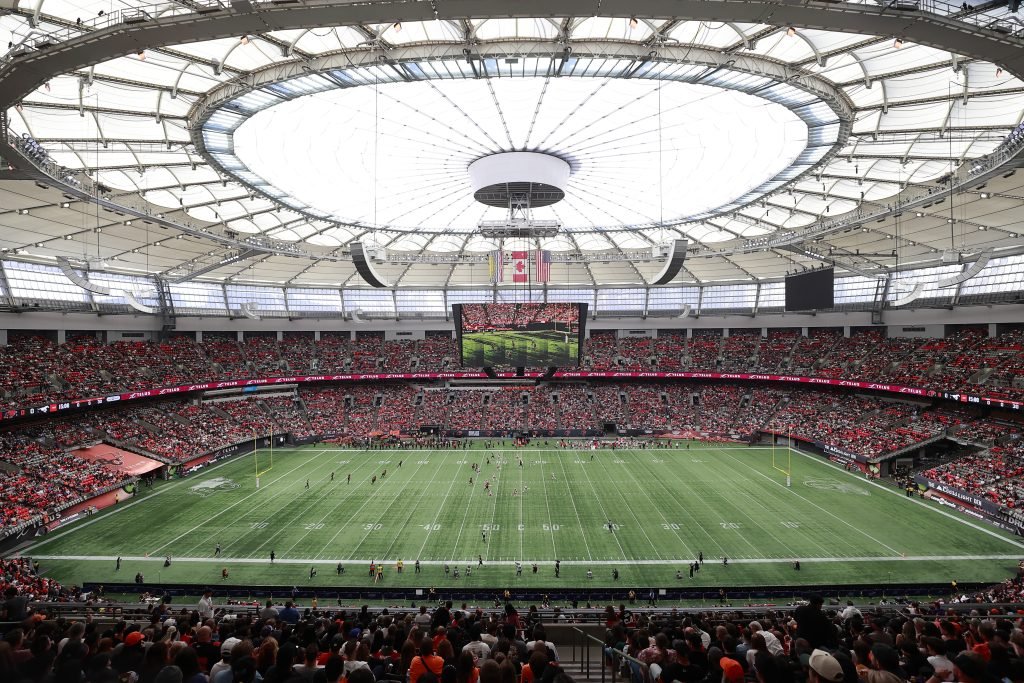
Photo courtesy: Jeff Vinnick/B.C. Lions
The removal of natural grass fields from stadiums after the 2026 FIFA World Cup has been a hot-button issue for NFL players, but members of the B.C. Lions don’t have the same degree of concern ahead of their return to BC Place on Saturday.
“We’ve just got a no-victim mentality. The other team’s got to play on it too,” veteran defensive back T.J. Lee told 3DownNation this week. “As much as we’d like for it to be grass for injury prevention and all that stuff, we’re just happy that we get to play on our turf.”
Vancouver played host to seven World Cup games, ending with the Round of 16 clash between Colombia and Switzerland on July 7. A natural grass playing surface is one of the requirements that FIFA imposes upon its venues, so a temporary field of Kentucky bluegrass and ryegrass sod, stitched together using artificial mesh and sand as a leveller, was installed at BC Place for the duration of the international soccer tournament.
↑ what lands at 3 p.m. daily
3DownNation Newsletter
Latest news, exclusive analysis, and more daily at 3 p.m.
Latest news, exclusive analysis, and more daily at 3 p.m.
as well as our terms of service and
privacy policy.
1900 Rose St, Regina SK S4P 0A9.
Global stars including Mo Salah, Romelu Lukaku, James Rodriguez, and Jonathan David all got a chance to show their athletic prowess on that grass, but it has since been removed. A similar process has played out in host stadiums south of the border, including MetLife Stadium in New Jersey, Gillette Stadium in Massachusetts, AT&T Stadium and NRG Stadium in Texas, SoFi Stadium in California, Mercedes-Benz Stadium in Georgia, and Lumen Field in Washington, all of which have now returned to artificial turf.
That has prompted an outcry from the NFL players who are the primary tenants of those venues, questioning why they aren’t worth the same investment as international soccer teams. Some of the biggest names in gridiron football, including George Kittle, Caleb Williams, Jonathan Taylor, and Saquon Barkley, have taken to social media in an attempt to pressure the NFL into mandating natural grass fields, utilizing the hashtag #WorthTheCost.
“That’s their livelihood, and they feel as though if they can roll out the grass for the soccer and the FIFA World Cup, they should be compensated the same and be able to play on grass fields for injury prevention and things like that,” Lions receiver Keon Hatcher explained.
So, do CFL players deserve the same investment? Hatcher wasn’t ready to go that far.
“Shoot, that’s not my call, man,” he chuckled. “We just go out there and play ball wherever. It don’t matter if it was concrete. We got a concrete slab, the clock starts, and we got to go get a win. That’s what we got to do.”
According to a 2023 survey conducted by the NFL Players’ Association, 92 percent of players prefer playing on grass compared to artificial turf. They claim that a natural playing surface provides more give and therefore reduces the risk of injuries, with players experiencing a 28 percent higher rate of non-contact lower-body injuries on turf.
The NFL has pushed back against those assertions, releasing their own data claiming that the rate of injury is essentially the same across playing surfaces. However, calls to install grass in all stadiums have only intensified.
The CFL Players’ Association has not taken an official position on artificial turf and did not respond to 3DownNation‘s request for comment on the subject. Lee, who is the Lions’ lead CFLPA rep, appears to agree with the statistics presented by his American union brethren, though he doesn’t lose much sleep over it.
“Over the years, statistics show turf causes more Achilles injuries and stuff like that,” he said. “As a player, we’ve just got to focus on what we can control, and we don’t control whether or not we play on grass or turf. We control the fact that we get to come out there and play the game that we love.”
16 NFL teams already play their home games on natural grass fields, accounting for 53 percent of the league. BMO Field in Toronto, which also played host to World Cup games, is the only natural grass venue in the CFL, though it still utilizes artificial turf in the end zones.
While turf fields are expensive to install, they are considerably cheaper to maintain than natural grass and offer fewer logistical challenges. PavCo, the Crown corporation that operates BC Place, has previously suggested that a permanent grass field under the dome would be virtually impossible due to the amount of time it would need to be covered to accommodate the venue’s schedule of concerts and other events.
Even if grass is a pipe dream, B.C.’s home field will be getting an upgrade before they are finally allowed to set foot on it. Brand-new artificial turf has been installed to replace the previous playing surface buried beneath the World Cup pitch, and the Leos will get the first chance to christen it.
“It should be fun,” Hatcher grinned. “I hope it’s fast. I’m ready to have a track meet.”
The Lions’ flexibility regarding playing surface may come from the firsthand experience that grass isn’t always better. The natural surface at the team’s Surrey practice facility hasn’t met CFLPA standards this season, which has forced them to shuttle 10 minutes up the road to a separate turf field for all except their walkthrough practice.
B.C.’s only win on the season to date did come on grass at the Apple Bowl in Kelowna, where the team played two games at a temporary facility during their World Cup eviction. It was the supportive fans, not the soil beneath their cleats, that helped that victory, and the team is eager to see the effect magnified in their return to BC Place for the first time since November 1, 2025.
“It means everything,” Lee said of returning to the dome. “It’s our home field. It’s where we win games. It’s where our fans bring excitement. It’s where we love to break down at the end of the game.”
The B.C. Lions (1-4) will host the Toronto Argonauts (2-4) at BC Place Stadium on Saturday, July 25, with kickoff scheduled for 7:00 p.m. EDT.