
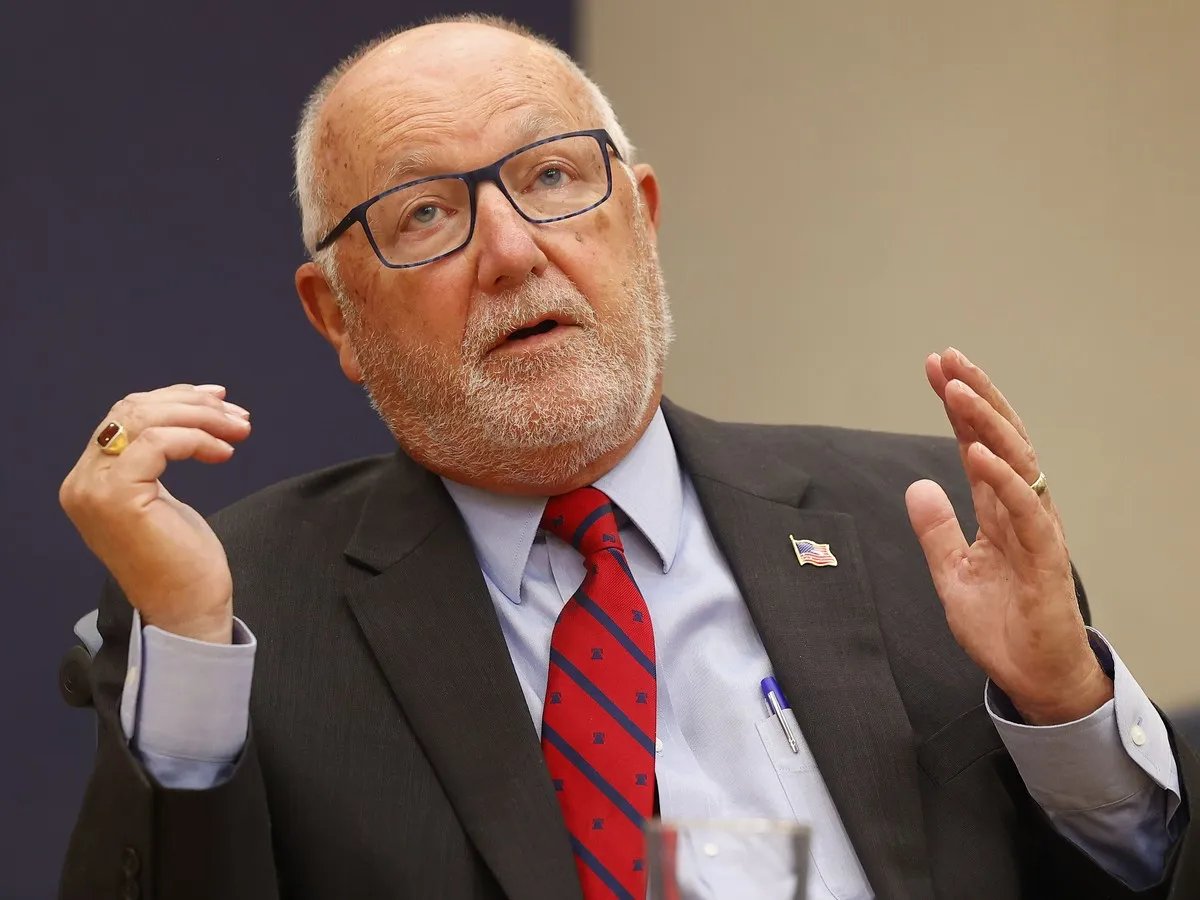
The opening of the Gordie Howe bridge is stalled because the U.S. wants to review the impact of construction costs and delays on revenue-sharing, according to U.S. Ambassador to Canada Pete Hoekstra.
Hoekstra said that Canada footing the bill for the bridge “is the big myth that is out there … I think it’s important that people realize this, okay? Because I hear it all the time. What does America have to do with this? We paid for the bridge. It’s our bridge. Just open it.”
He made the comments during a wide-ranging interview about Canada-U.S. trade on the July 2 edition of The Food Professor podcast .
Hoekstra recognized Canada loaned the bridge authority C$7 billion for the construction: “So, Canada, yes, Canada is serving as the bank for the bridge.” However, he noted that as the bridge generates revenue, the cost will be paid back. “The bridge will actually be paid for by the folks who are using the bridge. It will not be paid for by the Canadian government. So, Canada put the money up front, but at the end of the day, the expectation is that there will be a ‘use tax’ that will pay for the bridge.”
As previously reported by National Post , the revenue will eventually be shared by Canada and the state of Michigan, but that’s after Canada is repaid for the construction from the tolls. The government of Canada expects to recoup its investment over the next 36 years, according to the U.S. Department of Transportation .
But the opening has been held up as the revenue-sharing arrangement is reviewed . “We both look forward to getting it open,” said Hoekstra, but, he added, “the Canadian government and the U.S. government recognized that there are some issues that are outstanding.”
He noted that such large-scale projects are often not completed on time or on budget. “So, we have a bridge that has come in significantly over budget and has come in significantly later than originally forecast. That has changed the business model.”
And now, he says, the two federal governments have agreed to delay while they “get some of this ironed out … in terms of how the business case has changed, because it’s very, very different than when the original agreement was signed, what, 12, 15 years ago.”
He also alluded to concerns linked to owners of the Ambassador Bridge (also reported on previously by National Post ), which links Detroit, Michigan, with Windsor, Ont., and is the diversion for existing traffic to Gordie Howe bridge. The Moroun family of Detroit owns the Ambassador Bridge and made a U.S.$1 million campaign donation to a MAGA political action committee back in January. Shortly thereafter, President Donald Trump stated on social media that he would block the opening of the Gordie Howe bridge.
Hoekstra said that “traffic is not increasing in that Detroit River corridor … The Gordie Howe Bridge is not generating new traffic. So, you’re moving revenues … to the Gordie Howe Bridge … So, it’s a diversion of funds that will end up paying for this bridge.”
NEW EPISODE OUT!
No edits. No filters. Just a candid conversation with Pete Hoekstra.
In our Season 6 finale of The Food Professor Podcast, Ambassador Hoekstra tackles the issues everyone is talking about:
➡️The future of CUSMA
➡️The real story behind the Gordie Howe… pic.twitter.com/U4ii8qQcqv— The Food Professor (@FoodProfessor) July 2, 2026
The ambassador was invited onto the podcast to discuss trade, including the outstanding issue of Canada’s supply management system. He started off by stating that July 1 was supposed to be the day when a review of the Canada-U.S.-Mexico Free Trade Agreement (CUSMA) was to be completed, before potentially committing to extending it 16 years beyond the 2036 end point.
“Obviously, from our perspective, we’re not where we want to be. (Going forward) the president will be defining and clarifying (the) vision as to exactly where we’re headed at this point. I think that’s different from where we were 14 months ago … We were talking about a specific agreement that became very, very close to fruition in terms of getting it completed in the October, November time-frame that would have included steel, aluminum, auto parts, oil, and uranium. That would have been a pretty sizable deal too, you know, that we could have then built off of over the next seven months as we got to July 1. But that deal was not finalized.”
He says that now “the leadership of the two countries” need to outline the direction of future talks “since we haven’t made that much progress.”
When asked about Canada’s supply management system, a known trade irritant, Hoekstra counted it among a litany of issues that are unresolved from the U.S. perspective. “We want to deal with supply management. We need to deal with AI. We need to deal with digital streaming, online streaming taxes … We want to deal with the pharmaceutical industry. There’s a litany of things, but supply management is one of the areas that the president has talked about that we need to work on.”
When it comes to supply chain resilience, Hoekstra said, “Canadians have to define the expectations on the Canadian side … We’ve looked at shortening the supply chains. We find Canada to be a very, very reliable trading partner … I would say that the United States has great opportunities for bringing resilience into the food chain and shortening that supply chain by building and strengthening the relationships that we have … with Canada.”
He pointed toward the U.S. buying “a huge proportion of the food agriculture that Canada exports,” and rhymed off a list of numbers, such as buying 99 per cent of Canadian fresh vegetables that are exported. He said, with regard to baked goods, cereals and pasta, the U.S. buys 97 per cent of Canadian exports. And 80 per cent of Canadian beef exports.
Canadian spirits were a sticking point, as he noted the U.S. buying 93 per cent of Canadian exported spirits. “That’s kind of interesting … Eleven out of thirteen Canadian provinces banned the importation and the sale of American spirits … I wonder if the president has anything to say about that. I don’t know. We’ll find out … I think that gets into our head, in a lot of ways, and you know, not necessarily (a) positive. If Canada wants to ban American products, they can do that. And it’s more than alcohol. They ban other products as well.”
However, despite this, Hoekstra was quick to point out the value of trade with Canada among American business interests. With U.S.$2.4 billion of trade crossing the border every day, he says, the U.S. has been asking American companies to sign up to say how they feel about the trade relationship. “Would you sign a statement that just says, hey, we really feel good about the trade relationship? I think we’re at over 500 companies that have signed on. We’re getting a lot more companies that are saying, ‘Yeah, absolutely.’”
He added: “But you know what? We’re not mad at Canada. We’re fine with Canada. We like Canada. We like doing business with Canada. You know, we don’t ban products. And we don’t pick up something and say, ‘Oh, made in Canada. Ooh, put that away.’ Which we hear Canadians do. We don’t have people or premiers or governors saying, ‘Hey, don’t travel to America.’ We like Canada.”
Finally, Hoekstra listed a series of areas where Canada and the U.S. can further ties, including: mining, shipbuilding, artificial intelligence, digital technology, nuclear energy and critical minerals.
“And when Canada decides it wants to partner with the United States in those areas … we’re here to work on deals that will be good for Canada and America. You’ve been a very critical partner.”
Our website is the place for the latest breaking news, exclusive scoops, longreads and provocative commentary. Please bookmark nationalpost.com and sign up for our daily newsletter, Posted, here.
