
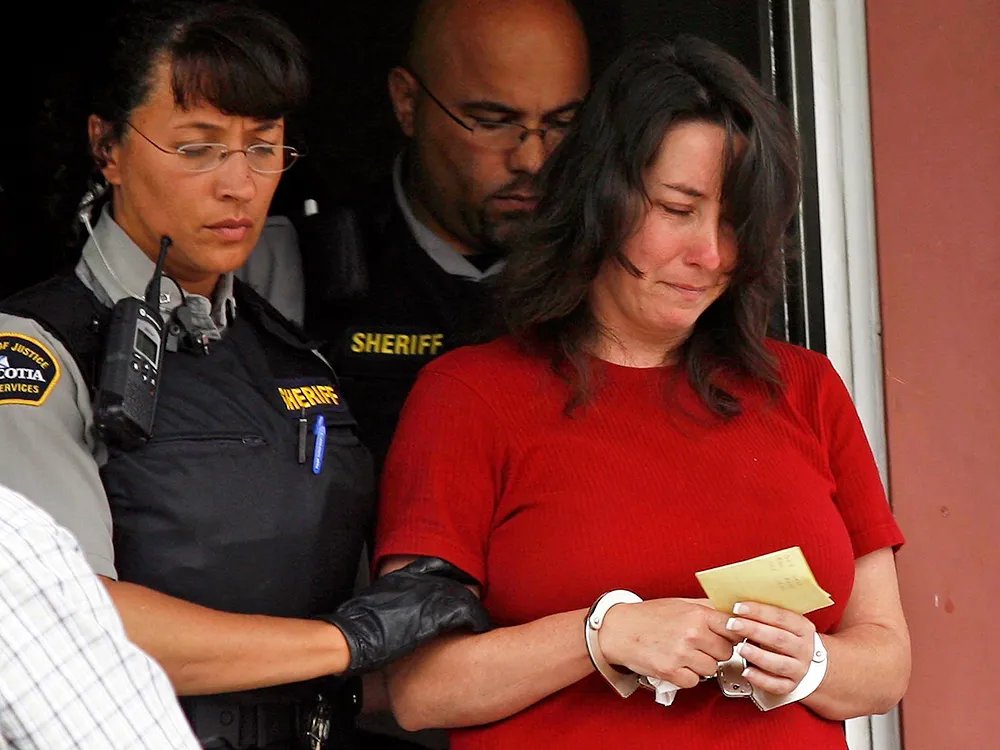
A Nova Scotia woman sentenced to life in prison 17 years ago for strangling her own daughter to death has “demonstrated clear and measurable progress” while on day parole and is working her way toward a paying job, according to a new decision granting her six more months of freedom.
Penny Patricia Boudreau, now in her early 50s, murdered her 12-year-old daughter Karissa Boudreau on Jan. 27, 2008, later claiming it was to save her relationship with her boyfriend. The following year, Boudreau pleaded guilty to second-degree murder. A judge sentenced her to life in prison with no chance of parole for 20 years.
“You strangled and dumped the body prior to a snowstorm in the hopes that it would not be found right away,” said the decision released Thursday by the Parole Board of Canada.
“You then reported her missing to the police. You admitted your crime to an undercover officer and later admitted it during an official interview.”
On the day Karissa died, the mother and daughter drove around for several hours, talking and arguing. After stopping to pick up some groceries, Penny Boudreau drove to the William Hebb Road in Bridgewater, N.S., and told Karissa to get out. She then strangled her to death with a piece of twine.
“‘Mommy don’t,’ was the only thing Karissa said,” the Crown told the court at her sentencing.

Karissa’s remains were discovered on Feb. 9, 2008, by a nine-year-old boy and his mother. Police began to suspect Boudreau in the murder of Karissa two days after the body was discovered, when neighbours overheard a ruckus in the apartment shared by Boudreau and her then-boyfriend, Vernon Macumber. “Macumber was saying over and over ‘Penn, how could you do this,’” the Crown told the court in January 2009.
Boudreau told the undercover police officer that she and Macumber were having issues, and that Macumber had given her an ultimatum to pick either him or Karissa.
“You have a history of engaging in unhealthy relationships, including the one you were in at the time you committed the offence,” said Boudreau’s June 18 parole decision.
Boudreau “demonstrated an anti-social response to challenging emotions and acted violently without caring about others or the legal consequences,” it said.
“This shows a deficit of emotional regulation and problem solving. The board considers your lack of self control as aggravating to your risk to reoffend.”
Boudreau “went to extreme lengths, including taking the life of the victim, in order to avoid losing a relationship,” said the decision.
“You have not been in a new relationship since then, but you did stay in contact with that partner for several years after your sentence began. While you have made some progress in managing your risk, you still need support with emotional control and building healthy relationships.”
Boudreau’s parole supervisor “must monitor any future relationships to make sure that they are healthy and include clear boundaries,” said the decision.
“Any situation where you may have contact with children must be carefully monitored from the start.”
Boudreau’s overall risk “is assessed as generally low” and her “global risk for future recidivism, whether violent or general, was estimated in the very low range,” said the decision.
The board opined that Boudreau doesn’t “present an undue risk to society if released on day parole and that such a release will contribute to the protection of society by facilitating (her) reintegration into society as a law-abiding citizen.”
Leave privileges “are important in the reintegration process,” it told Boudreau.
“These leave privileges will provide you with further opportunity to reintegrate into society slowly and safely.”
Boudreau’s “adjusted to communal living” and has “developed a structured and productive daily routine,” said the decision.
“You have taken steps to address personal matters and have participated in programming,” said the decision.
“You have also continued to build your employability skills as you work towards paid employment. You have engaged in ongoing mental health counselling on a regular basis and have used your time in the community in a positive and constructive way. You have begun to establish prosocial supports, which are important to your continued progress.”
Boudreau’s “current release plan reflects a continuation of what has already been working,” said the parole board.
“The board is satisfied that your gradual reintegration is proceeding in a stable and positive manner. Extending your day parole for a further six months will allow your case management team to continue monitoring your progress, provide support, and ensure that you maintain the gains you have made.”
Boudreau’s risk “can continue to be managed in the community under the current structured conditions,” it said.
Those include staying away from members of the victim’s family, following a treatment plan and reporting any new relationships with men, sexual or non-sexual.
“This includes disclosing whether those above have parental responsibility for children under the age of 16 years,” said the decision.
Our website is the place for the latest breaking news, exclusive scoops, longreads and provocative commentary. Please bookmark nationalpost.com and sign up for our daily newsletter, Posted, here.
