

Amid the hustle and bustle of the municipal market on the island of Sal, in tourist-heavy Cape Verde, 21-year-old Jessica Sousa talks about her dreams. She is taking a hospitality course and has a two-year-old daughter. She would like to remain in the country and build a career in the restaurant industry.
At the TUI Academy, other students look out the window as they finish up their internship. This vocational school works with young people from vulnerable communities in Cape Verde and other West African countries, in order to facilitate their entry into the tourism sector. This is one of the few industries capable of absorbing labor on the islands.
But if the plan doesn’t work out, Sousa doesn’t rule out emigrating, as thousands of other young people have done. There are more Cape Verdeans abroad than in the country. According to data from the International Organization for Migration (IOM), nearly 700,000 citizens reside in the United States and Europe, while just over half-a-million people live in the archipelago.
Not even the tourism boom and the revenue it generates have managed to halt this trend. In 2024, Cape Verde received nearly one million visitors, with the sector currently representing around a quarter of its gross domestic product (GDP). Each year, hundreds of thousands of tourists arrive, drawn by landscapes that also make the archipelago one of the main nesting areas for loggerhead sea turtles in the Atlantic.
But beyond the hotels and beaches, another reality – a less visible one – persists: that of a country where many young people continue to leave, because opportunities remain scarce and unstable. The unemployment rate among young people between the ages of 15 and 24 stands at 15.9%. Furthermore, almost 20% of citizens between 25 and 35 are neither studying nor working.
Ricardo Andrade, the president of SOS Children’s Villages in Cape Verde, warns that emigration is fracturing the country’s social fabric. “There are men and women who leave the country and their children behind. Sometimes, they leave them with their grandparents… and other times, they’re left practically all alone. This jeopardizes Cape Verde’s future. Because if you have a generation that’s poorly integrated into [their family structure] and [equipped] with a fragile education, you’ll end up with a much bigger problem in the future,” he points out.
In Cape Verde, more than half of all families are single-parent households. Many are headed by women. And, if they find work in the tourism sector, they face another problem: they have nowhere to leave their children. “This means that many children end up growing up on the streets,” Andrade laments.
For the organization, the key is to intervene before this vulnerability completely breaks down the family environment. “All these problems point to the same thing: family disintegration,” he maintains. “If we solve that, we solve most of the country’s challenges.”
Currently, SOS Children’s Villages cares for 122 children in alternative foster care and works with more than 2,300 children and teenagers through community projects. In the most serious cases, the children live in small houses with a mother who’s responsible for their care. In these placements, a family and school routine is maintained. Many of these children come from backgrounds marked by abandonment, violence, or sexual abuse.
The organization also acknowledges that a large part of its support network continues to depend on international cooperation. Andrade admits that the dismantling of the U.S. Agency for International Development (USAID) didn’t directly affect them, although it weakened some of the organizations they collaborated with. “In a country with so many [humanitarian] emergencies that have built up, the domino effect is felt quickly,” Andrade explains.
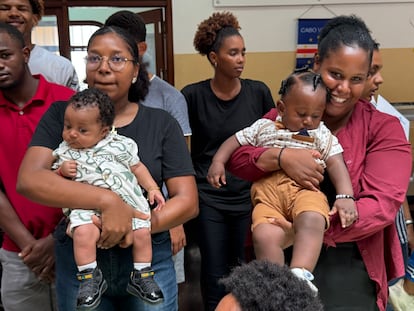
Young, single mothers
The consequences of this vulnerability appear early, sometimes even before adolescence ends. On the island of Sal, teenage pregnancy has become one of the most visible symptoms of this imbalance.
Oriana Maocha, a psychologist with the NGO Africa ’70, works with young women who became mothers while still minors. “Often, it’s a family cycle,” she explains. “The mother has her first child at 14, the daughter also gets pregnant at 14… and then, the same thing happens with the granddaughter.” In Maocha’s experience, many of these cases stem from unstable families and a lack of role models. “Many mothers have to leave for work very early and return at night. The daughters spend a lot of time alone or on the streets. They end up seeking acceptance in other groups,” she adds.
The impact isn’t only economic or educational: many young women drop out of school and become trapped in relationships of dependency that are difficult to break: “Some expect the child’s father to support them, but oftentimes, that help doesn’t come,” the psychologist explains. In the most serious cases, family pressure and isolation lead to mental health problems. “We’ve seen situations of anxiety, depression and even suicidal thoughts.”
Africa ’70 precisely aims to address this critical situation. In addition to psychological support, the organization offers sex education, childcare assistance and, in some cases, the opportunity for girls and women to return to school.
The new guardians of the turtles
In an archipelago where many young people still see their future abroad, access to stable employment can make a decisive difference. Not all opportunities come through hotels or restaurants. Some arise in less visible areas, such as environmental conservation, which, in recent years, has also begun to generate employment for young people from the islands.
On the southeastern tip of the island of Sal – where the wind blows fiercely – there’s a beach. Every winter, the sky fills with sails and the sea receives a constant flow of tourists, gliding across the crystal-clear water. Kite Beach is one of the most coveted spots in Cape Verde for kitesurfing enthusiasts.
But right now, in the summer, there are no kites; with insufficient wind, there are no foreign athletes taming the waves. And, under the cover of night, when the beach is shrouded in almost total darkness, the turtles arrive from the ocean. Any glimmer of light could disorient them. From summer until early autumn, when the loggerhead turtles return to lay their eggs, the landscape changes its rhythm.
As night falls, a group of young Cape Verdeans patrol the shore. They work with Project Biodiversity and the TUI Care Foundation, organizations that employ young people in conservation projects in one of the main loggerhead turtle nesting areas in the Atlantic. The pressures of tourism, the prevalence of poaching, as well as the effects of climate change have made the turtles’ survival a fragile balance.
For some of the students, the conservation work represents an opportunity for employment and training on an island where job options remain limited
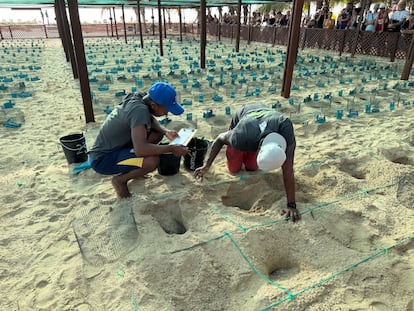
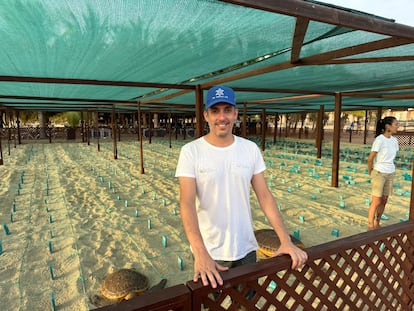
Albert Taxonera is a Spanish conservation biologist who works with Project Biodiversity. He’s been involved in this conservation effort for years, along with other international volunteers. His work begins with locating the turtles’ nests. Many eggs are often transferred to protected nurseries, in order to prevent losses due to predation, human activity, or flooding.
“The key moment isn’t just finding the nest, but everything that happens afterward,” he explains. After hatching, the turtles are returned to the beach: they’re released a certain distance from the water, so that they can complete the final journey to the sea on their own. “They have to do that last stretch by themselves; it’s what will allow them to recognize the beach in the future.”
But conservation doesn’t solely depend on monitoring the creatures or conducting scientific research. For years, consuming turtle meat was part of the local culture in several areas of the archipelago. Hence, much of the current effort also involves transforming that relationship with the species.
“Change is happening, but it’s not immediate,” Anice Lopes notes. She coordinates the Guardians of the Sea program at Project Biodiversity. Among older generations, turtle consumption remains deeply ingrained, which necessitates maintaining patrols and raising awareness in the local community.
Cultivating amidst scarcity
Beyond tourism and conservation projects, some Cape Verdeans are trying to become entrepreneurs, tackling sectors where there’s been limited development. One of these is food production, in a country where only 10% to 12% of the land is arable. On an arid island like Sal, this limitation becomes even more severe. Water scarcity and a long-standing dependence on imports shape much of life on the archipelago, where many basic goods still come from abroad.
On the island of Sal, a small family business is trying to create an alternative. At Milot Hydroponics, plants grow without soil, in raised structures. Water mixed with nutrients circulates and is continuously reused. There, they produce lettuce, tomatoes and beets, in a country where traditional agricultural struggles with a shortage of fresh water. The hydroponic system minimizes waste and building on that experience, the Field to Fork program – developed with the support of the TUI Care Foundation – promotes a training and incubation initiative for entrepreneurs who want to develop small agricultural projects that are adapted to the island’s conditions. People like Carla Djamila, who already tried farming on her own, have faced saline soil and a lack of resources. “Nothing grows easily here,” she summarizes. But she’s confident that her project will thrive and bring about change on the island.
Thus, caught between tourism and emigration, between scarcity and the search for opportunities, Cape Verde tries to maintain a delicate balance. The organizations working on the ground cannot transform the archipelago’s reality overnight, but they are trying to address some of the challenges that will shape the country’s future.
The solution doesn’t simply involve attracting visitors. It’s also about finding reasons for more young people to stay.
Sign up for our weekly newsletter to get more English-language news coverage from EL PAÍS USA Edition
