
Health systems today are pursuing an “all of the above” strategy when it comes to finding inpatient capacity. That means both working every lever to keep patients out of the hospital, and then moving them through the system more efficiently. This strategy starts with more aggressive chronic disease management in the primary care setting to prevent emergency department (ED) visits, and includes admission avoidance programs for ED patients who can be safely treated and discharged.
The single greatest bottleneck in the discharge process, however, is often the skilled nursing facility (SNF) pathway. While SNF patients make up a minority of all discharges, they account for a disproportionate number of a hospital’s excess days. Delays due to authorization, payer denials, and simply waiting for bed availability, all contribute to longer hospital stays than medically necessary, which in turn chokes capacity and increases costs.
SNFs are most appropriate for patients who do not qualify for inpatient care but still require skilled services. These skilled needs can include ongoing observation and assessment at least daily due to medical instability — which means there is a strong possibility their health could change and their treatment plan might need same-day adjustments. Skilled services also cover wound care, IV antibiotics, or physical therapy. Because of the frequency and level of monitoring needed by professionals, these services usually cannot be provided safely at home. Although home health services can manage complex cases, patients with significant medical instability often require more monitoring and care plan oversight than traditional home health can offer.
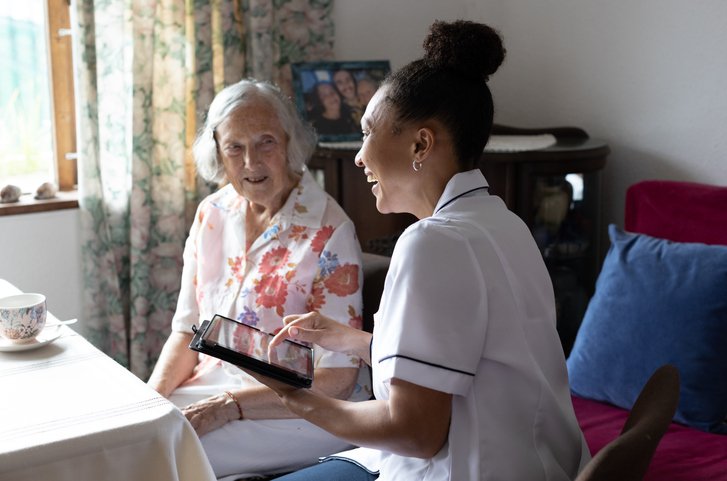
Unfortunately, too many patients who may be able to be cared for at home are still being discharged to SNFs. Offering in-home programs that can support patients with more medical instability and appropriately routing eligible patients away from a SNF to these programs can open up hospital beds — reducing ED boarding, boosting throughput, and creating capacity for patients coming from the PACU or outlying systems.
The power of alternative pathways
“Hospital-at-home” as a care pathway emerged in the mid-1990s, but really gained traction during the Covid-19 pandemic, when two catalysts came together: a federal waiver program was launched to address strained hospital capacity and infection concerns, and technology reached a point where hospital-at-home care became more logistically feasible.
According to the American Hospital Association, as of September 2025, 419 hospitals across 147 health systems in 39 states have been approved to provide hospital-at-home services. Given capacity constraints, the pressures of value-based care models, and major bottlenecks in the discharge process, it’s easy to see the appeal. Health systems have decided that just trying to operate their traditional system more efficiently is not enough to move the needle — they’ve concluded that it’s time to embrace a different paradigm, one that emphasizes “right-siting” care, creating inpatient capacity by keeping patients fewer days in the hospital, and delivering more care at home.
Hospital-at-home programs are a valuable pathway for patients who don’t require inpatient care but still require a level of care that can’t be delivered through traditional home health services. The benefits are many:
Capacity relief: Hospital-at-home programs immediately free up beds, making better use of limited SNF capacity by getting patients home who do not have functional rehabilitation needs but have skilled oversight needs beyond the scope of traditional home health. They also offer a more cost effective pathway for providing care for these patients. By routing eligible patients away from SNFs and into hospital-at-home programs, hospital systems can send patients with significantly restricted mobility and function or those who require intense physical or speech therapy to SNFs, in turn opening up inpatient beds for higher acuity patients.
Clinical appropriateness: When the alternative pathways are robust and well equipped, patients can be more accurately placed within the care continuum by a variety of criteria: acuity level defined by degree of medical instability, potential for procedural intervention, specialty consultation, or if they require treatments that could reasonably be provided in the home setting — things like wound care or IV drug administration. There are a myriad of benefits for patients when clinical appropriateness is prioritized: fewer readmissions, fewer return to ED visits, and improved patient satisfaction.
Quality patient care: Most patients prefer to recover in the comfort and familiarity of home, which can lead to higher satisfaction and, for many, better outcomes. A review of 959 adults with chronic disease across nine randomized trials showed that hospital-at-home care had a 26% lower risk of readmission and a lower risk of long-term care admission. For patients with cognitive challenges, home recovery can minimize issues like disorientation, while being at home can also lower the risk of hospital-acquired infections for many patients. And, patients who can recover in a familiar home environment tend to be more mobile, which can accelerate recovery.
Reduced burden on caregivers: For patients who don’t require a high degree of physical mobility support, alternative pathways can significantly reduce caregiver stress. Family members have easier access to the care team and can be present during important visits (rather than trying to coordinate with unpredictable hospital rounding schedules). They also avoid the time and expense of traveling to and from hospitals and clinics, which can be particularly challenging for working caregivers or those in rural areas.
The roadblocks to scaling
For many patients, recovery at home is a viable option today. But while the benefits are clear, there are significant obstacles we must overcome to make ‘Care Without Walls’ a new standard of care:
1. Identifying appropriate patients at scale – Capturing patient acuity, medical instability, and needs — then quickly matching them to suitable care pathways — is a major challenge. Care teams are already busy managing full panels. Manually screening every patient is labor intensive; teams must weigh diagnosis, hospital distance, home safety, payor coverage, and social support. Traditional methods require reviewing each patient one-by-one, which often delays transitions to different care levels due to late evaluations or limited awareness of evolving service options outside the walls of the hospital.
The path forward: AI-powered tools can address this by automatically screening patients against multiple criteria in real time, allowing care teams to focus on clinical decision-making rather than administrative screening, while identifying candidates early enough to make home-based care a viable option.
2. The frontline incentive problem – Many hospital leaders are on board with alternative pathways because they understand the capacity benefit. However, many frontline hospitalists and nurses have a different perspective that makes meaningful change management and faster throughput an uphill battle. For a hospitalist managing a full patient panel, discharging an easier patient early through an early supported discharge (ESD) program may mean they simply will be assigned a new, more complex patient. When earlier patient discharges mean more patients to care for rather than less, frontline staff may understandably hesitate to prioritize early discharge, regardless of the system-level benefits.
The path forward: Leadership must create financial or scheduling incentives that ensure early discharge genuinely reduces workload. Educating staff on how these programs improve patient outcomes and preserve SNF capacity for those who truly need it and guaranteeing smaller patient panels the following day are ways to incentivize frontline staff.
3. Regulatory and reimbursement challenges – The long-term viability of these programs depends on regulatory stability and clear payer coverage. The expiration of the waiver for the Acute Hospital Care at Home program on September 29, 2024 highlights the fragility of these models. Currently, there is neither a regulatory nor a reimbursement structure that supports these types of models effectively. Traditional home health reimbursement models don’t account for the cost of the elevated level of care at home, and SNF payments don’t cover services that happen in the home setting. Such uncertainty makes health systems hesitant to invest the necessary capital and resources into building out a robust home-care infrastructure.
The path forward: Congress must provide long-term regulatory guidance while health systems work with payers to negotiate coverage by documenting outcomes data that demonstrates reduced readmissions, higher patient satisfaction, and lower total cost of care. (Note: As of the date of publication, the Acute Hospital Care at Home Waiver has been extended through September 30, 2030. However, permanent funding hospital-at-home programs remains in flux.)
4. Operational hurdles and equity – Implementing these alternative care pathways requires continuous monitoring and investment. Service providers need to be available to cover the geographic area and intensity of services required. This raises an equity concern: service coverage can often be limited in lower-income or more geographically challenging areas, creating care deserts. We need to ensure that the adoption of these pathways doesn’t further exacerbate existing disparities in access to care.
The path forward: Health systems must proactively address coverage gaps through creative partnerships with home health agencies, employed home care teams for underserved areas, and telehealth to supplement in-person visits.
The future of care is at home
The shift to value-based care and the demand from patients for technology-integrated healthcare solutions is forcing us to acknowledge that the traditional hospital stay is not always the best, safest, or most economical option. These alternative pathways are the future, but programmatic success relies on more than just technological capability. How do forward-looking hospital leaders start paving the way toward successful care without walls? Here are a couple ways to begin moving in the right direction.
- Establish clear assessment criteria: Care teams may not frequently transition or discharge patients to alternative pathways because the criteria are not well defined. Additionally, the timing of assessments needed to determine the most appropriate level of care is often unclear, which can be challenging since a patient’s condition may change daily. While clinical appropriateness is crucial, it is only one aspect to consider. Involving multidisciplinary teams to evaluate all aspects of a patient’s condition and needs — including function, cognition, community, and social support — helps ensure consistency and enables clinicians to confidently identify suitable candidates for home-based care.
- Align incentives at the outset: As you’re exploring the implementation of new clinical models, engage a multidisciplinary team from the beginning. Figure out how to align incentives and work together to set quality goals, agree on how discharges will impact census and productivity, etc.
- Communicate early and often: Successful adoption requires persistent, consistent communication about program mechanics and patient benefits. This means directly addressing common misconceptions—such as concerns that home-based care compromises quality or safety—with concrete evidence from early outcomes data. Staff need to hear not just what is changing, but why patients benefit and how the evidence supports these new pathways.
With capacity constraints that are leaving EDs, inpatient units and care teams at their breaking point and with the ongoing move to value-based care, the expansion of alternate care pathways simply can’t wait.
By breaking down the administrative and cultural walls that keep patients hospitalized, hospital leaders can unlock system capacity, improve the patient experience, and build a more flexible and resilient healthcare system that will meet the current challenges and build the foundation for better healthcare in the future.
Photo: Alistair Berg, Getty Images
Emily Downing, MD, is a physician executive and health equity champion with more than 13 years at Allina Health. As System Clinical Officer for Continuing Care and Population Health, she leads clinical strategy across population health, home and community services, and health equity. A board-certified geriatrician, Dr. Downing completed her MD at the University of Minnesota Medical School and trained in internal medicine and geriatric medicine at the University of Colorado Anschutz. Her work has been published in the Journal of Hospital Medicine, and she has spoken at the Healthcare Analytics Summit and the Minnesota Hospital Association’s Health Care Leadership Institute. In 2022, she was named a Health Care Hero by the Minneapolis-St. Paul Business Journal.
Jason Cohen is the Chief Medical Officer, Inpatient, at Qventus, an AI solution that integrates with EHRs to optimize care across various hospital departments. The company kicked off 2025 with over $100M in funding, including a $85 million Series D led by premier global investment firm KKR & Co. Inc. (NYSE: KKR), with participation from Bessemer Venture Partners and new strategic investors, including leading hospitals Northwestern Medicine, HonorHealth, and Alina Health. Before joining Qventus, Dr. Cohen was Chief Medical Officer at North Valley Hospital and, before that, served as a hospitalist at Marcus Daly Memorial Hospital. Jason received his Doctor of Medicine degree from the University of Chicago and holds a bachelor’s degree in political science and government from Wesleyan University.
This post appears through the MedCity Influencers program. Anyone can publish their perspective on business and innovation in healthcare on MedCity News through MedCity Influencers. Click here to find out how.
