
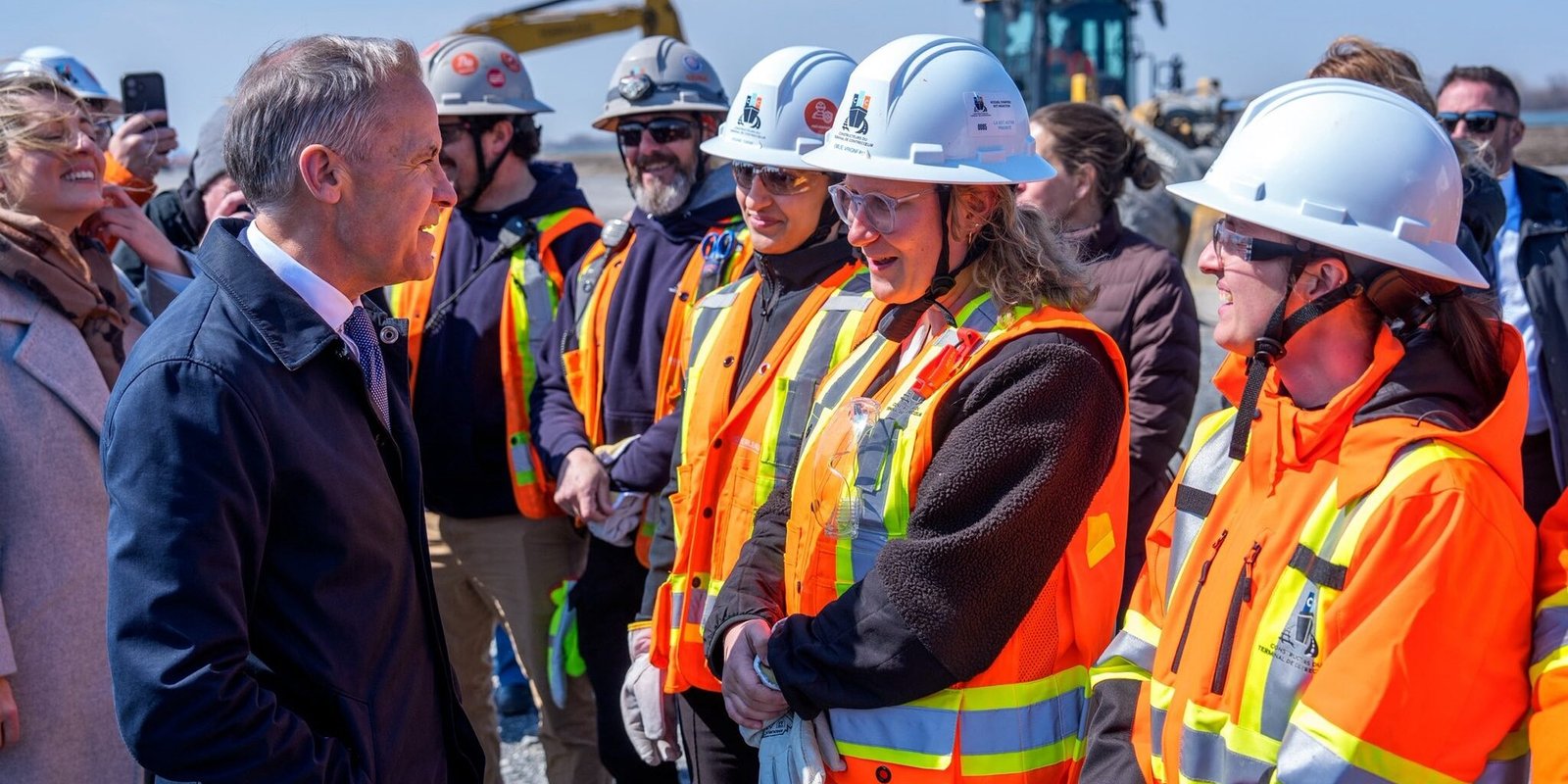
Canada’s prime minister Mark Carney is using a flood-the-zone strategy to implement a major shift on environmental and energy policy.
In the span of a few days his government has put out a discussion paper outlining a new and much quicker approval process for major projects, and announced a new national electricity strategy, whose ambitious goal is to double the capacity of Canada’s electric grid by 2050.
Earlier in the week, the PM sat down with Alberta’s United Conservative Party premier Danielle Smith and signalled the federal government was willing to slow down the planned rise in the industrial carbon tax, Canada’s main policy weapon against greenhouse gas emissions.
The industrial carbon tax is currently $95 per tonne and has been scheduled to rise to $170 per tonne in four years, by 2030.
According to unnamed government sources, Carney has agreed to lower the 2030 price to $130 per tonne.
As part of the deal, Carney has also agreed to pave the way for another pipeline to carry Alberta bitumen to the west coast – and from there, by tanker, to foreign customers.
The PM and premier Smith are meeting again on Friday, May 15, to make this deal official.
There is plenty in all this to worry those concerned with the future of the planet.
Species at jeopardy watch out
The major projects paper, for instance, mentions allowing early construction of projects to start before the impact decision is made. Doing so for a project would create a fait accompli, and render the assessment process toothless.
The paper also echoes 2025’s Bill C-5 in allowing cabinet ministers the right to “adjust assessment and environmental conditions” when needed, “in the national interest”.
As well, the paper proposes giving the cabinet undefined “limited power” to exempt specific projects from the application of what it calls “the jeopardy test for species at risk”.
That innocuous sounding phrase means that even if a project such as a mine or pipeline might threaten the very existence of a threatened or endangered species it could nonetheless go, nonetheless, ahead – if, of course, the project is in “the national interest”.
In practical terms, such a provision could allow a mining operation to dump its tailings into lakes and other bodies of water, killing, say, a rare species of trout or some other aquatic creature.
The Electricity Strategy, for its part, would make power generated by the four provinces which are the main producers of clean hydro-electricity more widely available across the country.
That would be a salutary outcome, from a climate change point of view.
But, “in the short term”, the Strategy would also favour electricity produced by natural gas – which, while cleaner than other fossil fuels, is not a renewable energy source. To that end, Carney has announced that his government will “adjust clean electricity regulations”.
The renewable energy sector is not at all happy
Despite the government’s conciliatory rhetoric in public, many Carney supporters privately dismiss the objections of environmental and Indigenous groups.
Away from the microphones, they complain about Canada falling behind such competitors for world markets as Australia – because of this country’s hidebound, slow, excessively deferential, and inefficient approvals process.
But there are also parts of the business community that are up in arms. And they make the argument that the Carney government’s new energy and environmental approach will be self-defeating and, long-term, bad for the Canadian economy.
An organization that represents renewal and clean industries in Canada, Canada’s Clean50, says Carney’s “gift to Alberta”” (referring to the industrial carbon tax changes) is “actively dismantling a high-growth sector”.
Gavin Pitchford, executive director of Clean50, says:
”A cap of $130 per tonne by 2040 will decimate the clean industry sector that currently contributes over $200 billion to our GDP and an estimated 700,000 jobs and has been on a rapid growth curve. If nurtured, that contribution could triple, while the oil industry steadily declines.”
The government’s choice to seemingly favour non-renewable oil, coal and gas over clean energy is chasing away investment and expertise, Pitchford warns.
The “brightest minds” and smartest dollars in the renewable energy industry are already looking for investment and employment opportunities in countries more favourable to renewables in Europe and Asia.
“I am hearing from young professionals with Masters degrees from Western and U of T who are actively seeking employment in the UK, Denmark, and Rome,” Clean50’s Pitchford reports.
Supporters of Carney’s turn-back-the-clock on Indigenous rights and the environment approach argue that the economy and jobs must take precedence over other “softer” considerations – given Canada’s current dilemma.
The environmental movement and Indigenous communities have been hearing that sort of argument for more than a year now.
