
Is the U.S. still at war with Iran?
It should be an easy question to answer. But the Middle East conflict has morphed from a barrage of U.S.-Israeli airstrikes to a drawn-out stalemate involving sea skirmishes, economic blockades and thorny diplomatic talks.
Whether the war is on has become an elusive topic that depends on who is speaking and in what context.
President Trump told Congress that hostilities ended when the countries entered a ceasefire in early April. He wanted to get around a War Powers Act deadline that gives the president 60 days to end hostilities or obtain congressional authorization to continue them.
Yet he’s imposing a major blockade of Iranian ports to bring the regime to heel, suggesting the countries are still furiously locking horns.
“Under intentional law, a blockade is an act of war,” Sen. Tammy Duckworth, Illinois Democrat, told CENTCOM chief Admiral Brad Cooper. “We are currently in an act of war with Iran under international law.”
Sen. Lisa Murkowski, Alaska Republican, pointed to the confusion in joining all Democrats and two Republicans in a vote last week to constrain Mr. Trump’s war powers.
“A statement has been made that hostilities are at an end, but it certainly wouldn’t appear to be that way,” Ms. Murkowski said.
Asked to comment on the status of the war, the White House recounted Mr. Trump’s progress to date.
“Under President Trump’s leadership, the United States decimated the Iranian regime’s military capabilities in 38 short days and is now strangling what’s left of their economy with one of the most successful naval blockades in history,” assistant White House press secretary Olivia Wales said. “President Trump will never let Iran have a nuclear weapon – and the president holds all the cards as negotiators work to make a deal.”
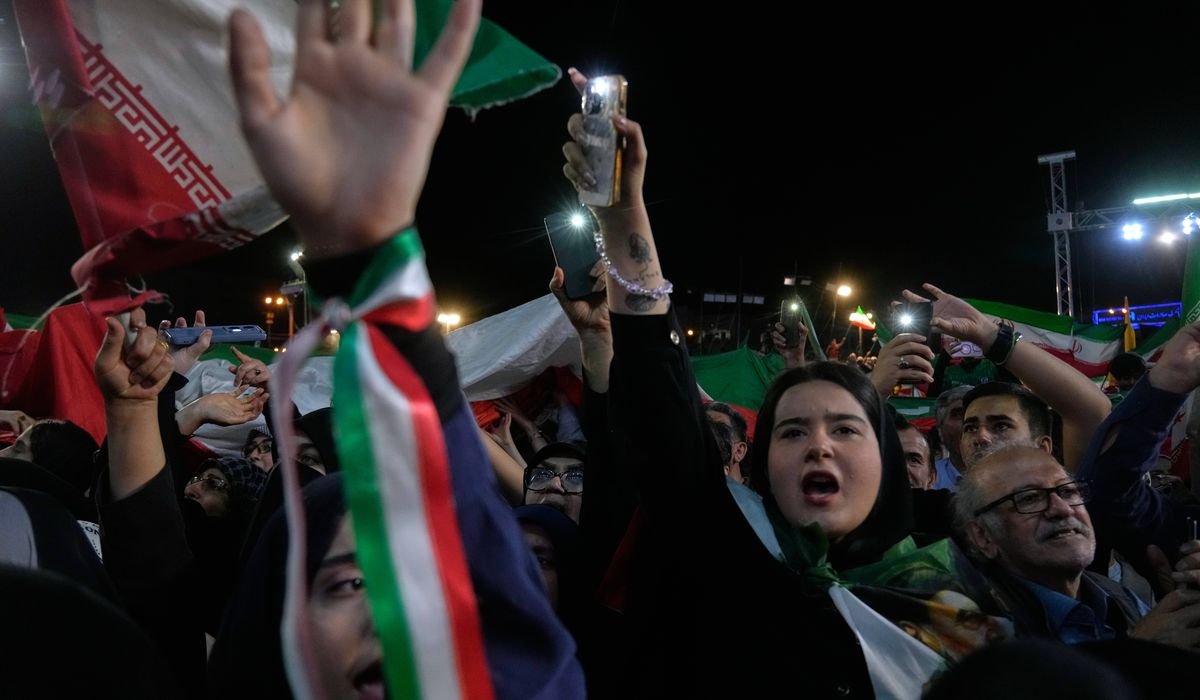
Government supporters stand for Iran’s national …
more >
The U.S. and Israel launched a military operation on Feb. 28 that killed Iran’s top leaders and decimated their military infrastructure.
Tehran responded by clamping down on oil traffic in the Strait of Hormuz, a critical chokepoint, and both sides reached a ceasefire in early April.
That ceasefire has held, though U.S. and Iranian forces have exchanged fire in the strait and Mr. Trump is imposing a strict blockade on Iran’s ports to squeeze the Islamic republic’s economy.
The upshot is a scenario in which the war is over – except when it’s not.
“We’ve beaten their military very soundly, that’s over with,” Mr. Trump told reporters as he departed on his trip to China.
In the same breath, he pleaded for time on high energy prices, suggesting the conflict is active.
“As soon as this war is over, which will not be long, you’re going to see oil prices drop, and you’re going to see a stock market – which is already at the highest point in history– go through the roof,” he said. “You’re going to see the Golden Age of America, frankly.”
Darrell West, a senior fellow of governance studies at Brookings Institution, said people “understand there is a ceasefire, but don’t believe the war is over,” as the countries remain far apart on an agreement.
“Gas prices remain high and show little sign of coming down any time soon,” he said. “The administration needs to do a better job communicating its strategy and vision so everyone understands how things will wind down. Trump can’t say the war is over until there is an agreement, both from Iran and the United States.”
The U.S. and Iran have traded peace proposals in recent weeks, with Pakistani officials serving as mediators.
U.S. negotiators have remained mostly consistent in their demands across nearly a year of negotiations with Iran: Tehran cannot obtain a nuclear weapon, it must eliminate its uranium enrichment program and cut its support for regional proxy terror groups.
Mr. Trump paused a mission to guide ships through the Strait of Hormuz, dubbed Project Freedom, citing a request from Pakistan as it pursued a lasting peace.
But days later, Mr. Trump called Iran’s latest offer a “piece of garbage,” leaving the situation in limbo and adding fuel to Democrats’ calls to wind down the conflict.
“Trump has forced American taxpayers to sink at least $29 billion into a war that still has no endgame,” said Sen. Charles E. Schumer, New York Democrat.
Congressional Republicans say Democrats are meddling with the White House at the worst possible time.
They have been careful to draw a line between hallmarks of a war, such as airstrikes, and the type of economic standoff and negotiation that is ongoing.
“We’re not having kinetic activity right now, as we would say. The president has declared Operation Epic Fury to have concluded, and now we’re working on the next project, which is getting the Strait of Hormuz open,” House Speaker Mike Johnson, Louisiana Republican, said at a press conference Friday. “We don’t expect that to be a warfare activity, so to speak. So, we’ve got to allow the administration time to negotiate these things. The president has been doing that in earnest.”
The speaker said lawmakers should stay out of the commander-in-chief’s way while negotiations proceed.
“We think it comes to a conclusion soon,” he said, “and I don’t think Congress needs to get in the way of the administration as they finish what is now a negotiation instead of a military conflict.”
The other side of the aisle isn’t so sure.
Ms. Duckworth, in a back-and-forth with Adm. Cooper, said Iran still seems to have operational access to missiles and is controlling the Strait of Hormuz.
“The American people, our service members, deserve clear answers: What does ’done with the war’ look like, and how do we get there?” she said. “We have no strategy.”
