
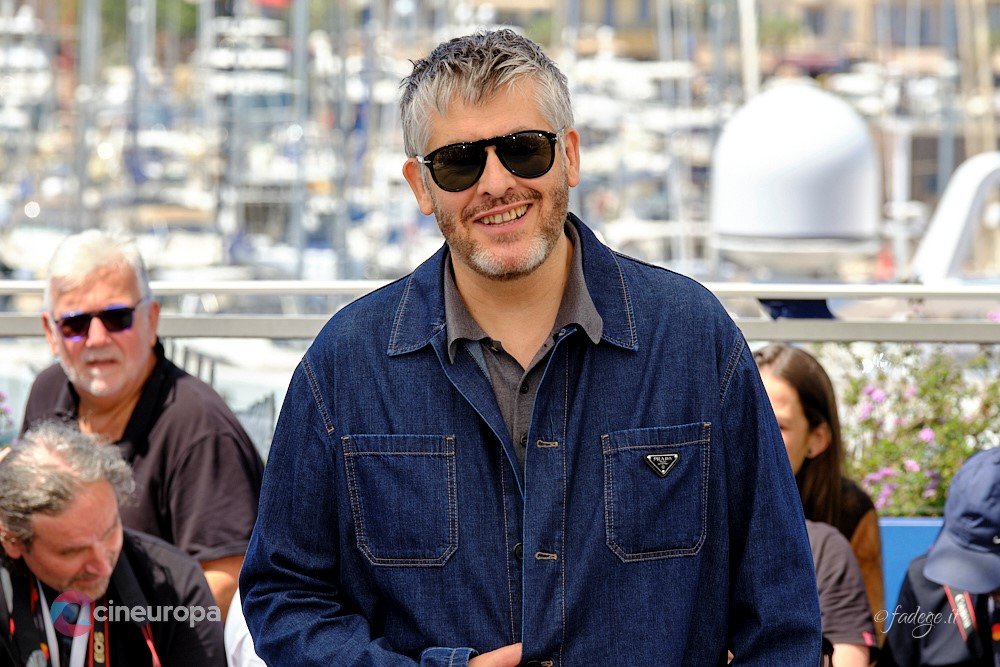
– CANNES 2026: The filmmaker recounts the deeply personal origins of his new film, which reimagines his own family’s memories – rich in emotion and turmoil – as a work of fiction
(© 2024 Fabrizio de Gennaro for Cineuropa – fadege.it, @fadege.it)
Unveiled in the Cannes Premiere section at the 79th Cannes Film Festival, Orange Flavoured Wedding is Christophe Honoré’s 16th feature film, following six other films presented at Cannes (including his latest, Marcello mio, which was in competition in 2024).
Cineuropa: How personal is this story of a wedding in Nantes in 1978 to you?
Christophe Honoré: This film is rooted in family memory. The characters are all from my mother’s side of the family. I was there for that wedding. I wanted to stay true to the way I saw things as a child back then. As a child, I could sense the tensions within that family, but also the love. It really is a film based on real people. I kept the first names and surnames and I’ve toned down the events a little. It’s a family that was on the verge of extinction, but they still have a very good day at this wedding and it’s certainly one of the last happy moments of their lives. In the film, with the flash-forwards, you sense that something is threatening them, a kind of impending tragedy. It’s a family that will be decimated during the 1980s.

That’s probably why it took me so long to make this film. I started working on it over 20 years ago, with a project that began just after 1945, when my grandmother met this Spanish man, found herself pregnant and was forced to marry him, and which ran right up to the 2000s, when my grandmother died. But I couldn’t make this film until I had the idea of bringing everything together within a single timeframe, a single day, and above all of stopping telling myself that I had to tell the stories. What was interesting wasn’t the fictional element I was going to project onto the characters, but trying to let them live and to focus solely on the bonds they shared with one another, how they burdened one another with their suffering and their joys. That is the film’s narrative substance.
How did you handle the complexity of so many characters?
I knew them inside out; I knew what I wanted to show about them, what mood to aim for, and how to work with tones that alternate and are contradictory. When I shoot on film, I do only one or two takes. It’s not at all a film shot in a documentary style, with a handheld camera, trying to capture things on the fly and thinking that in the editing room we’d recreate the flow, the fluidity and so on. The film consists solely of dolly shots, tracking shots and pans. The script was made up of very precise shots. At the same time, when you have 15–20 main characters in the same frame, after a while, you can’t claim to be directing everything. So you had to be on the ball, organising a sort of chaos. I liked the idea of a film where the point of view changes frequently and which works in a somewhat choreographed way. At the start, the characters are presented solely as a group, and then at a certain point, the action narrows down to a room, and so on. And as the film progresses, I hope the audience ends up becoming attached to the various characters. As a cinemagoer, I’m a bit tired of individual destinies and I firmly believe that we define ourselves through the relationships we have with others. And I believe in the collective. This family, even if it is dysfunctional to say the least, is together despite everything: they cannot escape a kind of collective consciousness that belongs to them all, that is shared by everyone. That was really what interested me and, as I went along, I added characters – children in particular – with the idea of giving close-ups and prominence even to very minor characters, and of creating a collective work. I took my cue from Jean Renoir’s films, with their great tenderness towards the characters, yet without any indulgence for their reprehensible traits, and above all the shifts in tone: it seems whimsical, anecdotal, and then suddenly, tragedy strikes without warning.
What about the three flash-forwards?
When I decided to create this narrative structure, at one point I realised I needed to expand on it. And also that I had to be true to myself: even though I wanted to tell the story from a child’s perspective, I was no longer that child and I knew more than my characters did. I escaped from that family which both fascinated and terrified me; I built myself up in opposition to it, in opposition to that environment. There was a fourth flashforward that I didn’t keep in the final cut, a documentary sequence where I filmed myself with my mother as she gave me her opinion on the film.
The film stirs up intense emotions, ranging from love to the wounds of the past that refuse to heal.
There is a relentless side to it, a blinding family truth that they all know but cannot escape. They cannot escape their fate, and the behaviour of some members of this family can be unforgivable. There is something senseless about it: they could be fighting one moment, and the next, love would resurface. For love is certainly linked to their childhood terror in the face of a tyrant, and that fear has bound them together for life. But there is a kind of curse, a transmission and reproduction of violence. It is not a question of judging them, but of acknowledging that they have not escaped it. It is true that, for me, the family is the familiar setting for tragedy.
(Translated from French)
