

Before wellness became a multimillion-dollar industry; before models talked openly about mental health, fertility, Mercury retrograde calendar dates or self-care, fashion turned emaciation into aspiration. Early-1990s beauty meant sunken eyes, pronounced bones, a languid attitude, messy hair, a vacant stare and a general look of stunned bewilderment. Of all the young women who came to embody that aesthetic, few paid as high a price as Jaime King. For years she was one of the faces of so-called heroin chic, the trend that turned fragility into a form of glamour. Decades later, her greatest triumph is not so much having become one of the decade’s most popular models as having survived the persona—and the aftermath—that fashion imposed on her.
King was born 47 years ago into a middle-class family in Omaha, Nebraska. She was the middle child of three, and her parents named her Jaime after the heroine of the 1970s TV series The Bionic Woman. From an early age she was passionate about fashion and spent her mornings making collages from magazine cutouts. She knew every model, every designer and every photographer. Far from fitting the popular-girl mold, the model has said on several occasions that she was bullied in high school—an experience that followed her into her time as a runway star: “I thought if I went into modeling, I would escape this unending feeling of not belonging,” she wrote in Elle. “Then I realized that I didn’t feel any different. No matter how successful I was, I still didn’t feel like I fit in.”
Her life changed forever when Michael Flutie, the owner of an agency, discovered her talent for the runway at a school for aspiring models in her hometown. She arrived in New York at age 13, accompanied by her mother. Her mother soon returned home and Jaime—who adopted the professional name James as a model—moved between strangers’ homes, from couch to couch, while her agent found temporary places for her to stay. “A child at that age should not be in the fashion industry,” the protagonist herself told The Cut. She dropped out of school and devoted herself fully to modeling, landing campaigns and runways for houses such as Alexander McQueen (for whom she starred in the iconic Spring–Summer 1998 show in which she ended up drenched by a jet of water), Chanel and Christian Dior, and becoming a fixture on the major international covers thanks to her melancholic, almost spectral face.
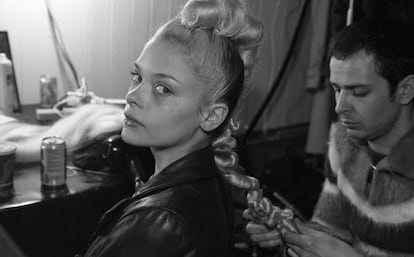
Alongside her rising success, King sank—or was driven—into a self-destructive spiral from which she has never fully recovered. At 14, she revealed to The Cut, that a photography assistant gave her her first line of heroin. Champagne was the usual drink in dressing rooms when, at age 13, she was already posing nude for photo shoots. She later said she had suffered sexual abuse. “I was working and traveling and making a lot of people a lot of money but wasn’t even allowed to open up a bank account. I had zero autonomy.” By 16 she was an international star, and her romantic relationship with Davide Sorrenti, a fashion photographer and one of the intellectual authors of heroin chic, made them both the epitome of cool in New York’s grunge, bohemian ’90s.
The turning point came on May 4, 1997. Although his death was ultimately due to complications from a hereditary blood disease he suffered, Davide Sorrenti’s death at 20 had a huge impact on public opinion, which attributed his tragic end to indiscriminate drug use. The nature of his romance with Jaime became tabloid fodder and even reached the halls of Washington. Barely two weeks later, then–U.S. president Bill Clinton devoted a press conference to denouncing the rise of heroin chic among young people. “In the press in recent days, we’ve seen reports that many of our fashion leaders are admitting—and I honor them for doing it—that the images projected in fashion photographs in recent years have made heroin addiction seem glamorous, sexy and cool,” Clinton said. His remarks argued that not everything is fair game in selling clothes and denounced those images as destructive rather than creative; not beautiful but ugly, and more about death than art. “And glorifying death is not good for any society.”
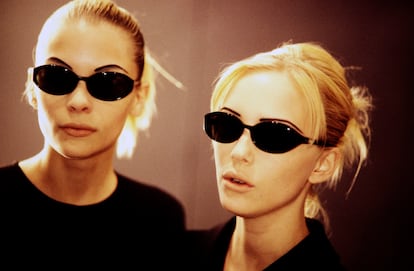
King never forgave Clinton for sullying the photographer’s memory. “After Davide passed, that was the first time I experienced any — I didn’t know what a panic attack was, but I felt like I was always going to die. The cruelest thing was having Bill Clinton, the president of the fucking United States of America, talk about you and the love of your life and describing us as “heroin chic” while displaying our images and distorting them. People made it seem like we were glamorizing death, but we weren’t; it was our way of saying something about the kids who were dying too young. And then, of course, as dumb politicians do, especially ones that sexually abuse women like President Clinton — and you can put that in there — he tried to moralize things. So he called us heroin chic as though we were glamorizing something,” she told The Cut.
Alone, depressed and in the eye of the storm, King decided to quit modeling at the height of her career. Everyone tried to persuade the money-making machine—barely 18—to change her mind, but she chose to enter rehabilitation for her addictions and pursue a career in film, her true passion. She only partly succeeded. She debuted in small roles in films such as Blow and Pearl Harbor, and her biggest opportunity to date came playing twin sisters in Robert Rodriguez’s Sin City. Her career has moved between television series, such as Kingdom Hospital, and low-budget thrillers aiming for mainstream entertainment. Her resurgence among a new generation of viewers came with her friendship with Taylor Swift, whom she named godmother of her second child.
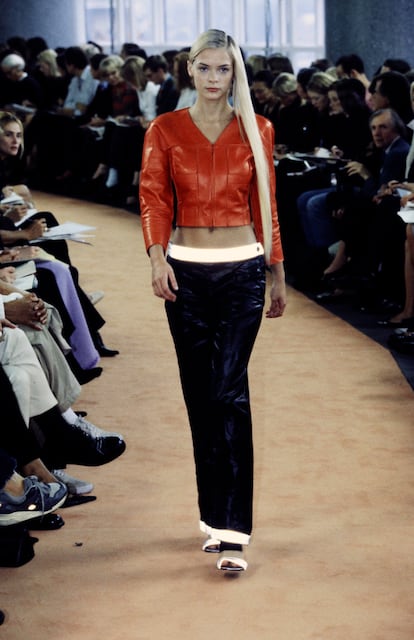
Her style has evolved over the years. She still nods to rock and grunge, but she also brings much more romantic or sensual notes depending on the occasion. On the runway she alternates major houses such as Dior, Schiaparelli and Oscar de la Renta with independent designers she supports and gives visibility to, like her friend Jason Wu. As a model she has kept a chameleon-like ability to slip into a Hollywood-classic gown—as she recently did at the Cannes Film Festival—and, the next day, to wear a vest turned minidress in pure Kate Moss style, a slip-inspired design with boots or an ultraminimal strapless gown. Her iconic platinum-blonde hair and distinctive personality serve as the aesthetic thread that ties together everything she wears.
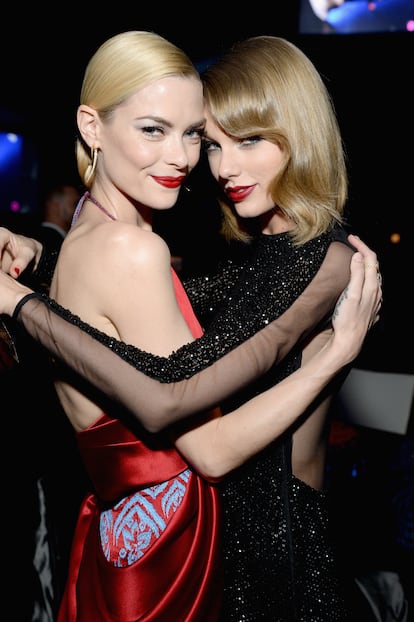
Her attempts to rebuild her personal life have not been easy either. A mother of two—James (12) and Leo (10)—she has been embroiled since 2020 in a legal battle with the filmmaker Kyle Newman, her husband of 13 years. After she filed for divorce citing “verbal, physical and emotional abuse,” a judge in 2025 awarded sole custody of the children to Newman and ordered King to enter a six-month rehabilitation program for alcohol and drug use. A year later, the actress shares happy everyday images with her children on Instagram. In addition to continuing to act, she runs her own production company and a talent agency.
Sign up for our weekly newsletter to get more English-language news coverage from EL PAÍS USA Edition
