
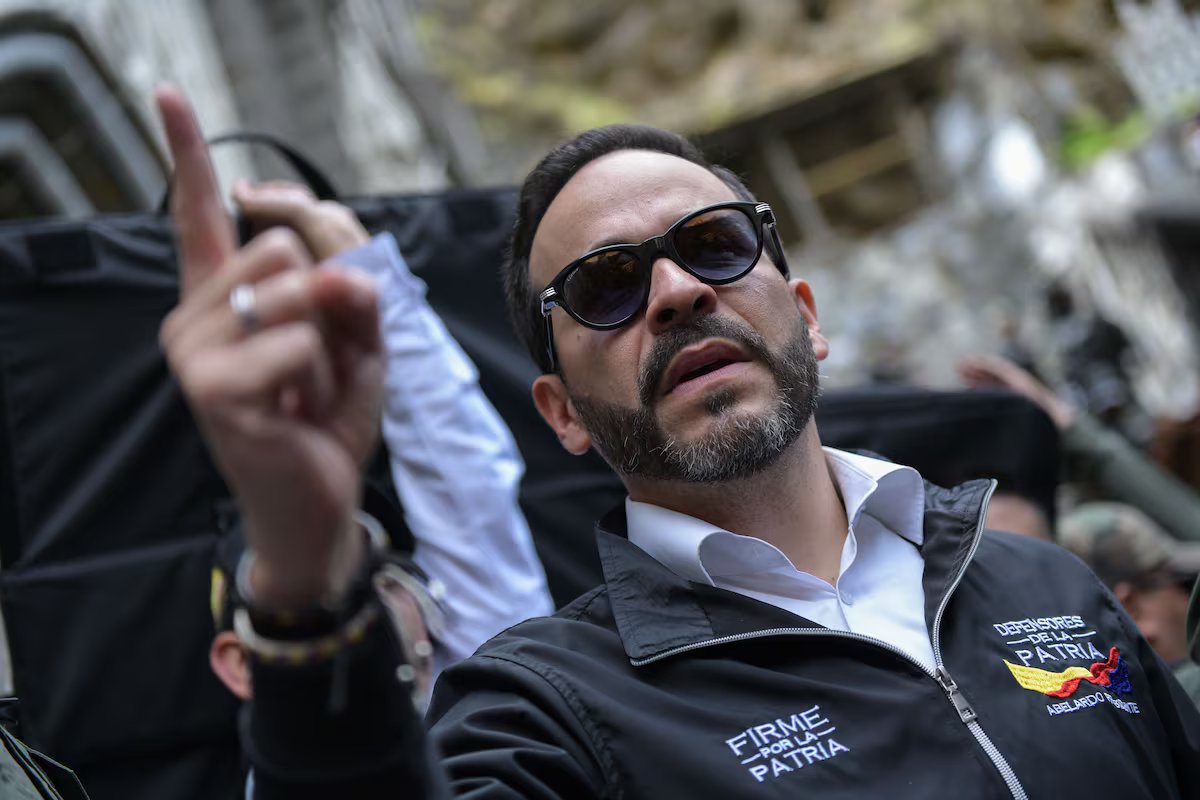
Colombia’s president-elect Abelardo de la Espriella has declared war on the entities created to achieve and sustain peace. The far-right politician has announced that, in the year that marks the 10th anniversary of the peace agreement with the FARC guerrilla, the government will close several offices dedicated to carrying out the measures that were negotiated to end the conflict, and in their place, will create a national security commission.
Three weeks before taking office, the former criminal defense lawyer has identified downsizing the government as a priority for the incoming administration and emphasized his opposition to negotiated settlements.
On Tuesday, as Rodrigo Londoño — the last head of the guerrillas and leader of the movement that led to the demobilization of 13,000 former FARC soldiers — spoke at the International Peace Congress, De la Espriella’s team put out a press statement that expressed profound rejection of the 2016 pact, stating “That bandit deserves to be locked up for life.” The former leader of the guerrilla group referred in his remarks to the incoming administration’s threats, saying, “the lives of all signatories are in danger with these hateful discourses.”
According to Colombia’s Special Jurisdiction for Peace, 460 former FARC combatants have been murdered since 2016. Independent investigations suggest that in the majority of these cases, the suspects are dissidents from the same guerrilla group. The bulk of the crimes took place while victims were participating in the reincorporation process, and that they had not gone back to criminal activity. The Agency of Reincorporation and Normalization (ARN) has found that only 15% of the demobilized guerrillas have taken up arms again. In light of such findings, Londoño warned Tuesday that the rhetoric of the new government puts at risk the lives of those who laid down their weapons 10 years ago.
The Office of the High Commissioner for Peace, created in 1994 as the evolution of a peace council founded a decade before, has since served as the state’s formal channel for negotiating an end to the conflict. It operates alongside the Implementation Unit of the Final Agreement, which is charged with carrying out the commitments taken on by the state in 2016, from the reincorporation of former combatants to security guarantees. Rounding out this team is the Office of National Reconciliation, which oversees meetings between victims and perpetrators of the conflict, and the Presidential Office for Human Rights and International Humanitarian Law, which monitors the rights of the civil population during conflict, as it has done for more than three decades.
These four entities, which form the heart of the institutionalization of peace and human rights in the executive branch, and which were built by several administrations, will either disappear or become tied to a securitization agenda. De la Espriella announced that the future National Security Commissioner will join the already appointed Ministers of Justice and the Interior in “immediately dismantling” what he calls “mechanisms of impunity shielded by the current peace model.”
Former president Juan Manuel Santos, who signed the original agreement, has asked De la Espriella to “retake the road to implementation, not as a governmental legacy, but as a state policy that benefits all Colombians.” The president-elect has not given any details on his own plan and at the time this article went to press, his administration’s two spokespeople had yet to comment.
Symbolic blows have also been struck against other entities belonging to the structures Colombia created in the attempt to overcome decades of armed conflict. One of these is the Agency for Reincorporation and Normalization, which oversees the process of returning more than 11,000 former guerrillas to civilian life. Alejandra Miller, its director, explains that “the president-elect and his administration have introduced a dangerous narrative that equates the signatories of the peace agreement with the FARC dissidents. This puts them at tremendous risk, because it falsely suggests that they have continued to commit crimes,” she says. Miller is also a former commissioner of the Truth Commission, the body that for three years sought to shed light on the conflict’s most harrowing episodes. “One of the major conclusions we reached was that peace was not a national project. We were deeply concerned to find a country that is not united around the goal of peace.”
De la Espriella has announced that the entities will disappear August 7, the day he takes power, but there are legal obstacles to his plan. Emilio Archila, who was senior presidential advisor for stabilization and consolidation during Iván Duque’s administration, warns that the Presidential Office of Security will not be replacing the Office of the High Commissioner for Peace. “We are talking about two complementary, but completely different things. This is what is fundamentally needed to prevent violence from recurring, but it has only a distant connection to the issue of security.”
Archila also explains that these commitments do not belong to any single government, nor are they related to the peace agreement. “They are matters of state,” he warns. “Lacking a central point of authority within the presidency leaves highly relevant issues adrift, such as reintegration, fulfilling obligations to victims, and the implementation of the PDETs [Territorially Focused Development Programs].”
In addition, many of the commitments are legally protected. In 2017, Congress approved a constitutional reform to safeguard the peace agreement and compel the government to comply with it for three consecutive presidential terms, through 2030, precisely for this reason. Therefore, laws, decrees or decisions that run counter to the agreement may ultimately be struck down by the courts.
Another obstacle stems from institutions that are not part of the executive branch and cannot be eliminated by decree. The most notable of these is the Special Jurisdiction for Peace (JEP), the transitional justice body that prosecutes former combatants, former military personnel, and some civilians for the most serious crimes committed during the armed conflict. Unlike the Office of the High Commissioner, this court is not part of the executive branch and did not arise from an administrative restructuring, but rather from a constitutional amendment.
In the past, Iván Duque’s right-leaning administration attempted to halt and redirect implementation, using the budget as a tool to weaken the entities tasked with carrying out the agreement’s commitments. They managed to stall the reintegration processes and delay the launch of the transitional court, but the implementation process overcame that obstacle. In that case, however, the High Commissioner for Peace did not disappear. This time, under the ultra-right incoming leader, the panorama is different.
Sign up for our weekly newsletter to get more English-language news coverage from EL PAÍS USA Edition
