
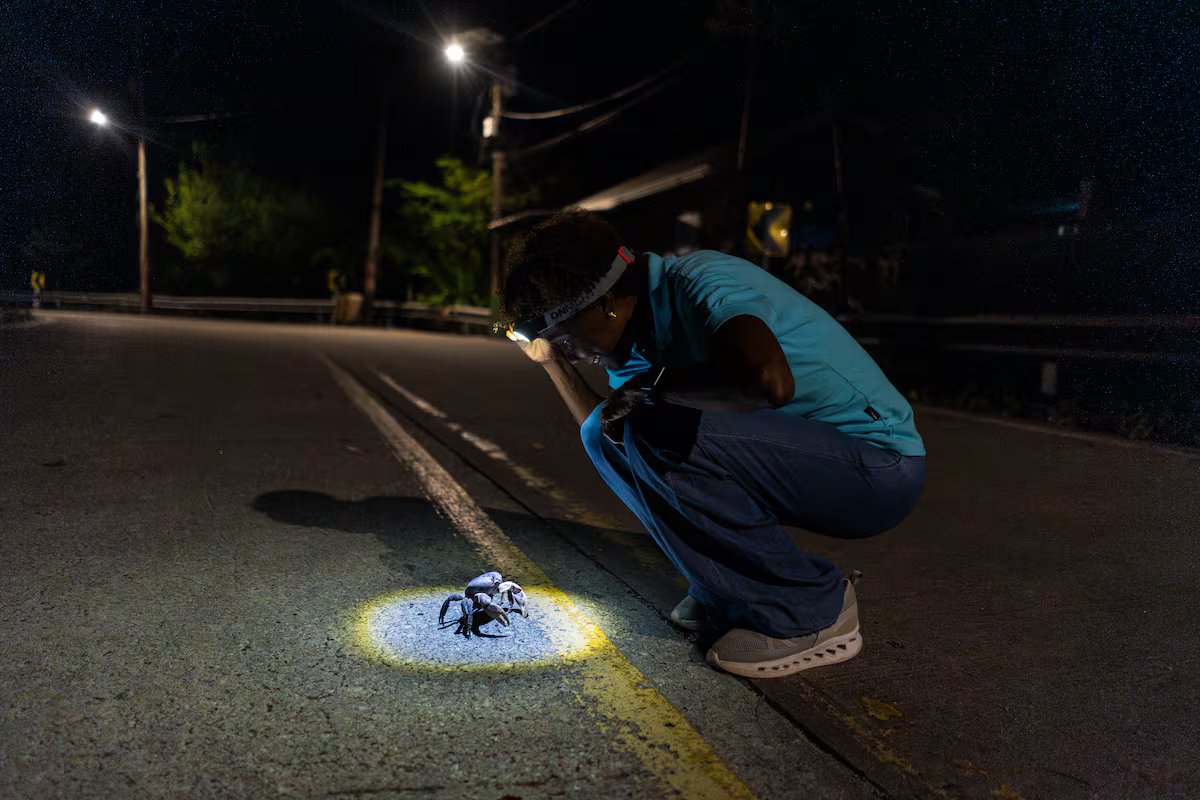
With the first rains of the year, everything changes on the islands. Residents of the Archipelago of San Andrés and Providencia, about 775 km (481 miles) northwest of mainland Colombia, know that in the rainy season the migration of a nine-centimeter (3.5 inch) crustacean disrupts everyone’s routine. It has been this way for as long as islanders can remember. When she was little, Asilvina slept with earplugs, Darson placed towels under his doors and Nicolás’ school bus driver would get down with a palm frond to sweep crabs off the road as they crossed from the mountain to the sea. Hundreds of thousands of Gecarcinus ruricola once carpeted the main road in black and purple, making it impossible for any vehicle to pass at night. Today, the same children who used to go to sleep worried that the claws would catch their ears are the biologists who, from April to July, close the roads so the few individuals that now climb the hill can reach the coast to spawn without being crushed by a car.
The Gecarcinus ruricola —which in Colombia only lives in this archipelago located 1,300 km (807 miles) from Bogotá and just 200 km (124 miles) from Nicaragua— is a species in danger of extinction. It is estimated that more than half a century ago the islands hosted around 20 million of them, and today the population barely reaches a million. The few that remain hide in the burrows of Providencia’s hills; on San Andrés the population has already fallen to historic lows. Older residents of this paradisiacal island of just 5,000 people still find it hard to understand what happened for an animal so present in their childhood to now be under conservationists’ protection. The main reasons are three: climate change, overharvesting and roadkill. “In short, only one: human beings,” summarizes Asilvina Pomare, coordinator of Coralina’s office in Providencia, from her office a few steps from the sea.
These closed season months are vital for the crab’s survival. It is now that the females —which have already been fertilized and activated their eggs with an initial plunge into the sea— head to the shore to spawn in their final bath of the year. On their pleopod, or belly, they carry roughly 20,000 tiny eggs that will only hatch after a couple of days feeding on microorganisms in the seawater. Twenty days later, the larvae will have transformed into megalopae (little crabs with tails) and later into juveniles with claws. These small red crustaceans will then retrace their mothers’ path to begin their adult life in the hills.
Asilvina arrives at 10 p.m. to the fenced area on a motorcycle she parks a few feet away. She gets off, her eyes fixed on the ground, and smiles when she hears the dry leaves crunch. They are there, hidden from sight. Waiting for the best moment to cross the street. The woman waits on the other side of the sidewalk for them to gather the courage to cross. She watches them with the same tenderness a mother gives her babies taking their first steps. A couple of crabs hop down from the hill and effortlessly climb onto the asphalt. “Come on, you’re almost there,” the biologist urges.
A motorcycle speeds by a few centimeters from the crustaceans, blinding them with its headlight. The crabs that were about to complete the crossing raise their claws menacingly and return to the hill in seconds. Asilvina flies into a rage and shouts in Creole at the rider: “Slow down, man! We told you to go slow!” “How dramatic! I didn’t kill any!” he replies from the motorcycle as he rides away.
On an island with exponential growth and thousands of cars and motorcycles, the act of spawning is a true odyssey for the crabs. In fact, when females feel deeply threatened they scrape their bellies and kill their own larvae rather than face a greater threat. That is why in the mornings it is common to see crushed females on the island and rivers of bubbling black eggs. The streets become graveyards for one of Providencia’s few terrestrial animals.
Climate change only makes it harder. For slightly more than a decade, the scientific community began to notice that currents returned barely 1% of the megalopae to the coasts as a consequence of changes in sea temperature and variations in currents. Of that tiny percentage, hundreds are crushed on the way up to the hills. The crab’s survival faces one obstacle after another.
Asilvina’s role is key to conserving the Caribbean’s most emblematic crustacean. Twenty years ago she secured approval for a resolution that gives Coralina the authority to close roads during the closed season, which runs from April 1 to July 31. During these dates, streetlights are dimmer (so they aren’t mistaken for the moon, which the crabs use for navigation) and the authority’s 12 biologists take shifts from 9 p.m. to 2 a.m. to ensure no four-wheeled vehicles pass through the area of greatest crab activity and that motorcycles go slowly.
No one on the team is paid overtime for the work they do for a third of the year. And Asilvina bears the worst of it. “I don’t care if the whole island hates me. If by doing this I save even one, we are giving it the chance to produce thousands of baby crabs,” she says. Residents with cars who forget the regulation turn around and take the other direction along the ring road.
“Young people aren’t connected to nature”
Although awareness campaigns begin months in advance, the San Andrés–born biologist acknowledges the task is increasingly difficult. “When we started doing this, the older people understood and respected it, but today’s young people are not at all connected to nature or to what it means to us. They laugh at people for doing all this for some little animals,” she says angrily.
But saving these little animals is not a whim. They play a key role in the island’s ecosystem, because by digging burrows they improve soil quality, facilitating water filtration. The habitual act of digging also contributes to nutrient recycling in the dry forest, and they serve as food for various terrestrial and marine species.
The possibility of the black crab’s extinction is a loss that goes far beyond the environmental. It is Providencia’s emblem and one of the cultural roots of the Raizal people and their cuisine. Its image is in every corner of the island: on figures that mark beach entrances, on benches under native cotton trees, on hotel tiles and in many companies’ logos. It is part of the identity of a coastal community that honors it in songs and stories and that cooks it in about 20 ancestral recipes. Biologists estimate that around a hundred families make a living from this resource, such as the Livingstone family, for whom Imarsita has been processing crab for as long as she can remember. The closed season is sacred to her. “We cannot afford to be left without it.”
“The black crab is the islands’ bioindicator”
The crustacean’s importance is such that the strategy to safeguard it is multidimensional and ranges from educating children to closing roads, encouraging capture outside the closed season and breeding crabs in captivity. Faber Andrés González, a biologist from San Andrés, led a pilot project for the latter.
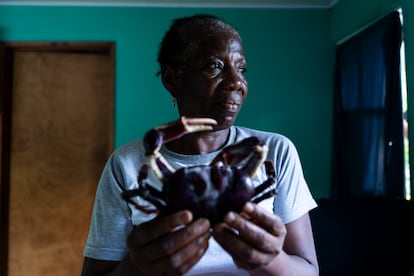
In 2019 he began to realize that many islanders were ignoring the closed season to hunt crabs and sell them (at 50,000 pesos a pound, about €10, a price higher than many fish). Overharvesting, shifts in sea current direction and prolonged droughts have steadily reduced the population, much like what happened with the blue crab in Asia. So he decided to bring the egg-hatching process into the laboratory until megalopae were obtained. In a self-funded project, he went to Providencia to gently scrape females’ pleopods with a brush —mainly those of crushed individuals— and those eggs were placed in a hydroponic environment with conditions similar to the natural habitat. Days later, the surviving juvenile population was five times larger than the ones typically found in the wild.
“My intention was for people to consume meat from lab-reared crabs and leave the island’s wild population alone,” he explains. However, the project became economically unsustainable and today there is no one running it. “The black crab is the bioindicator of this natural reserve. When it disappears, life will be unviable,” he laments.
It is 11 p.m. at the home of Alberto Curramba Mercado, a fisherman from Barranquilla, and Claudia Feix, a German geographer. Their home sits at the crabs’ favorite spot. Twenty years ago, the Colombian says, during the rainy season he would carefully remove dozens of Gecarcinus ruricola that accidentally ended up in the bathroom, between the beams of the living room or on his bed. Feix shows, emotional, images she took decades ago when the asphalt was practically invisible during migration days. “There were waves after waves. Today we see nothing compared with what it used to be,” she recalls. Tonight, Curramba will take only three from the house.
The last one he finds is trapped behind the refrigerator. It looks terrified. The fisherman climbs barefoot onto the counter with a broom and dustpan and reaches for it very carefully so as not to scrape any larvae. “I’m not going to do anything to you, relax,” he tells it. Seconds later he catches it from behind in a swift move and places it in the garden. It rushes off to hide. “This is how we amuse ourselves these days,” he says. No one seems bothered by this routine. “It’s the least we can do. We’re the ones in their house,” they acknowledge.
Sign up for our weekly newsletter to get more English-language news coverage from EL PAÍS USA Edition
