
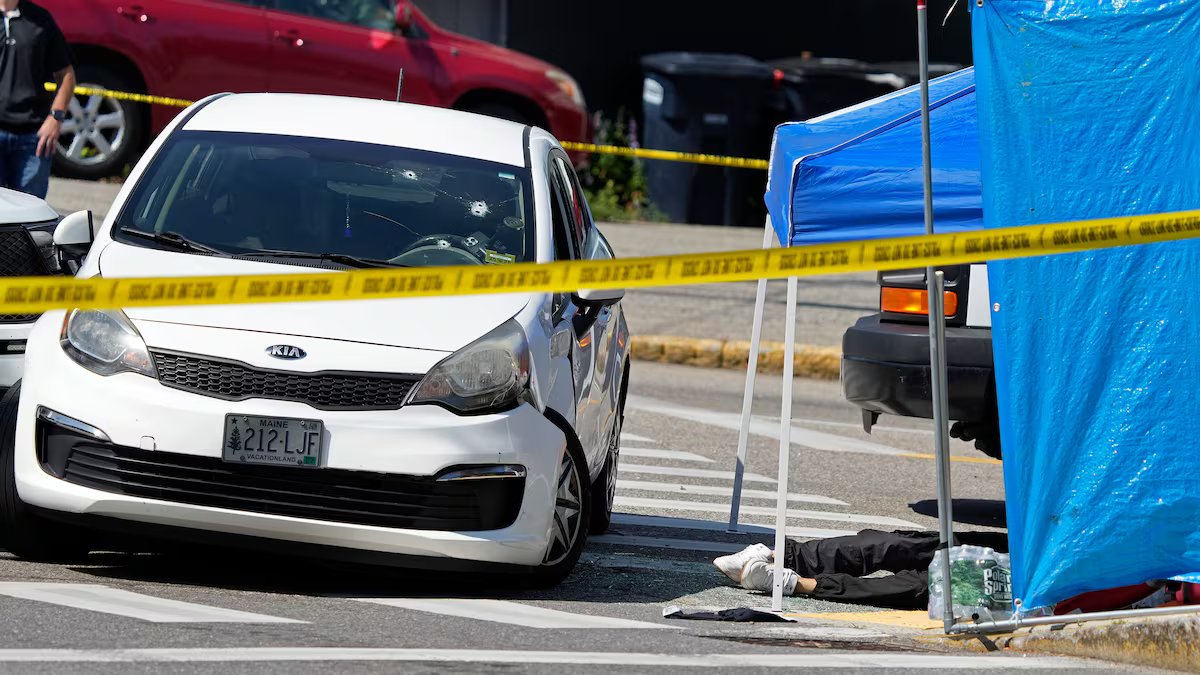
The coastal city of Biddeford, Maine, was the scene on Monday of the second fatal shooting by agents of U.S. Immigration and Customs Enforcement (ICE) in less than a week. A 26-year-old Colombian, whom authorities had not identified more than 12 hours after the incident, died from shots fired by an ICE agent as he was getting ready to go to work in his car. Maine independent Senator Angus King said that, according to Homeland Security Secretary Markwayne Mullin, the victim was not the same man for whom ICE had a warrant. The incident echoed what had happened six days earlier in Houston, when another ICE agent fatally shot Lorenzo Salgado, a 52-year-old Mexican man who had been mistaken for someone else.
It was shortly after 7 a.m. when gunfire alerted residents of Biddeford, a small working-class city of about 23,000 people located roughly 24 kilometers (15 miles) southwest of Portland. Several witnesses saw federal agents running after a white car whose windshield was riddled with bullet holes. The driver was killed. Hours after the incident, authorities had still not identified the man, who, according to the organizations Maine Immigrants’ Rights Coalition and Presente!, was a 26-year-old Colombian national with a work permit and a Social Security number.
Soon, several residents began gathering at the scene to protest ICE operations, while Salgado’s death was still fresh in the public mind. In both cases, the government’s initial explanation, nearly 12 hours after the events, was that the agents had acted in self-defense.
On July 13, 2026, at approximately 7:00 AM ET, ICE was conducting targeted surveillance on the last known address of an illegal alien with a final order of removal. An illegal alien departed the residence in a vehicle. ICE law enforcement attempted to conduct a vehicle stop. The…
— Homeland Security (@DHSgov) July 13, 2026
“ICE was conducting targeted surveillance on the last known address of an illegal alien with a final order of removal. An illegal alien departed the residence in a vehicle. ICE law enforcement attempted to conduct a vehicle stop. The vehicle attempted to flee the scene and, fearing for public safety, an officer discharged his weapon,” DHS said in a statement.
“The Biddeford Police Department and FBI responded to the scene. DHS OIG has been notified and like all discharge of firearms this will be investigated. This is a developing situation, and we will update the public when more information is available,” it added. The DHS statement did not reveal whether the man was the target, as Secretary Mullin reportedly told Senator King.
Maine Governor Janet Mills, a Democrat, responded to reports that the victim was not the ICE target. “This development makes this tragedy even more disturbing and infuriating, and it underscores the reckless and haphazard manner in which immigration enforcement operations are being conducted in Maine and across the country. This has to end,” she wrote on X.
Questionable accounts
In Salgado’s case, witnesses who were riding in the car with him when he was shot have contradicted the administration’s claim that he was about to attack the agents. In the Biddeford shooting, residents near the scene believe the driver had already been struck by gunfire when agents chased the car, which was reportedly spinning out of control and which, according to the Department of Homeland Security (DHS), had attempted to run them over.
‘I tried to stop’
Daniel Boucher said he looked out the window of his third-floor apartment after hearing popping sounds and saw a small car “turned 90 degrees to the curb,” with a pickup truck behind it, the Associated Press reported. The driver appeared to be injured, and the vehicle began rolling down the street until the pickup struck it again, Boucher said.
“His face was bloody. His head was bloody,” Boucher said. “I clearly heard the victim say, ‘I tried to stop’ — clearly heard him say that.”
In both cases, the agents were not wearing body cameras that could verify their accounts, despite the DHS’s earlier commitment to provide them to all immigration officers. After U.S. citizens Renée Good and Alex Pretti were killed by shots fired by federal agents in Minneapolis in January, the DHS invested millions of dollars in body cameras in response to pressure from Democrats and the public. However, most agents still do not have them.
Mary Hayes, who lives near where the shooting occurred, said the man lived nearby with his wife and daughter. “I watched a wife fall to her knees looking at her husband’s dead body on the ground,” Hayes told the AP as she held a piece of cardboard with “No ICE Stop ICE” written on it. “I watched a little girl crying with a little pink backpack on because she’s never going to see her father again.” Witnesses said they saw the victim bleeding from the head.
Cory Poulin, whose family runs a laundromat near the scene, said the store’s security cameras captured footage of the man’s car moving toward the intersection after the shots were fired. Other images from the scene showed the vehicle spinning and the windshield with bullet impacts.
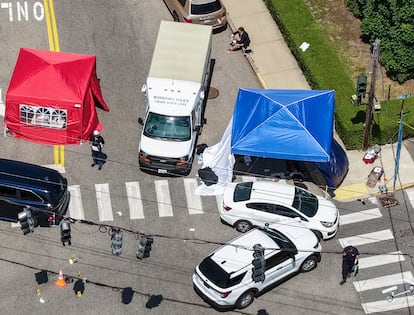
“Two ICE members ran to the intersection and another ICE member in a Ford SUV went into the intersection to stop the car from rolling,” he said. “I don’t know for a fact, but I don’t believe he was alive when the car started rolling.” According to Poulin, the Maine State Police asked him not to release the footage.
Liam LaFountain, Biddeford’s mayor, called in a statement for “ a full, thorough and transparent investigation into this fatal incident.”
Maine Attorney General Aaron M. Frey said Monday afternoon that, according to initial reports, “the subject attempted to flee in a vehicle in the direction of the officer and was fatally shot.”
ICE steps up arrests
Maine has an aging population and in recent decades has welcomed migrants who have helped revitalize the economy and now make up about 5% of the population. ICE’s presence in the state intensified in January with the so-called Operation Catch of the Day, a reference to Maine’s seafood and lobster industries. Residents say ICE activity has increased further in recent weeks. Nationwide, the administration has stepped up detentions, reaching about 2,000 arrests per day by late June — double the rate recorded in previous months.
Mullin, who has led the DHS since late March after replacing Kristi Noem, took the position with the goal of keeping ICE out of the headlines. The killings of Good and Pretti sharply increased public disapproval of the department, and a majority of Americans said they opposed what they viewed as abuses by federal agents in carrying out President Donald Trump’s immigration agenda.
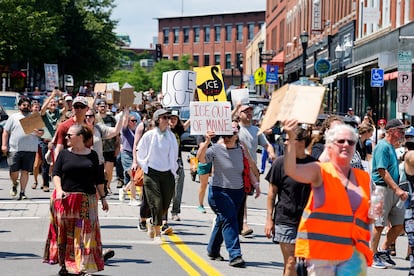
Politicians and civil-rights organizations have called for a comprehensive investigation. In previous cases, concerns have been raised about the impartiality of inquiries conducted by the FBI without the involvement of local authorities.
“The extrajudicial killing of another community member by ICE agents in Maine — just days after the fatal shooting of Lorenzo Salgado Araujo in Houston — is a devastating and unacceptable escalation of violence,” said Angelica Salas, executive director of the Coalition for Humane Immigrant Rights (CHIRLA), in a statement. “These are not isolated incidents; they reflect an immigration enforcement system that has become increasingly militarized, unaccountable, and willing to use deadly force against the very communities it is supposed to serve.”
Sign up for our weekly newsletter to get more English-language news coverage from EL PAÍS USA Edition
