
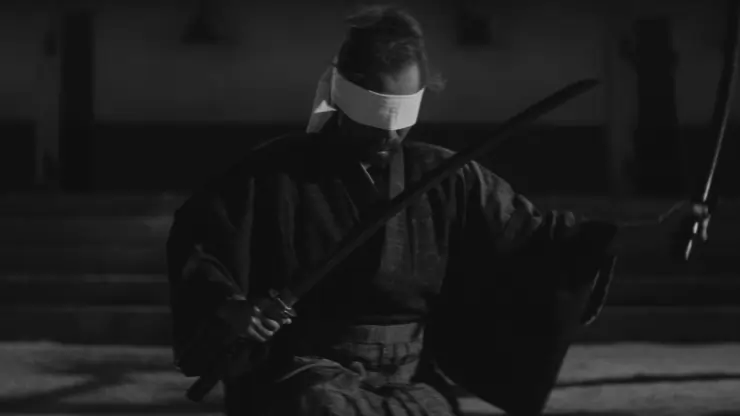
Subservience to a greater power is something we all experience, even as we strive to be the masters of our own destiny and resist this harsh reality. We constantly push back against the systems that govern us, though we are not always successful. Cruel Tale of Bushido explores this idea—as well as other enduring themes that resonate just as strongly in 2026 as they did at the film’s premiere in 1963. Through its powerful narrative, we witness how generational cruelty, obedience, and exploitation shape a family lineage across time.
Beginning in the 1960s, we see Iikura (Kinnosuke Nakamura), a salaryman, informed of his fiancée’s attempted suicide. While at the hospital, he reflects on the last 350 years of his family history, noting how generations of his ancestors suffered repeated acts of cruelty at the hands of their lords. Throughout the film, we witness what happened to seven generations of the Iikura family as the story steadily moves toward the present day.
Kinnosuke Nakamura is absolutely incredible as the many generations of Iikura. Despite portraying a wide range of characters—from a tortured concubine to a skilled samurai and even a kamikaze pilot—you truly witness how he transforms himself for each role. It’s a genuinely immaculate performance, one that only a performer of Nakamura’s skill could deliver. The rest of the cast are equally impressive, allowing each segment of the family’s lineage to flourish and carry real emotional weight.
My favourite segment is unquestionably the Kyutaro concubine era. The film’s exploration of homosexual dynamics among samurai and the ways retainers are forced to please their lavish lords is strikingly bold for its time. It powerfully illustrates that, regardless of sexual orientation, the abuse of lower classes by those in positions of power is universal and can be inflicted upon anyone (even if, statistically, men are more likely to abuse women). It’s remarkable to see a film from 1963 confront this subject matter so directly. It’s a theme rarely discussed within modern Japanese cinema discourse, with the only modern comparable example that comes to mind being Takeshi Kitano’s Kubi.
Cruel Tale of Bushido also tackles loyalty and the bushidō code of the samurai. It presents this set of arbitrary rules as more ritualistic than honourable, another mechanism of systemic control. From the death of a lord prompting the mass suicide of retainers as a display of loyalty, to the notion that samurai are nothing without their masters, the film exposes how deeply this ideology is ingrained. Watching generations of one family remain subservient to those in power—people who view them as inherently lesser—is nothing short of powerful.
The black‑and‑white cinematography by Makoto Tsudoi is absolutely striking. Despite being nearly 62 years old, the film looks remarkably timeless, even though it is unmistakably a product of the 1960s. It creates a fascinating juxtaposition—feeling both distinctly of its era and yet visually enduring. The mono audio track is similarly impressive, sounding crisp and full. The film’s practical sets and effects are also impeccable, transporting the audience seamlessly into each respective period of Japanese history.
It’s not all perfect; the film’s narrative creates a somewhat repetitive rhythm as each generation of the Iikura family falls victim to yet another act of cruelty. This repetition causes the later segments to feel less engaging, even though the final chapter should be the most compelling, given its attempt to apply shogunate ideals to the corporate world of contemporary Japan. However, when we finally reached this segment, part of me simply wanted the film to end.
The disc presented by Eureka Entertainment is solid. It features a new, informative interview with film critic Tony Rayns and an excellent video essay, Years of Honour, by the ever‑fantastic Jonathan Clements. The 1080p presentation, sourced from Toei’s 4K restoration, also looks fantastic—even on my high‑end LG 4K OLED. I do wish the package offered more in terms of bonus features, but having some is certainly better than having none.
Cruel Tale of Bushido, while often cruel and difficult to watch, is a film worth experiencing. It’s not perfect—the highs are truly splendid, while the lows stem mainly from its slightly repetitive structure. Nevertheless, it remains a worthy purchase for any fan of Japanese cinema.
★★★★
Out Now on Blu-ray / Kinnosuke Nakamura, Eijirō Tōno, Kyōko Kishida, Masayuki Mori, Shinjirō Ehara / Dir: Tadashi Imai / Eureka Entertainment / 15
Discover more from
Subscribe to get the latest posts sent to your email.
