
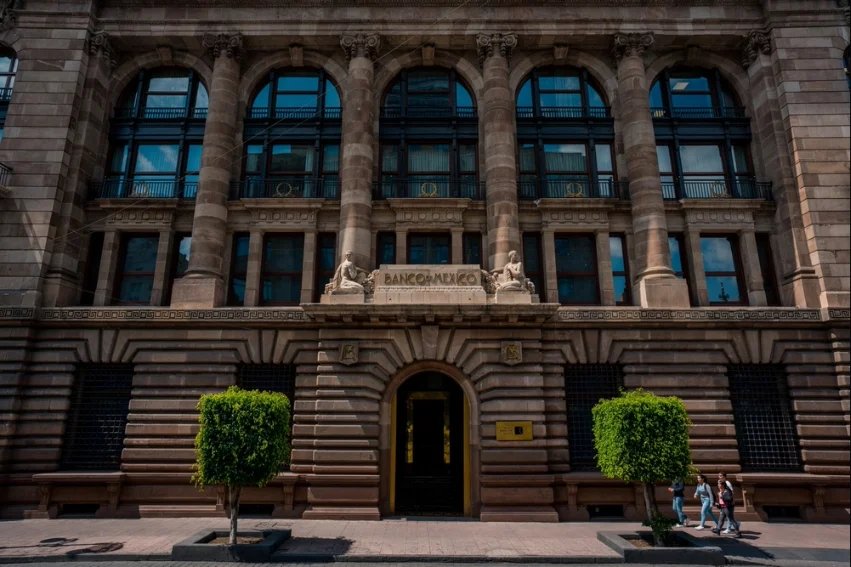
The Bank of Mexico adopted a guarded approach in its Aug. 6-7 monetary policy meeting, indicating it is likely to keep its benchmark interest unchanged, even as inflation is easing.
In minutes from the meeting released on Thursday, the central bank cited an uncertain global backdrop and lingering inflation risks in its decision to maintain a 6.5% interest rate, deeming it “adequate to face the current economic risks.”
It further justified maintaining the rate by assessing “the observed levels of the [peso-dollar] exchange rate, the absence of demand pressures in the economy and the degree of monetary restriction implemented.”
The board said it believed the monetary policy stance “is adequate to meet the challenges of the macroeconomic environment, including those arising from the international context.”
Still, four of the five members of Banxico’s Governing Board said the persistence of inflation in services remains a concern, prompting the cautious stance. A balance of risks skewed to the upside and the continued weakness of the Mexican economy also impacted the decision.
Policymakers view inflation in services (i.e., restaurants, hotels and air travel) as a key concern as it has remained above 4% since late 2021. It is viewed as one of the primary obstacles to bringing overall inflation back to the bank’s 3% target.
Board members attributed lingering price pressures in the service sector to businesses adjusting prices slowly while facing elevated costs for labor and living expenses

Headline inflation slowed to 3.12% in July, down from 3.37% in June, marking its lowest level since May 2020. However, core inflation — which excludes some volatile food and energy prices — registered at 3.95%, down slightly from 4.03% in June.
Banxico, as the Banco de México is also known, now says it doesn’t expect headline inflation to converge to its 3% target until the fourth quarter of 2027, requiring sustained monetary discipline. In the short term, analysts surveyed by Banxico expect year-end headline inflation of 4.00%.
A strong peso has helped curb inflation. The currency — hovering at and below 17 to the U.S. dollar since last week — has strengthened nearly 6% in 2026, helped considerably by a weaker dollar, though Mexico’s solid macroeconomic fundamentals are a factor as well.
The minutes noted that the economy expanded in the second quarter (+1.5%) after contracting in the first, but some members warned that weakness persists in various components of demand.
Regarding the international environment, the board highlighted tensions in the Middle East that continue to pose upside risks to inflation, cautioning that the prolonged conflict has tested the buffers that “have mitigated the rise in oil prices.”
With reports from Reuters, El Economista, Forbes México and Mexico Business News
