
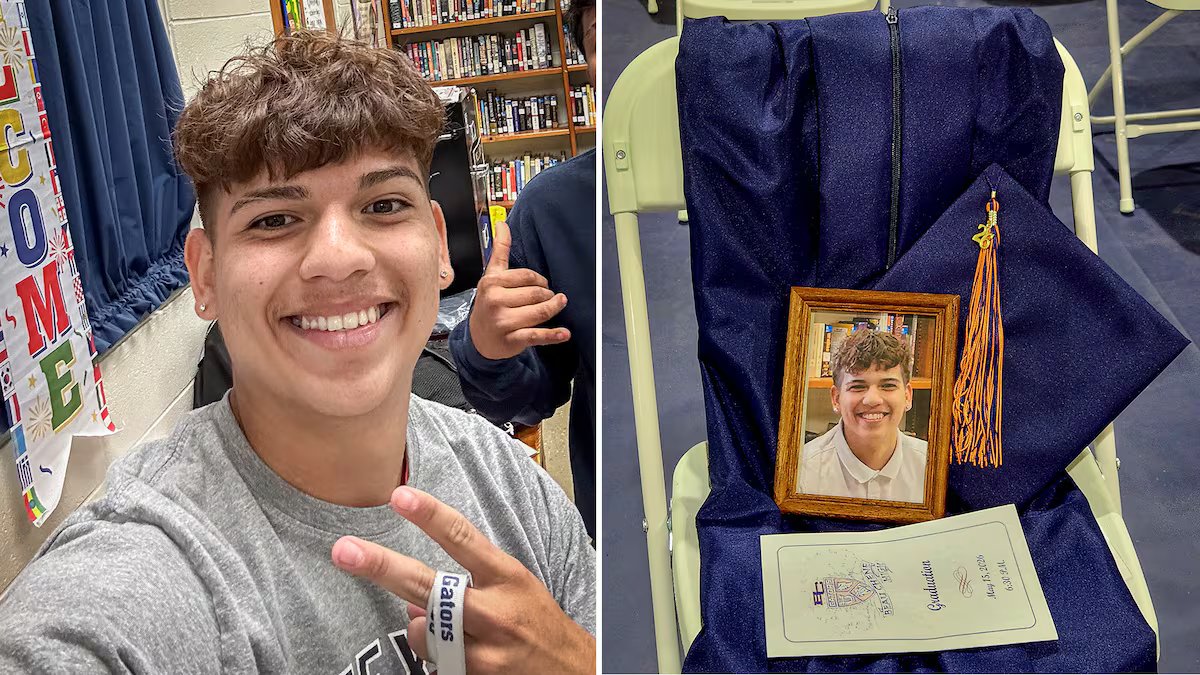
As every year around this time, Beau Chêne High School in the city of Arnaudville, Louisiana, held its high school graduation ceremony on May 15. A long-awaited day, when students and their families gather to attend the presentation of diplomas marking a milestone in their lives, took on a bittersweet tone this year. Among the rows of students waiting in uniform, one half-empty chair stood out. Resting on it were the traditional gown and cap worn by students that day, a photo of a smiling young man, and a diploma bearing the name of the absent graduate: Josué Zamora.
Instead of taking part in the ceremony — one of the dreams that had led him to leave his home country, Honduras, four years earlier — Josué, 20, was unable to collect his diploma because he was being held in an Immigration and Customs Enforcement (ICE) facility. When his name was read among those being honored — “This is a special and emotional moment for Josué Zamora,” they said — the audience expressed their frustration at his absence with a loud round of applause.
Teachers and classmates had spent months campaigning for his release after, on March 7, during a routine traffic stop in which he reportedly tested positive for alcohol, Josué was handed over to ICE agents, who placed him in the Pine Prairie detention center in Louisiana.
“It was very hard arriving here because you come in and see grown men crying like children because their families are outside. Because they don’t know what to do. There are people who are locked up here even though they have a green card,” he says from detention.
His soccer coach and several classmates recorded an emotional video, which they shared on social media to show how well integrated he was in his community and to call for his release. In it, he appears with his soccer team, taking part in the school’s media program, joking with his teachers… “Josué has lots of friends. He’s a cheerful person and likes helping others,” says his classmate Fernando, who prefers to use a pseudonym. “If he saw someone new at school — whether Hispanic, Black, or white — he would go talk to them because he likes making friends and connecting with everyone,” he adds.
His case is one of many that show how, under the Donald Trump administration, young migrants who had previously been protected from deportation due to abuse or neglect under the Special Immigrant Juvenile Status program (SIJS) have become vulnerable to removal.
Josué fled Honduras because his father had abandoned him and his mother could not take care of him. He was also deeply afraid of being recruited by the criminal gangs that are widespread in Central America. At just 16, he embarked on a dangerous journey — details he prefers not to share — to reach the United States, the place where he hoped to fulfill his dream of graduating and going to college.
After being detained and transferred to the Office of Refugee Resettlement (ORR), which handles unaccompanied minors arriving at the border without documentation, he was placed under the custody of his older brother, who lived in Louisiana. When Josué turned 18, his brother moved to Texas and he was left on his own. Since then, he has lived with several families in the community, who took him in so he could finish school.
SIJS was created decades ago to protect young people under 21 who had experienced parental abandonment, abuse, neglect, or similar harm, allowing them to apply for a green card granting permanent residence. Starting in 2016, processing delays surged, and to prevent them from being deported while waiting, Joe Biden’s administration created Deferred Action in 2022. The Trump administration eliminated that protection last June, and dozens of children have been deported since then.
‘Illegal detention’
When Josué was detained, he had deferred action. His lawyer, Ellie Norton, from the nonprofit National Immigration Project, has filed a habeas corpus petition, arguing that his detention was illegal. Recently, U.S. Citizenship and Immigration Services (USCIS) revoked his Deferred Action, and he now faces a deportation order.
“ICE is detaining these young people even when they have Deferred Action,” says Norton. “Shortly after detention — especially if they file a habeas corpus petition challenging it — USCIS revokes it without providing explanations or giving them a chance to respond. At least a couple of district judges and courts in other jurisdictions have noted that this measure appears clearly retaliatory and an after-the-fact attempt to justify what from the start was an unlawful detention.”
Several organizations, including the National Immigration Project, sued the administration over the elimination of Deferred Action for SIJS recipients. In November, a judge ruled in their favor but did not set a timeline for granting it, meaning the government is not obligated to act.
The lack of protection for migrant minors since Trump launched his mass deportation campaign has led several Democratic senators to push for legislation. Nevada Senator Catherine Cortez Masto introduced the Protect Vulnerable Immigrant Youth Act in the Senate this month, aimed at speeding up green card applications and exempting these young people from the employment-based visa cap that causes delays in their applications.
Student, mechanic and Uber driver
Before his detention, Josué’s routine involved going to school to complete the last two credits he needed to graduate, working as a mechanic until 5 p.m., going home to shower, and then continuing to work as an Uber driver late into the night. For leisure, he would gather with friends on weekends to play soccer.
The accounts of those who know him contradict the narrative often repeated by the administration that its campaign for the largest deportation effort in history targets criminals. “They said they were going after the worst of the worst. Josué is one of the best young people you’ll ever meet,” says Debra Delegal, one of his teachers.
Delegal taught English to newcomers with no knowledge of the language, as was Josué’s case. “He arrived with a different attitude from all my other students. Most would say, ‘I can’t do this, it’s too hard.’ But his attitude was: ‘I can do this, I can achieve anything.’ It was pure honesty and hard work, and he was willing to do whatever it took,” she explains. “All the teachers grew very fond of him; we tried to help him, knowing he had no support.”
Delegal speaks with him often, as does Fernando. Both have visited him at the Pine Prairie detention center. They say he tries to appear okay, but his concern — and at times desperation — is evident. In statements to EL PAÍS, he admits that he “fears for his life.”
He now faces a deportation order. “This is something that would never have happened under the previous administration, because immigration judges have the authority to pause or even terminate deportation proceedings for SIJS youth,” Norton explains. “Since they are waiting to apply for their green card, both regulations and case law allow courts to suspend proceedings until they can do so. However, under the current administration, judges have refused to do that and are instead ordering the deportation of all these young people.”
Ironically, when asked what he likes most about the United States, he answers, “There is a lot of freedom,” even as his own is restricted. Asked what he likes least, he does not mention the difficult situation he is facing: “The weather here in Louisiana — it’s crazy. In the morning it’s sunny, and three hours later it’s pouring rain.”
Sign up for our weekly newsletter to get more English-language news coverage from EL PAÍS USA Edition
