
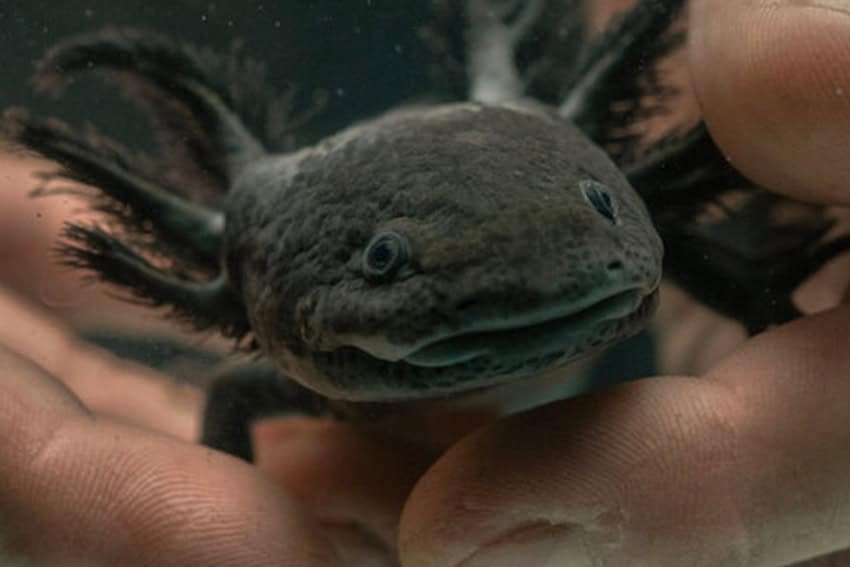
The remarkable axolotl is native to the lakes and wetlands of highland Mexico. It is closely related to salamanders, but unlike its amphibian cousins, it does not undergo a complete metamorphosis, remaining an aquatic creature throughout its life. This is reflected in the name, axolotl being a Nahuatl word that has been translated as “water servant” or “water dog.” They have become critically endangered due to a combination of factors, including the loss of habitat and the pollution of the waters that remain available to them. The introduction of carp and tilapia into the lakes to provide fish for the local market also proved a disaster as these predators took a heavy toll on axolotl eggs and juveniles. It is uncertain how many axolotls survive in the wild, but it is probably no more than 1,000, and perhaps much fewer.
The thriving axolotl pet trade
Ironically, while they are disappearing in the wild, there are hundreds of thousands of axolotls being kept as pets in aquariums around the world. It is easy to see why axolotls attract pet owners, for they are amusing animals to look at with their fringed gills and what appears to be an endless smile. Their popularity has increased recently thanks to their appearance in animated movies and video games, most notably Minecraft. They are generally considered good pets in that they are not dangerous in any way, and any diseases they might carry do not pass to humans. Another bonus is that they can live up to 15 years under optimal conditions, so you get value for money.
Even if they are released into the wild, which they never should be, they are unlikely to become a threat to native wildlife. And they do occasionally get released. In April 2026, a young girl looking for frogs and fish in a British river made the first documented discovery of an axolotl living in the wild in Europe. On the downside, they are sensitive animals that require a lot of care, which includes providing a gentle flow of cool water and ensuring minimal light exposure. Anybody keeping them needs to invest in specialized tank filters and be prepared to make frequent water changes. It is feared that many captive axolotls experience stress due to poor living conditions.
Legal controls and regulations
In addition to the ethical demands of keeping axolotls, there are also legal considerations. As a critically endangered species, they have been added to Appendix I of the Convention on International Trade in Endangered Species of Wild Fauna and Flora, or CITES. This means that international trade in these animals is strictly controlled, and restrictions and regulations can change from country to country. In Mexico, you must purchase your axolotl from a certified breeder and have authorization from the Ministry of Environment and Natural Resources to keep them. However, regulations can change from place to place. For example, while axolotls can be kept in many U.S. states, owning one as a pet is illegal in California, Maine, New Jersey and Virginia.
A major concern is not that axolotls make dangerous or difficult pets, but that captivity is changing the animals. A feature that has always attracted considerable attention is the axolotl’s healing ability. It does not heal by scarring, but is capable of tissue regeneration. Entire limbs and tails can regrow over a period of months, and in certain cases even organs can be replaced. Much of the stock now available in the pet trade is thought to have originated from a small number of wild axolotls that were collected for medical research in the late 1880s.
Captive breeding programs
As few if any animals are now captured in the wild, the captive gene pool is small, and it is feared that this has made pet axolotls susceptible to genetic defects that might include a weakened immune system, poorly developed digestive systems and underdeveloped gills. In the wild, axolotls develop different colors but are typically a dark brown, tan or gray, often with dark spots, a color combination that helps them blend into the muddy waters of their native lakes.
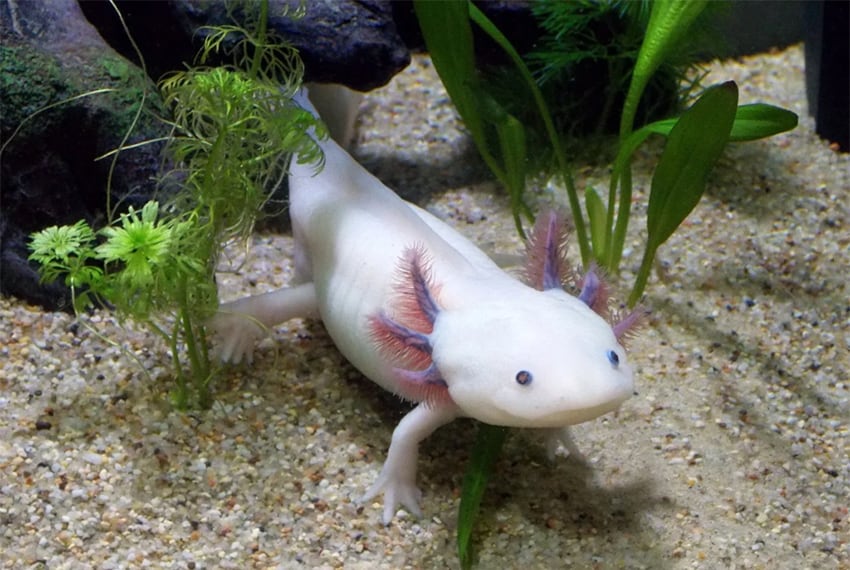
In captivity, breeding pairs are deliberately chosen to produce colors thought attractive to the pet trade. At one point, it was thought that captive axolotls might even have been crossbred with tiger salamanders. The result is strains of animals that might look like axolotls but do not necessarily represent any animals found in the wild. Releasing a pink or albino axolotl into a Mexican lake would be like putting a pack of dachshunds into the Serengeti and pretending they are African hunting dogs.
Conservation efforts
This is a vital issue, for if the pet trade has any higher goal, then it is the dream that one day captive stock might be returned to the Mexican lakes. This is one reason that an Axolotl Museum and Amphibian Conservation Center has been opened in Chapultepec Zoo. A recent experiment in releasing captive axolotls has proved remarkably successful. In April 2025, captive-bred axolotls were released into the artificially created wetland of La Cantera Oriente and the animals seemed to do well. They carried small trackers, and not only did all survive the initial release, but those later captured and weighed had put on weight, showing they were successfully hunting. It might work in the axolotl’s favor that they are optimistic eaters, taking anything from worms to insect larvae.
Attempting to protect populations in the heartlands of Lake Xochimilco is even more ambitious. A decade-long project led by the Ecological Restoration Laboratory of the National Autonomous University of Mexico’s Biology Institute has attempted to do just that. The axolotl has lived alongside humans for many generations and has adjusted to the traditional farming methods practiced since Mexica times. Therefore, the project involved working with local farmers to restore chinampas, those small agricultural islands that once fed the great city of Tenochtitlán.
Hope for the future
It was hoped that these would both provide a haven for axolotls and support sustainable agriculture for the local people. A major problem is that the waters of Xochimilco are no longer flushed clean with spring water from the mountains, so biofilters have to be built. These are stacks of volcanic rocks and reedy plants placed around the chinampas to clean the water and provide shelter from predator fish.
After the early promise with such projects, there was a concern when a couple of adult axolotls were seen to be taken by egrets. This raises the possibility that captive-bred axolotls might lack the survival instincts of those brought up in the wild. However, where there is goodwill, there is hope. Since 2018, Feb. 1 has been celebrated as National Axolotl Day, drawing attention to one of Mexico’s most charming, remarkable and endangered animals.
